1991issue C111-19
True strength index from signed, double-smoothed momentum
One-bar momentum is the current close minus an earlier close, so it carries both the size and the sign of the price change. The true strength index keeps that signed momentum in the numerator and its absolute value in the denominator, then double-smooths both series with exponential moving averages and multiplies the ratio by 100.
- One-bar momentum is the current close minus an earlier close, so it carries both the size and the sign of the price change.
- Raw one-bar momentum oscillates rapidly about zero, so averaging is required before turning points are readable, and applying a moving average to momentum is presented as generally producing less lag than averaging price.
- The Relative Strength Index separates one-bar momentum into up and down components, averages them, and maps the up average over the sum of both averages onto a 0-to-100 scale, a construction still described as following high-frequency price noise.
- The true strength index keeps signed momentum over absolute momentum, double-smooths both series with exponential moving averages, and multiplies the ratio by 100. The second long-and-short smoothing pair is presented as reducing choppiness while keeping lag acceptable.
One-bar momentum needs averaging
One-bar momentum is defined as the current close minus an earlier close and therefore carries both the size and the sign of the price change.
Raw one-bar momentum of an unsmoothed close series tends to oscillate rapidly about zero, so some form of averaging is required before turning points are readable.
Smoothing reduces noise and adds delay
Averaging reduces jagged responses but also introduces delay, so very smooth moving averages can mark a turning point well after the corresponding price extreme.
Applying a moving average to momentum rather than to price is presented as generally producing less lag than averaging the price series itself.
How the Relative Strength Index is built
The Relative Strength Index separates one-bar momentum into up and down components, averages those components, and maps the ratio of the up average to the sum of both averages onto a 0-to-100 scale.
Because that construction still follows high-frequency price noise, the Relative Strength Index is described as better suited to amplitude and divergence readings than to clean turning-point calls.
A double-smoothed Relative Strength Index
A double-smoothed Relative Strength Index is obtained by applying two successive exponential moving averages, with constants 2/(y+1) and 2/(z+1), to the up and down one-bar momenta before forming the same ratio.
Those two passes apply exponential smoothing to the up and down one-bar momenta, not to the close series itself.
How the true strength index keeps the sign
The true strength index keeps signed one-bar momentum in the numerator and the absolute value of that momentum in the denominator, then double-smooths both series with exponential moving averages and multiplies the ratio by 100.
With only a single smoothing pass the true strength index differs from the Relative Strength Index by a scale factor. The second long-and-short smoothing pair is what distinguishes the construction and is presented as reducing choppiness while keeping lag acceptable.
A two-pass worked example
A worked true-strength-index example first applies a 14-period exponential moving average with constant 2/(14+1)=0.1333, then a 3-period exponential moving average with constant 2/(3+1)=0.50, to both signed momentum and absolute momentum.
14-day / 3-day true strength index on daily closes
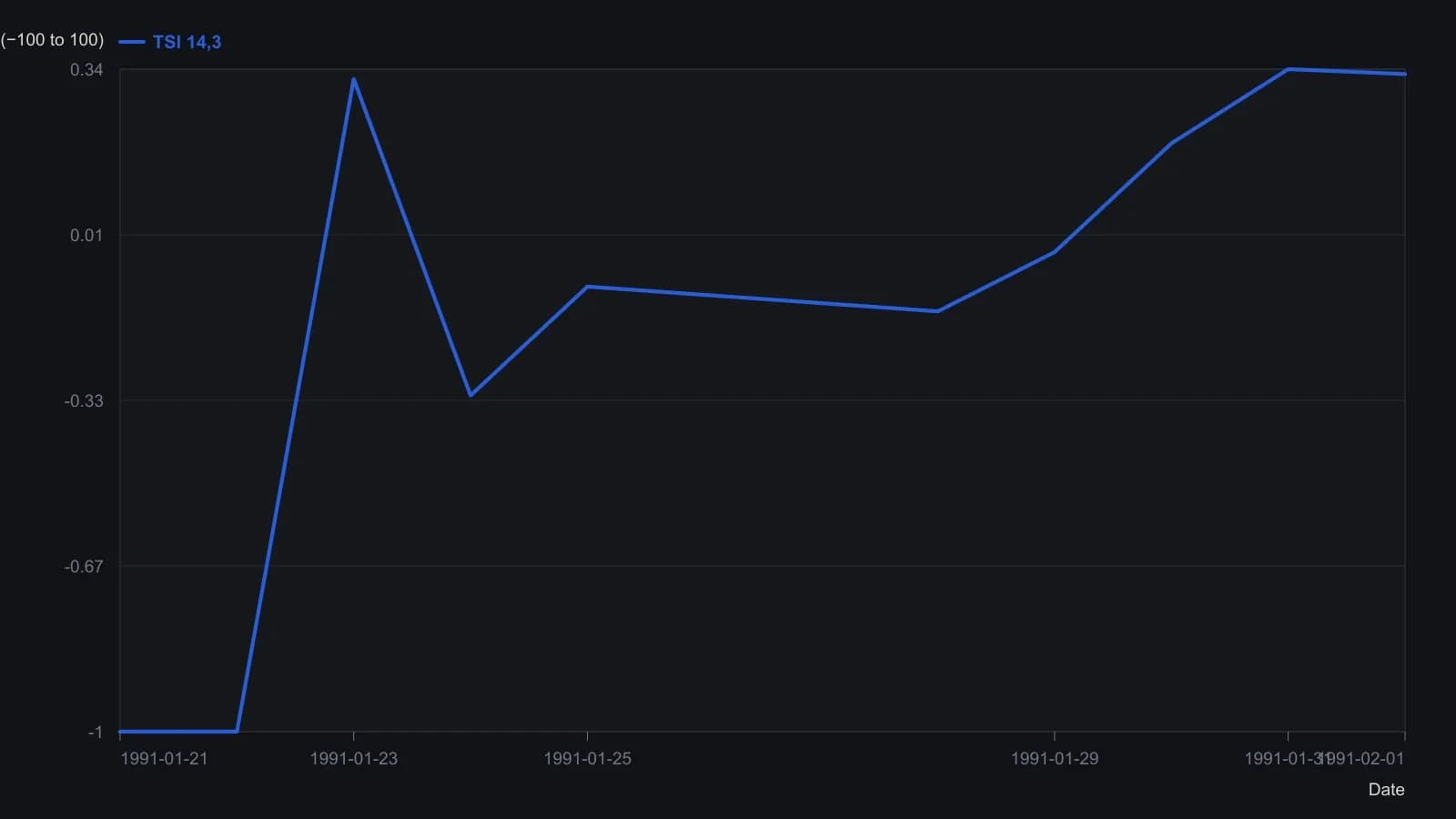
Numerator is a 14-day EMA of one-bar momentum, then a 3-day EMA of that result. Denominator uses the same two EMAs on the absolute momentum. TSI is 100 times the ratio. First six rows have no TSI because the 14-day average has not filled.
All readings on this track · 41 readings
- 1984Matching average age across price filters
- 1984Residual-impact construction of exponential smoothers
- 1988Constructing simple and exponential moving averages as specified filters
- 1989Evaluating smoothed free reserves and funds-discount spreads
- 1990Integer construction of moving averages and exponential smoothing
- 1990Constructing incremental moving average filters
- 1991Constructing a double-smoothed stochastic oscillator
- 1991Constructing an exponential average from a smoothing weight
- 1991Constructing a double-smoothed momentum oscillator family
- 1991Competing certainty rules from exponential-average conditions
- 1991Hybrid construction of a mechanical timing system from smoothed signals
- 1991Constructing an exponential smoother from a moving-average length
- 1991Equivalent relative-strength-index constructions from a ratio and from smoothed momentum
- 1991Constructing the true strength index from double-smoothed momentum
- 1991True strength index from signed, double-smoothed momentum
- 1992Constructing exponential averages from simple lookbacks
- 1992Constructing exponential averages by the smoothing constant, startup length and lag
- 1992Nested range smoothing and windowed high-low damping
- 1992A weekly equity stance from the discount-bill spread
- 1993Double-smoothed stochastics momentum index construction
- 1993Constructing the true strength index with double exponential smoothing
- 1994Polarized fractal efficiency with a shared exponential smoother
- 1994Five-interval exponential smoothing of ten-interval signed path-efficiency
- 1994Hand-ranked price-volume series with stacked smoothing and stochastic
- 1995Range expansion filter on multi-horizon averages
- 1995The exponential smoothing constant from averaging lag
- 1997Construct a nested-average rainbow band and oscillator
- 1998Filter stacks that combine a moving average with exponential smoothing
- 2002Smoothed relative-strength construction from wilder-averaging and a price prefilter
- 2003Reverse-engineered RSI price targets
- 2004Piecewise trend quality from moving-average reversals
- 2004Nested smoothing recipes versus unaudited oscillator experiments
- 2008Weight construction beyond the N-day label
- 2010A consensus filter for objective RSI and smoothing construction
- 2012Sentiment-zone oscillator from signed closes
- 2012Classic RSI one-over-N smoothing versus the standard exponential average
- 2013Why exponential smoothing uses two over n plus one
- 2015Constructing ratio indicators with moving-average and exponential-smoothing weights
- 2015Slow relative-strength index from an exponentially smoothed price
- 2017Rebuilding the relative strength index as open-scale buy-sell pressure
- 2017Comparing Wilder and exponential smoothing inside a relative-strength index