1992issue C111-8
Constructing relative-strength KST from weighted rate-of-change
KST is assembled as a weighted sum of four separately smoothed rate-of-change series so several cycle lengths share one reading. The same build can be stacked across three horizons and applied to a price-to-basket relative-strength line.
- KST is a weighted sum of four separately smoothed rate-of-change series, so several cycle lengths appear in a single reading.
- A reversal is the finished oscillator crossing above or below a moving average of itself. Changing the spans and weights produces short-, intermediate-, and long-term versions that can be stacked.
- Relative strength is an item price divided by a basket or index. A rising line means outperformance versus the basket, not necessarily a rising absolute price, and it is distinct from the relative strength index.
- Long-term relative-strength oscillators for interest-sensitive and inflation-sensitive groups tend to move in opposite directions, and that contrast is used to locate the stage of a group-rotation cycle.
Four series in one reading
KST is the weighted sum of four separately smoothed rate-of-change series, used as a multi-cycle oscillator. Each term is a close-to-close percentage change over a chosen lookback, recentered at zero after multiplying by 100 and subtracting 100. Combining the four smoothed series into one weighted sum lets several cycle lengths appear in a single reading.
How the oscillator is computed
Computation has three steps. Form each rate-of-change as the current close divided by the close n periods earlier, multiply by 100, and subtract 100. Smooth each series with a simple or exponential moving average. Then multiply the smoothed series by weights and sum them.
An exponential moving average used in that smoothing is updated as the prior average plus alpha times the difference between the new observation and the prior average, with alpha equal to 2 divided by n plus 1. Suggested parameter tables specify daily, weekly, and monthly lookbacks, moving-average lengths, and weights of 1, 2, 3, and 4 for the four rate-of-change terms.
The reversal line and the three-horizon layout
A reversal condition is defined as the finished oscillator crossing above or below a moving average applied to that oscillator. The moving average is used both as a smoother on each rate-of-change component and as the crossover line on the finished KST.
Changing the rate-of-change spans and their weights produces short-, intermediate-, and long-term versions that can be stacked as a three-horizon layout. That stacked reading is the market-cycle-model: short-, intermediate-, and long-term oscillator prints used to place a move inside a longer trend. In that layout the long-term reading is assigned to primary swings lasting one to three years, while the shorter two horizons are reserved for timing.
Relative strength as a price-to-basket ratio
Relative strength is constructed as an item price divided by a basket or index. A rising line means outperformance versus the basket, not necessarily a rising absolute price. This ratio is distinct from the relative strength index.
The same build on a relative-strength series
The same three-horizon construction can be applied to a relative-strength series. A long-horizon setup is described as the long-term relative oscillator below zero and crossing above its moving average, while the shorter horizons are not overextended and the ratio line itself confirms by an exponential moving-average crossover or a trendline break.
Opposite group readings and rotation
Comparing long-term relative-strength oscillators of interest-sensitive and inflation-sensitive groups is presented as a way to locate the stage of a rotation cycle, because those two group readings tend to move in opposite directions. That contrast is the group-rotation reading: a shift of leadership among industry groups across a cycle, visible when the long-horizon relative oscillators for those contrasting groups move in opposite directions.
Intermediate-term KST of Dow Jones financial relative strength
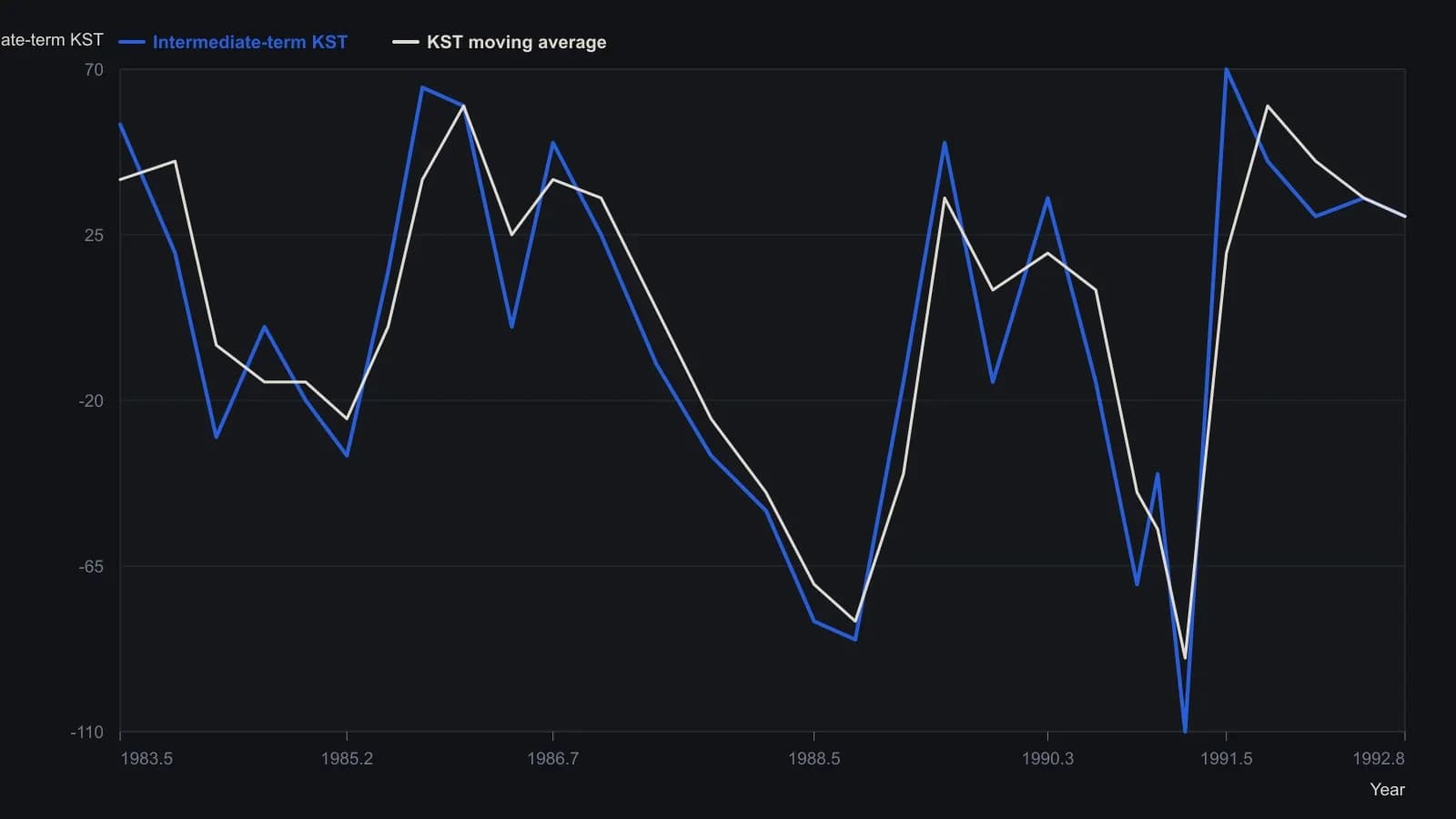
Digitized from the published weekly raster, so turning-point levels are approximate to the nearest five KST points. The original pane is blank before mid-1983 while the longer rate-of-change spans warm up.
All readings on this track · 46 readings
- 1985Constructing excess and momentum difference-curve oscillators
- 1988Five reading rules for smoothed indicator charts
- 1989Momentum overlays that speed moving-average oscillators
- 1990A laboratory template that constructs Rate of Change as a pane module
- 1991Volume-scaled rate of change as a momentum construction
- 1991Three-indicator market overview from tape, sentiment and rates
- 1991Three-component trend model with rate-of-change filters
- 1992A KST oscillator from a weighted rate-of-change stack
- 1992Four-window weighted rate-of-change composite
- 1992Constructing multi-span smoothed rate-of-change filters
- 1992Constructing a four-horizon summed rate of change
- 1992Constructing KST from four weighted smoothed rates of change
- 1992Constructing a composite from weighted smoothed rates of change
- 1992Three-horizon KST maturity alignment
- 1992Construct a bond-led dividend-to-bond-yield regime first
- 1992Constructing relative-strength KST from weighted rate-of-change
- 1993Constructing a volume oscillator from average ratios and smoothed rate of change
- 1994Gold as a cycle clock for commodities and yields
- 1994Constructing a composite from weighted, smoothed rate-of-change windows
- 1994Constructing gold-mining rate-of-change tripwires for Treasury bonds
- 1994A capacity-stress checklist across commodities, bonds, and breadth
- 1994Rate of change parameters for testable entries
- 1994Constructing rate-of-change midpoints, lookbacks and divergence
- 1994Lead oscillator breaks need price trendline confirmation
- 1994Nested averages for an annual momentum curve
- 1994Evaluating a Coppock-style rate of change as a bottom-regime filter
- 1995A weighted eleven-month Dow rate of change as one testable timing procedure
- 1996Named lookbacks, thresholds, and streaks for entry rules
- 1997A midpoint rate-of-change test for bond trend follow-through
- 1997Constructing a short-rate-adjusted equity momentum filter
- 1998Daily momentum rank-churn as a portfolio-construction problem
- 1999Constructing a lagged rate of change cycle system
- 2000A triple delay line then a one-bar elliptic oscillator
- 2001Confirming rate of change divergences with price
- 2001Momentum trendline breaks need price confirmation
- 2001Market breadth, On-balance volume, and Rate of Change as a combined timing framework
- 2001Know Sure Thing with stacked horizons and trendline confirmation
- 2003Constructing a mechanical system from a rate of change condition
- 2003Constructing momentum from two closes and spotting divergence
- 2003Formula choice tilts which momentum mismatches count as divergences
- 2004RSI and momentum agreement as an asymmetric filter
- 2005Constructing price-normalized moving-slope hybrids
- 2005Unsigned speed gates on a fixed average-cross pair
- 2007Rebuilding rate of change as a path-weighted oscillator
- 2008Construct Special K so short-horizon signals stay inside the primary trend
- 2013Restore volume balance before adding another price-time indicator