2005issue C021-12
Construction of a volatility-bounded long entry
The archive workflow times a 7-bar Relative Strength Index oversold window, then allows a long only at a stop-entry set two average true ranges above the 20-bar low. A trailing stop, a recent-low stop, and an ATR-offset target keep exposure inside those precomputed distances while the position is open.
- A 7-bar Relative Strength Index must cross above 30 and remain valid for a 10-bar window before a volatility entry is allowed, so the oscillator is a timed filter rather than a standalone trigger.
- The long stop-entry is the lowest low over 20 bars plus two times a 10-bar average true range, which places the trigger a volatility multiple above the recent range floor.
- Weekly higher-high and higher-low sequences or a rising 34-week average of close select the pool, while daily ATR position sizing and Relative Strength Index rules place and manage the long.
- Once a long is open, the working trailing stop is the running maximum of the 15-bar high minus two times the same 10-bar average true range, and the position can also leave at a 3-bar low stop or at a 13-bar exponential high plus two ATR.
Weekly selection, daily placement
Candidate selection is split by horizon. Weekly higher-high and higher-low sequences or a rising 34-week average of close identify the pool. Daily ATR position sizing and Relative Strength Index rules place and manage the position.
Relative Strength Index as a timed filter
A 7-bar Relative Strength Index must cross above a 30 threshold and then remain valid for a limited subsequent window before a volatility entry is allowed. That window is 10 bars in the strategy inputs. The oscillator is a timed oversold filter rather than a standalone trigger.
A stop-entry above the range floor
A long entry is constructed as the lowest low over a 20-bar lookback plus two times a 10-bar average true range. The stop-entry price sits a volatility multiple above the recent range floor.
Trail, recent-low stop, and profit offset
A trailing protective level is constructed as the highest high over a 15-bar lookback minus two times the same 10-bar average true range. The working stop is the running maximum of that series while a long is open.
An initial protective stop is the lowest low of a short recent window. That window is 3 bars in the strategy inputs. A profit-taking level is an exponential average of high over 13 bars plus two times the 10-bar average true range.
Amgen daily close versus ATR profit taker and trail
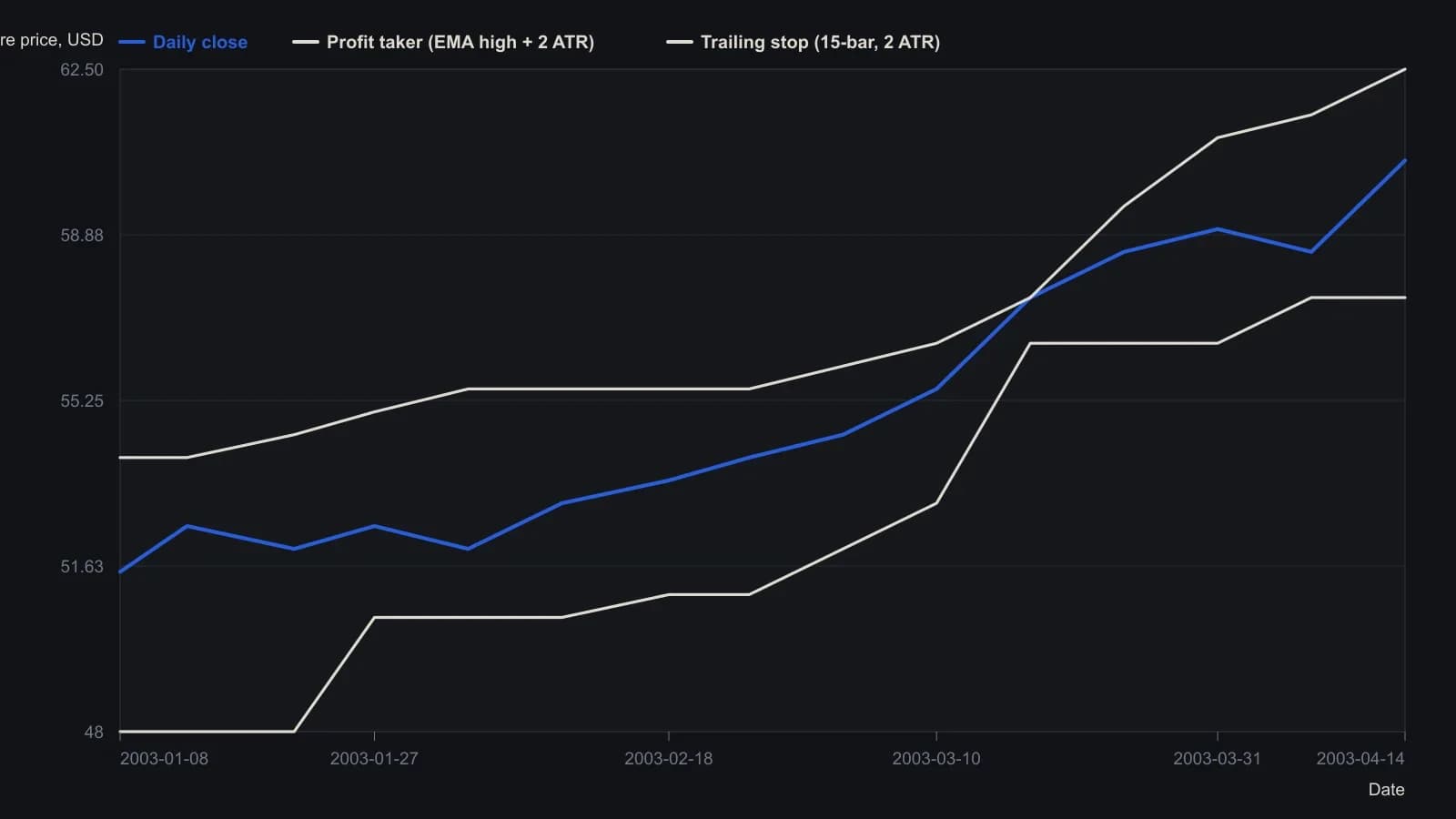
Digitized from the on-screen daily Amgen window (January–April 2003), not a numeric table. Source formulas: profit taker = 13-bar EMA of high plus two 10-bar ATRs; trailing stop = 15-bar highest of close minus two ATRs. Half-dollar rounding matches what the raster can support.
Trend, oscillator, and volatility together
A combined long filter requires a close above a 34-period average that is itself rising, a recent oversold Relative Strength Index reading, and a close above the 20-bar low plus two ATR. Trend, oscillator, and volatility conditions must all be true before entry.
Once a long is on, an exit is constructed when close crosses back below the ratcheted ATR trail, or at the recent-low stop, or at the ATR-offset profit target. Exposure remains bounded by precomputed volatility distances throughout the trade.
All readings on this track · 36 readings
- 1988Constructing unsigned true range for directional models
- 1989Evaluate an always-in ATR breakout as one procedure
- 1992Variable lookback and average true range as a trend-filter construction
- 1993A random-walk index that uses true range as its scale
- 1993A shared harness for trend-filter construction
- 1998Finish a trend with a volatility trail, wave permission, and a slower-frame veto
- 1999A trend filter that switches tactics and scales ATR targets
- 2001Filter higher lows with linear regression, then judge the exit
- 2003A Mechanical trading system is a maintained procedure, not only an entry trigger
- 2005Construction of a volatility-bounded long entry
- 2005Six-zone encoding of open, high, low, and close
- 2006Normalized average true range as a pre-entry volatility bound
- 2006Chandelier exits, ATR position sizing, and trailing stops
- 2007Constructing a rule-based entry with Relative Strength Index and ATR position sizing
- 2008Constructing a zero-lag TMA and heikin-ashi crossover as a complete rule set
- 2010Use the session-range percent stop as a pre-trade filter
- 2011OCA exit groups, trailing limits, and ATR stops
- 2011ATR bands around support and resistance for stops and targets
- 2013Algorithmic head-and-shoulders construction with bounded exits
- 2013Constructing ATR-scaled swing pivots and linear-regression divergence
- 2013Constructing volatility bands from typical price
- 2014Constructing true-range contraction filters before expansion
- 2015Constructing touch plans from modified true range
- 2015One checklist for breakout entry and ATR risk
- 2015Percentage true-range construction for cross-market volatility filters
- 2015Construct a percentage true range for cross-market volatility
- 2015Percentage true range as a pre-entry exposure filter
- 2016Constructing ATR-filtered breakout entries
- 2017A dividend date as a pairs-trading classroom
- 2018Range-based volatility as a true-range construction
- 2018Moving average support and volatility-band construction
- 2018Construct a lifecycle breakout from compression
- 2018Pair the book first and let volatility or range set the size
- 2019Trend systems need a no-trade rule
- 2020Average true range as a shared unit for size, pairs, and stops
- 2020Volatility sizing and target-risk leverage as a pre-trade gate