2014issue C0962-64
Price-rooted lookbacks for a relative strength index, a moving average, and a trend filter
Successive square roots of a traded level form a nested-square-root ladder of four period candidates. A relative strength index, a moving average, and a trend filter can take their lookback periodicity from that shared ladder.
- Successive square roots of a market price can assign lookback lengths for a relative strength index, a moving average, and a trend filter.
- Four nested square-root values are treated as a complete set of period candidates on a nested-square-root ladder.
- The operative series and the remaining lookback periodicities change once the traded level sits above or below stated price thresholds.
- Taking periods from the price itself is presented as a way to smooth how volatile the indicators look.
One shared clock from the traded level
The construction starts with the traded level. Successive square roots of that market price are taken until four values exist. Those four values are the nested-square-root ladder, and they are treated as a complete set of period candidates for lookback lengths on common indicators.
A relative strength index, a moving average, and a trend filter can then use that same ladder. The relative strength index is a momentum oscillator whose lookback can be taken from a nested square-root of the traded level instead of a conventional fixed count. The moving average is a smoother whose averaging window can be taken from the same nested-root ladder as the other filters in the set. The trend filter is a directional gate whose confirmation length can share that same price-derived period set.
Reading the nested-square-root ladder
Each integer window assigned from one of the nested roots is a lookback periodicity for an indicator.
A price near 17000 produces rounded nested roots of 130, 11, 3, and 2. A price near 1600 produces rounded nested roots of 40, 6, 3, and 2.
Choosing the operative series
The operative series is the price or first-root series the indicators actually measure once the level sits above or below the stated thresholds.
When the price is above 1526, the first square root can become the series the indicators act on, and the remaining roots become its periods.
At a whole-number price of 1600 or lower, the fourth nested root rounds to the same integer as the third. Below that 1600 threshold, the third nested root can be used twice, or the raw price can be used with the first three roots.
Smoothing the look of the indicators
Taking periods from the price itself is presented as a way to smooth how volatile the indicators look.
Nested-square-root lookback ladder from DJIA and S&P levels
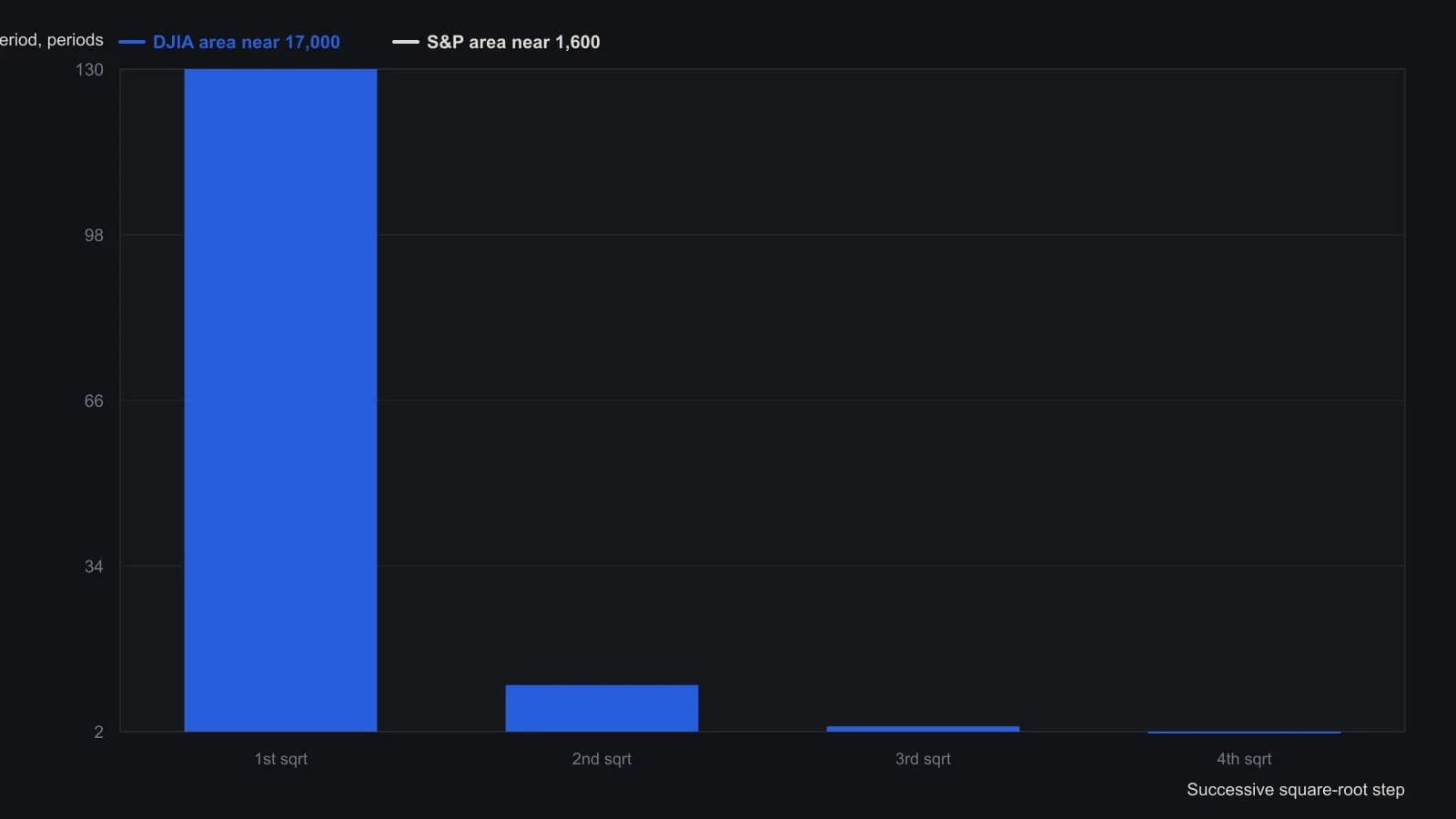
The source rounded each root to a whole number. It also treats about 1,526 as a cutoff: above that print the first root is the operative series, while below it the fourth root rounds to the same integer as the third.
All readings on this track · 33 readings
- 1988Opening-range brackets, a two-bar trend filter, and bounded stops
- 1990Bezier-curve price trend filter
- 1992Constructing a damping-index trend filter
- 1992Building a random walk index trend filter
- 1992Phase diagrams for moving-average trend filters
- 1993Volume-weighted change smoothing and trend ranking
- 1993Concurrent highest-low filter with a largest-low-fall trigger
- 1994Unit-invariant trend filters and the c-test
- 1995Constructing cup and cap entries with a three-bar net line
- 1997Why a daily timing evaluation depends on interval, lookbacks, and the fitting objective
- 2001A volume budget clock for trend-segment construction
- 2001Keep three jobs separate when you test a composite score
- 2002Evaluating the weekly four-percent close filter as a market-state procedure
- 2003Constructing a confirmed zigzag trend filter
- 2004Decompose high, low, and close into separate forecast streams
- 2005Three-state moving-average breakout bar coloring
- 2005Constructing a volume and move-adjusted trend filter
- 2005A fifty-day average breakout as a trend permission filter
- 2005Current-bar inclusion can mute a stochastic channel break
- 2006A stochastic oscillator gated by a long-term exponential average
- 2010A construction test for a modified volume-price trend filter
- 2011Constructing a Spearman rank trend filter
- 2013Constructing a repeated-median slope as a resistant trend filter
- 2014Combining a relative-strength index and trend filters for oversold setups
- 2014Price-rooted lookbacks for a relative strength index, a moving average, and a trend filter
- 2015Evaluating next-session intermarket range forecasts
- 2018Read the intermarket weight matrix first, then the predicted moving-average filter
- 2018Constructing the stiffness trend filter from moving-average holds
- 2018The averaging kernel and the lagged trend gate are separate specifications
- 2019A trend filter is not ready to compare until portfolio constraints are written down
- 2019Lookback, threshold, and position-capacity for a stiffness trend-filter
- 2020Combining a trend filter with a moving average and a stochastic oscillator
- 2020Constructing a relative-strength oscillator with a rank-agreement trend filter