2014issue C0265
Lookalike money flow is not on-balance volume
A money-flow line that only resembles on-balance volume or the accumulation-distribution line does not inherit that model's formula, sign convention, or decision thresholds. This article teaches a construction audit that separates visual similarity from formula identity.
- The published reply states that the study under discussion did not use on-balance volume and did not use a finite-volume-elements indicator.
- One substitute series was described as a long-term accumulation-distribution indicator that is graphically similar to on-balance volume while its readings are not the same.
- A second substitute series was described as graphically similar to a finite-volume-elements plot while its values are not the same, and the formulas for both substitutes were not revealed.
- On-balance volume is not always positive, so another volume series cannot be treated as equal to it from chart shape alone.
Start with construction, not resemblance
Volume-flow models are easy to misread when two traces share a shape. The construction question is narrower. Does the series use the same disclosed calculation as on-balance volume or the accumulation-distribution line, or does it only look like one of those plots?
On-balance volume is a cumulative volume construction that adds volume on an up close and subtracts volume on a down close, so the running total can be positive or negative. The accumulation-distribution line is a volume-weighted pressure series that tracks whether closes sit toward the high or low of the bar, used to read persistent accumulation or distribution. A later money-flow line that only resembles either series does not inherit that model's formula, sign convention, or decision thresholds.
What the published reply stated
The published reply states that the study under discussion did not use on-balance volume. The same reply states that a finite-volume-elements indicator was also not used in that study. Finite-volume elements is a volume-element oscillator that readers may confuse with other short-horizon money-flow plots because the traces can look alike.
The reply describes one substitute series as a long-term accumulation-distribution indicator. That accumulation-distribution series is described as graphically similar to on-balance volume while its readings are not the same. A second substitute series is described as graphically similar to a finite-volume-elements plot while its values are not the same. The reply states that the formulas for both substitute money-flow series were not revealed.
Named constructions that can look alike
Money-stream accumulation is a longer-horizon accumulation-distribution construction that can plot like on-balance volume without sharing its readings. Time-segmented volume is a shorter-horizon money-flow series that can plot like a finite-volume oscillator without sharing that oscillator's values. Those names describe construction types. They do not turn an undisclosed substitute into the named model it resembles.
AAPL MoneyStream and TSV, Sep 2012–Nov 2013
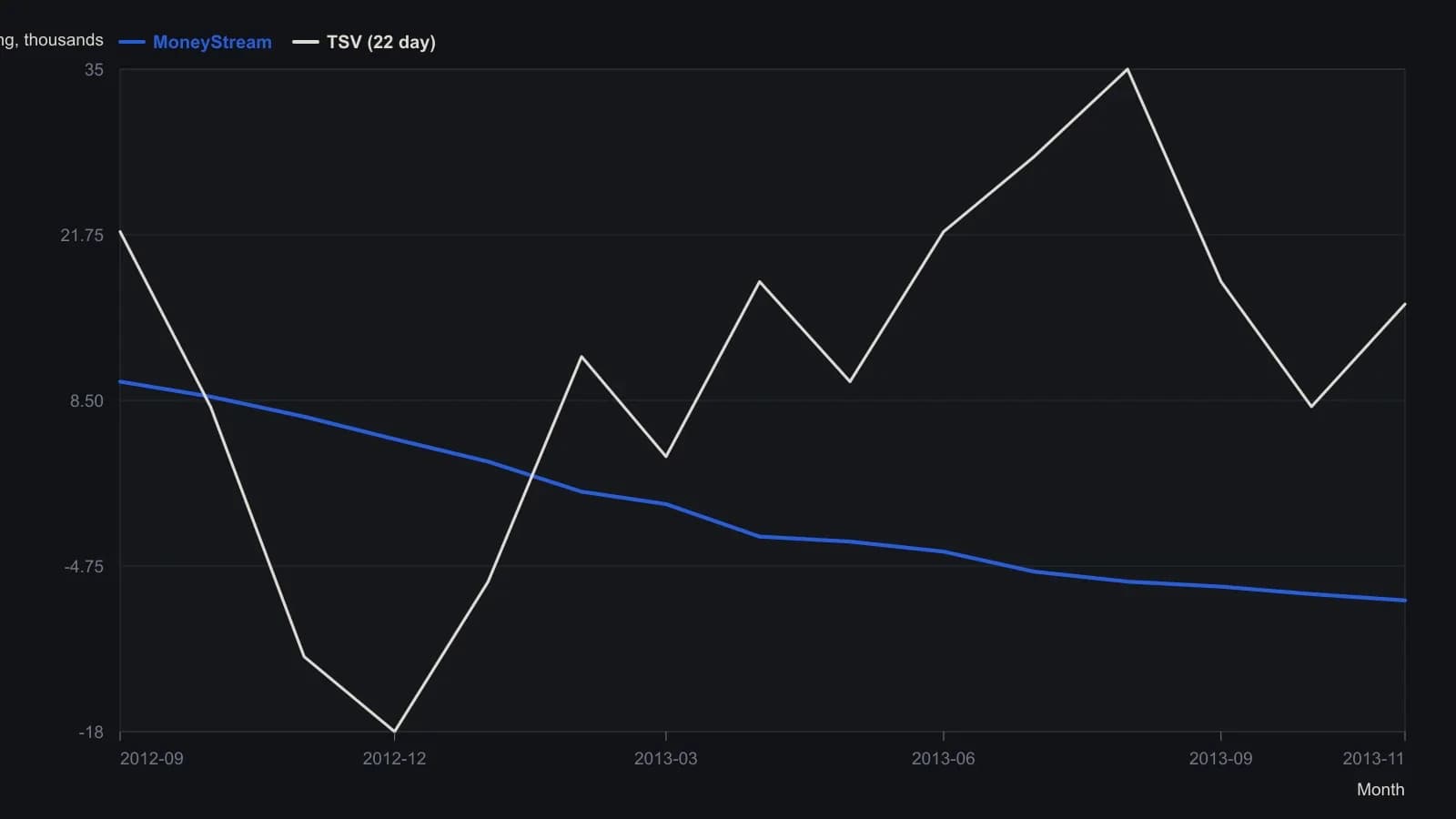
Values are approximate readings from the published TC2000 raster (AAPL, ending 13 Nov 2013). MoneyStream and TSV 22-day are proprietary Worden formulas; the 40-period moving averages drawn on the source panes were not digitized. TSV is noisier than MoneyStream, so fewer, more rounded points were kept.
Sign convention is part of the identity test
A reader question notes that on-balance volume is not always positive when asking whether another volume series can be treated as equal to it. That is a sign-convention check. Because on-balance volume can sit above or below zero, treating another volume series as the same object requires more than a similar path on the chart. The sign convention belongs to the construction.
Editorial construction audit
Editorial interpretation: the substitutes belong in a lookalike class until their formulas are disclosed. The long-term accumulation-distribution substitute can be discussed as money-stream accumulation, meaning a longer-horizon construction that may plot like on-balance volume without sharing its readings. The shorter substitute can be discussed as time-segmented volume, meaning a series that may plot like finite-volume elements without sharing that oscillator's values. Neither discussion licenses copied decision thresholds. A construction audit stops when formula identity is missing.
All readings on this track · 8 readings
- 1995Constructing an accumulative swing index from open-high-low-close comparisons
- 2001Confirming a price-box break with on-balance volume and the accumulation-distribution line
- 2004Why on-balance volume and the accumulation-distribution line disagree
- 2006Lagged commercial nets and a weekly accumulation trigger
- 2007Constructing dominant cycles from participant accumulation
- 2011Linear regression overlays on volume-flow primaries
- 2014Lookalike money flow is not on-balance volume
- 2015Volume-free accumulation and a next-session bias overlay