2010issue C0568-80
Assembling a smoothed percent-b oscillator from Heikin-Ashi and stacked averages
A Heikin-Ashi close is passed through a two-stage triangular-style average stack and paired with a Weighted moving average to form a percent-b style oscillator. The archive presents the raw percent-b and the smoothed version as separate indicators, as a way to smooth a choppy calculation while trying to limit added delay.
- A Heikin-Ashi open is primed from the prior bar average of open, high, low, and close, then updated with the previous Heikin-Ashi open, and the close mixes that open with the current bar average and the greater and lesser of the bar extremes.
- Two triangular-style stages, each combining three successive exponential averages, turn the Heikin-Ashi close into a zero-lag series.
- A Weighted moving average of that zero-lag series, using linearly declining weights, is the reference for a percent-b style reading that also uses the series standard deviation.
- Upper and lower limits sit at fifty plus and minus scaled standard deviations of the percent-b series after an extra lookback, and the raw and smoothed readings are kept as separate indicators.
What the construction assembles
The archive builds a percent-b style oscillator from a Heikin-Ashi close, a two-stage triangular-style average stack, and a Weighted moving average. The construction is presented as a way to smooth a choppy percent-b calculation while trying to limit added delay.
The raw percent-b and the smoothed version are implemented as separate indicators, so the extra stages remain visible rather than being folded into a single reading.
How the Heikin-Ashi close is formed
A Heikin-Ashi open is primed from the prior bar average of open, high, low, and close, then updated as the average of that same prior-bar average and the previous Heikin-Ashi open.
A Heikin-Ashi close is formed from the current bar average of open, high, low, and close, the current Heikin-Ashi open, the greater of high and Heikin-Ashi open, and the lesser of low and Heikin-Ashi open. That close is the series passed into the later average stages.
How the triangular-style stack is applied
The first Triangular moving average stage applies three successive exponential averages to the Heikin-Ashi close and combines them as three times the first average minus three times the second plus the third.
The second triangular-style stage repeats the same three-average combination on the first-stage output. A zero-lag series is then formed as twice the first-stage result minus the second-stage result.
How the weighted reference becomes a percent-b reading
A Weighted moving average of that zero-lag series uses linearly declining weights from the lookback length down to one and divides by the triangular number period times period plus one over two.
A percent-b style reading is computed from the zero-lag series, its standard deviation, and the Weighted moving average as one hundred times the zero-lag series plus two standard deviations minus the Weighted moving average, divided by four standard deviations.
Upper and lower oscillator limits are placed at fifty plus and minus scaled standard deviations of the percent-b series after a defined additional lookback.
Smoothed percent-b oscillator on Gaiam daily bars
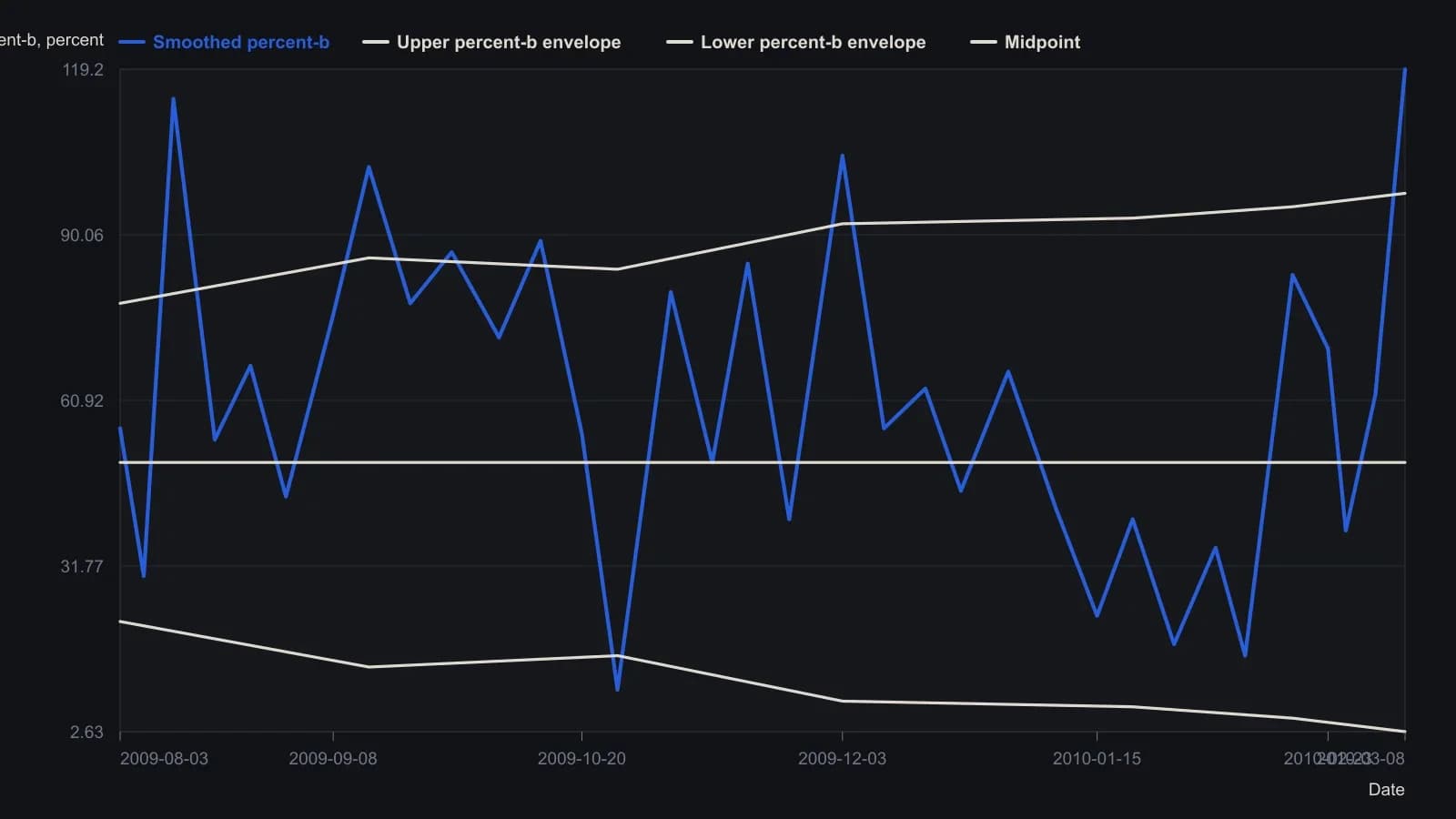
Except for those last-print labels, levels are approximate visual readings from the raster. The construction uses an 8-bar triangular-style TEMA stack on the Heikin-Ashi close, an 18-bar weighted average inside the percent-b, and 1.6-sigma envelopes of that oscillator over 63 bars.
All readings on this track · 8 readings
- 1989Constructing lag-matched triangular moving averages
- 1990Lag-aligned MACD from triangular moving averages
- 1990Constructing triangular moving average weights
- 1990Constructing a lag-aligned triangular MACD
- 1998Paired tests for moving-average lag and smoothness
- 1999Fixed-lag construction of moving-average smoothers
- 2003Weighting recipes inside one moving-average lookback
- 2010Assembling a smoothed percent-b oscillator from Heikin-Ashi and stacked averages