1992issue C111-14
Fitting oscillator parameters to stock personality
Two issues can need different oscillator settings over the same window. Lookback length and Chaikin trigger height are measured on recent data for one issue. Agreement among those customized oscillators is proposed only after that fit.
- Over one shared window, two issues can show different personalities, from a steady trend to more cyclic, volatile swings, so a single indicator setting is unlikely to fit both.
- Treat the lookback period, and the Chaikin peak or trough trigger height, as identity settings of one issue rather than as universal defaults.
- The stochastic oscillator is described as a better match for cyclical issues with well-defined channels. The relative strength index is described as a better match for issues that reverse abruptly after long intermediate advances or declines.
- After those settings are measured, the proposed screen asks for turning-point signals, agreement with the measured trend, and preferably two or more customized oscillators confirming.
Why one setting will not fit two issues
Over one shared window, two issues can show different personalities. One may follow a steady trend. Another may make more cyclic, volatile swings. A single indicator setting is unlikely to fit both.
Issue personality here is a short-horizon mix of volatility path, cycle, trendiness, and accumulation or distribution. The working assumption is that this mix can persist briefly if it does not change abruptly. The lookback period is treated as a measurable trait of one issue rather than as a universal default.
What each oscillator measures
The relative strength index is a bounded comparison of up-period versus down-period movement over n observations. In the archive wording, it compares up days with down days over an n-period window. That n is the fitted lookback. Conventional reversal lines sit at 30 and 70. The relative strength index is described as a better match for issues that reverse abruptly after long intermediate advances or declines.
The stochastic oscillator is a bounded reading of where the latest close sits inside the high-low range of the last n periods. That n is again the fitted lookback. Conventional reversal lines sit at 20 and 80. The stochastic oscillator is described as a better match for cyclical issues with well-defined channels.
The Chaikin oscillator is a volume-flow oscillator formed as the gap between short and longer exponential averages of accumulation and distribution. In this workflow it is the difference between three-period and 10-period exponential averages of accumulation and distribution. The more distinctive parameter across stocks is the peak or trough trigger height rather than those averaging lengths.
Defaults, a search range, and one illustrated year
Commonly listed defaults in the illustrated set include a nine-period stochastic oscillator, a 14-period relative strength index, and a 1,000-level Chaikin oscillator.
The stochastic lookback search was specified as five through 25 periods in steps of four, giving the candidate set 5, 9, 13, 17, and 21.
In the illustrated one-year fit, the selected settings were a 17-period stochastic oscillator, a 20-period relative strength index, and a 1500-level Chaikin oscillator.
American Airlines 1991 test profit by oscillator setting
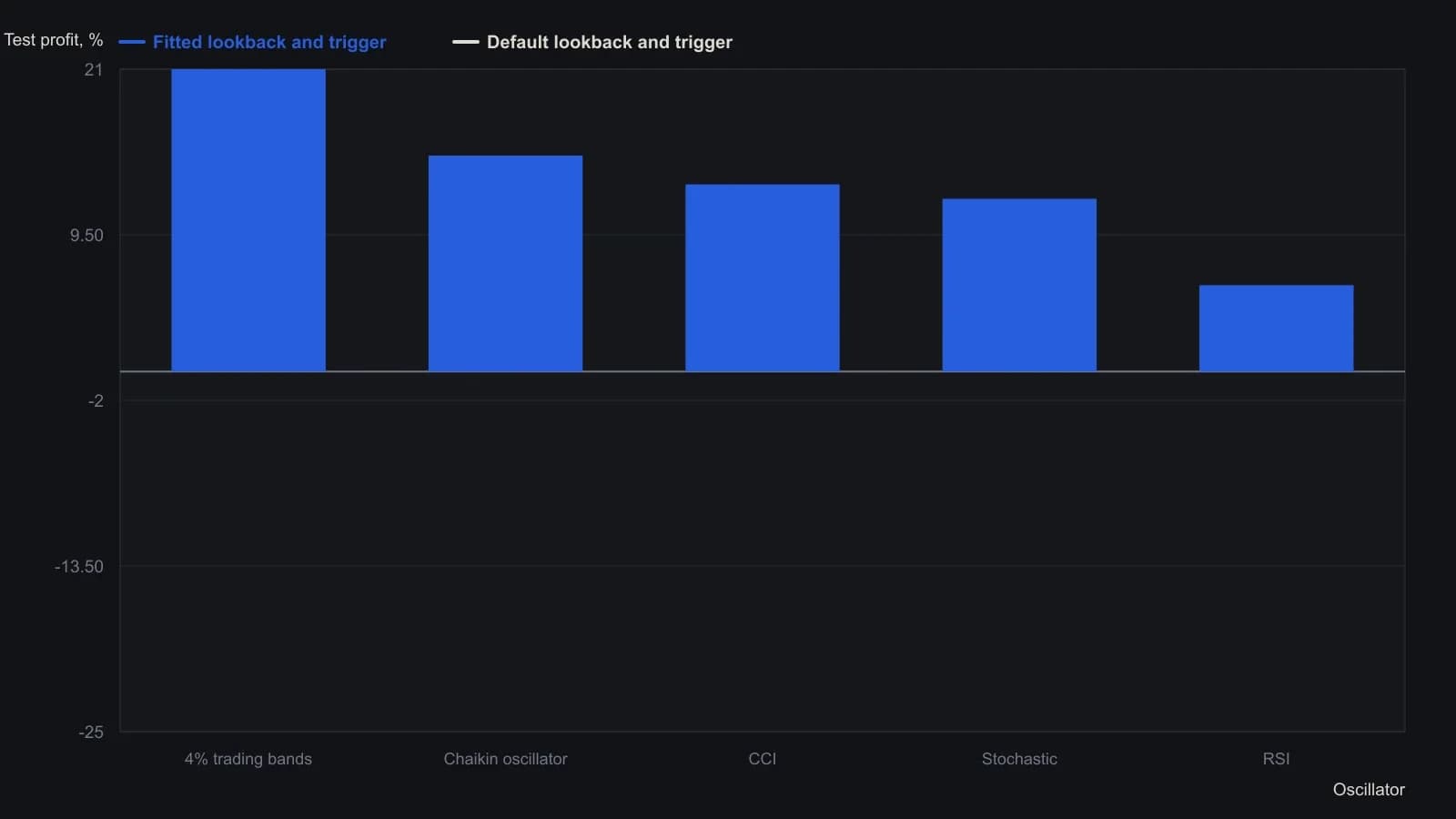
Tests used MetaStock 3 with 1% entry, 1% exit, and commissions (2% round trip), full capital, and fills at the close on the signal day. Entries are peak or trough reversals beyond the trigger, not the first cross of the level. Stochastic lookbacks were searched from 5 to 25 days in steps of 4; Chaikin used fixed 3/10 EMAs and searched only the trigger height.
A peak-reversal trigger instead of a first cross
A peak-or-trough reversal is used instead of a simple level crossover because a crossover is treated as late. The peak-reversal trigger fires only after the oscillator has crossed a stated level and then turned, instead of on the first crossing of that level.
A long setup requires yesterday's oscillator below the buy trigger and a two-day average of the oscillator below the current oscillator value.
Agreement only after the settings are known
The proposed screen asks for oscillator turning-point signals, agreement with the measured trend, and preferably two or more of the customized oscillators confirming before an entry is considered.
Editorial note. In the TradersWeek reading, that confirmation step is meaningful only after lookback and trigger height have been measured on recent data for the issue at hand. Agreement is not a substitute for the fit.
All readings on this track · 9 readings
- 1992Fitting oscillator parameters to stock personality
- 1994Constructing the Chaikin oscillator from close-in-range volume
- 1994Constructing Chaikin money flow and a double-exponential smoother
- 1994A three-lock reversal drill: line, oscillator, and volume
- 2000Constructing a Chaikin oscillator from the accumulation-distribution line
- 2005Volume-spike alerts versus direction from follow-through
- 2014A 2014 research stack as a classroom for volume-flow hypotheses
- 2015Money flow oscillator construction from volume pressure
- 2017Small-cap swing entries that wait for accumulation and Chaikin to clear