1992issue C121-2
Constructing volatility-adaptive exponential smoothing
A variable-index dynamic average keeps the exponential-smoothing recursion and replaces the fixed mixing weight with a volatility ratio, so the same update can be rebuilt on a close, high, or low series.
- A variable-index dynamic average is exponential smoothing whose mixing weight follows measured volatility instead of staying fixed.
- The volatility ratio is a 30-day standard deviation of the series being smoothed, scaled by a reference standard deviation of 0.5.
- The recursive update blends the latest observation with the previous average, scaled by that volatility ratio and a fixed coefficient of 0.065.
- The same construction applies to daily highs or daily lows when that series is used in both the standard-deviation window and the update.
Keep the recursion, change the weight
A variable-index dynamic average is built from exponential smoothing by letting the mixing weight change with measured volatility instead of staying fixed. Exponential smoothing is a recursive average that applies a constant mixing weight to the newest observation and the complementary weight to the previous average. An adaptive moving average is a recursive average whose mixing weight is allowed to change with a measured property of the input series. A variable-index dynamic average is an exponential smoother whose mixing weight is scaled by recent standard deviation relative to a reference standard deviation.
Form the volatility ratio on the series being smoothed
The volatility input is the ratio of a 30-day standard deviation of the chosen price series to a reference standard deviation. That 30-day standard deviation is taken over a 30-observation window of the same series being smoothed. The reference standard deviation used to scale the 30-day window is 0.5. A volatility ratio is the quotient of that short-window standard deviation and the chosen reference standard deviation.
Blend the latest observation with the previous average
The recursive update blends the latest observation with the previous average, with the blend scaled by the volatility ratio and a fixed coefficient of 0.065. The smoothing weight is the coefficient that determines how much of the latest observation enters the updated average. The volatility ratio lets that smoothing weight change with measured volatility while the recursion itself stays the same.
VIDYA on the closing-price worksheet
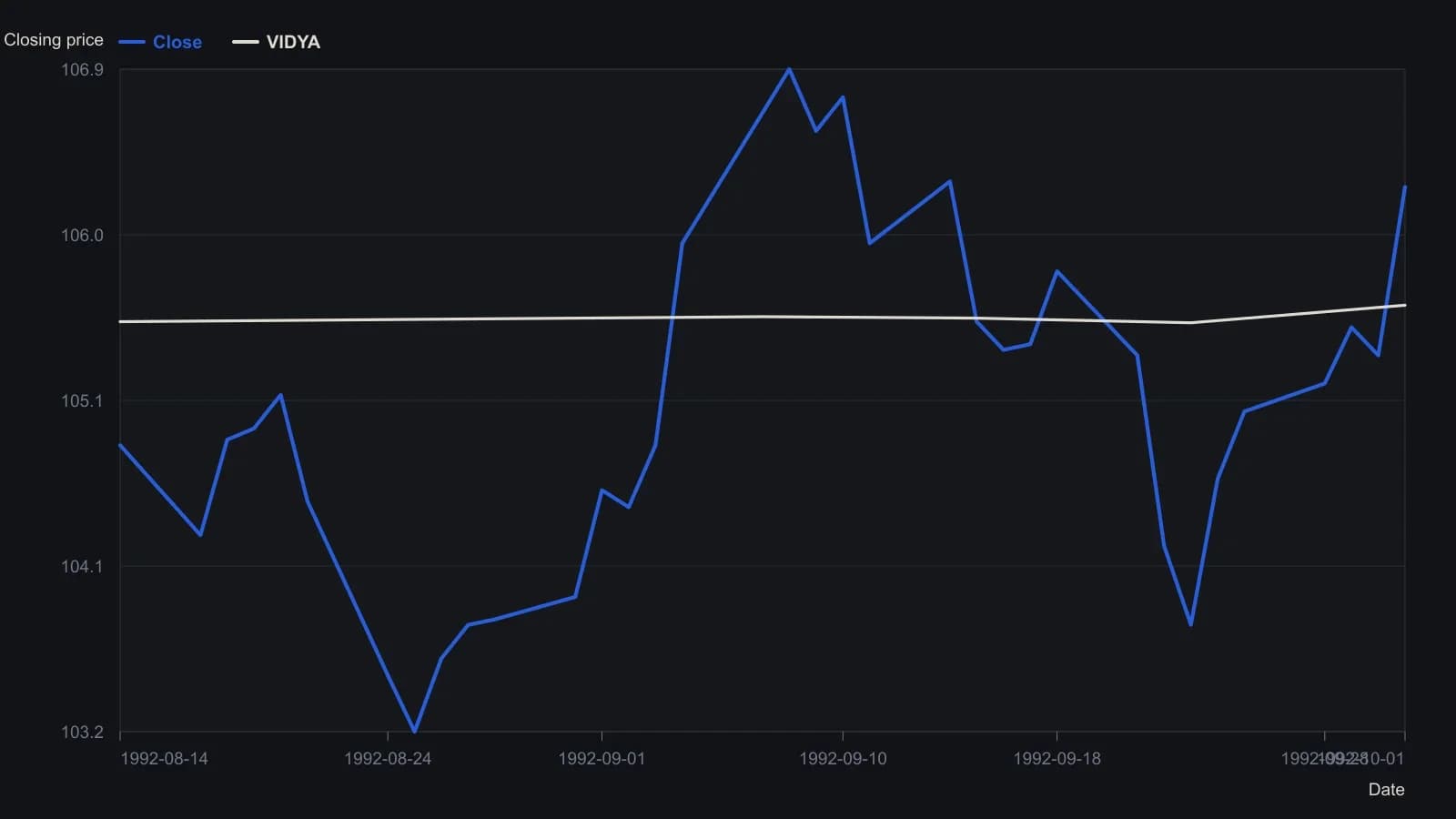
VIDYA starts only at row 31 because the 30-day STDEVP window needs D6:D35. The source fixes the reference deviation at 0.5 and the base alpha at 0.065 in =(E35/0.5*0.065*D35)+((1-(E35/0.5*0.065))*F34).
Rebuild the same update on highs or lows
The same construction can be applied to daily highs or daily lows by substituting that series into both the standard-deviation window and the recursive update. The window and the average stay on one series: a high-based smoother uses highs for the 30-observation standard deviation and for the recursive blend, and a low-based smoother does the same with lows. The historical presentation treats the method as an extension of the exponential moving average.
All readings on this track · 24 readings
- 1991Building variable-length moving averages from partitioned price changes
- 1991Variable-length moving average from change dispersion
- 1992Constructing volatility-adaptive exponential smoothing
- 1995Constructing an adaptive moving average with an efficiency ratio and filter
- 1995Two-gate breakout confirmation with adaptive averages
- 1995Building momentum-scaled adaptive moving averages
- 1995Adaptive length as a construction choice inside exponential smoothing
- 1998Testing price-channel breakouts with a lag-aware adaptive average
- 1998Constructing filters by nesting offsets and variable weights
- 1998Constructing an efficiency ratio adaptive average and entry filter
- 2001Encoding candle structure as a numeric filter
- 2001Adaptive averages driven by cycle-phase speed
- 2005Constructing an adaptive moving average from a fractal-dimension weight
- 2005Range-dimension adaptive exponential filter
- 2010Constructing simple, exponential, and adaptive averages
- 2010How a price-hugging smoother is assembled from ordinary averages
- 2013Evaluating an adaptive moving average against a same-window moving average
- 2016Three-layer confirmation: adaptive average, stochastic relative strength index, and stop-and-reverse
- 2017One-alpha reverse-path exponential smoothing
- 2018Pair two adaptive averages to filter swing turns
- 2018Two Adaptive moving averages as a confirmation pair
- 2018Constructing an adaptive filter for adoption-cycle reversals
- 2018Constructing a deviation-scaled adaptive moving average
- 2020Walk-forward and adaptive averages as two tests of the same trend