1993issue C011-2
Double-smoothed stochastics momentum index construction
A worked stochastics momentum index measures the close against the midpoint of a lookback range, applies two nested exponential averages to that displacement and to the range width, and forms the finished index from those twice-smoothed series.
- A worked construction uses a two-period lookback together with two successive 20-period exponential smoothings.
- The unsmoothed momentum term equals the close minus the midpoint of the lookback high-low range.
- The lookback high-low width is double-smoothed with the same exponential procedure applied to the momentum term.
- The finished index equals 100 times the twice-smoothed momentum term divided by half of the twice-smoothed range width.
A stochastic-family reading from two series
A stochastic oscillator is a range-normalized reading that locates the close relative to a lookback high-low window and then scales that location to a bounded series.
A stochastics momentum index is a stochastic-family construction that measures the close against the midpoint of the lookback range and divides a double-smoothed version of that displacement by half of the double-smoothed range width.
A worked construction uses a two-period lookback together with two successive 20-period exponential smoothings.
Lookback range and the unsmoothed momentum term
The lookback range is the highest high and lowest low observed over a stated number of sampling periods.
The lookback high is the maximum high over the chosen window, and the lookback low is the minimum low over the same window.
The unsmoothed momentum term equals the close minus the midpoint of that lookback high-low range.
Exponential smoothing, the constant, and seeding
Exponential smoothing is a recursive average that blends each new observation with the prior average using a constant derived from a chosen length.
A moving average is an average of ordered observations over a defined length; here it supplies the length used to set the exponential smoothing constant.
The smoothing constant is the blend weight formed as two divided by one plus the moving-average length. For a length of 20 that constant is 0.095.
Each exponential average is updated as the prior average plus the smoothing constant times the gap between the new observation and that prior average.
The first exponential average is seeded by copying the unsmoothed input because no prior average exists, and recursive smoothing begins on the next observation.
Double smoothing and the finished index
Double smoothing is two nested exponential averages applied in sequence to the same input series.
The lookback high-low width is double-smoothed with the same exponential procedure applied to the momentum term.
The finished index equals 100 times the twice-smoothed momentum term divided by half of the twice-smoothed range width.
The construction is illustrated with a spreadsheet figure that walks through the successive columns of the calculation.
Stochastics momentum index, q=2 and double EMA 20
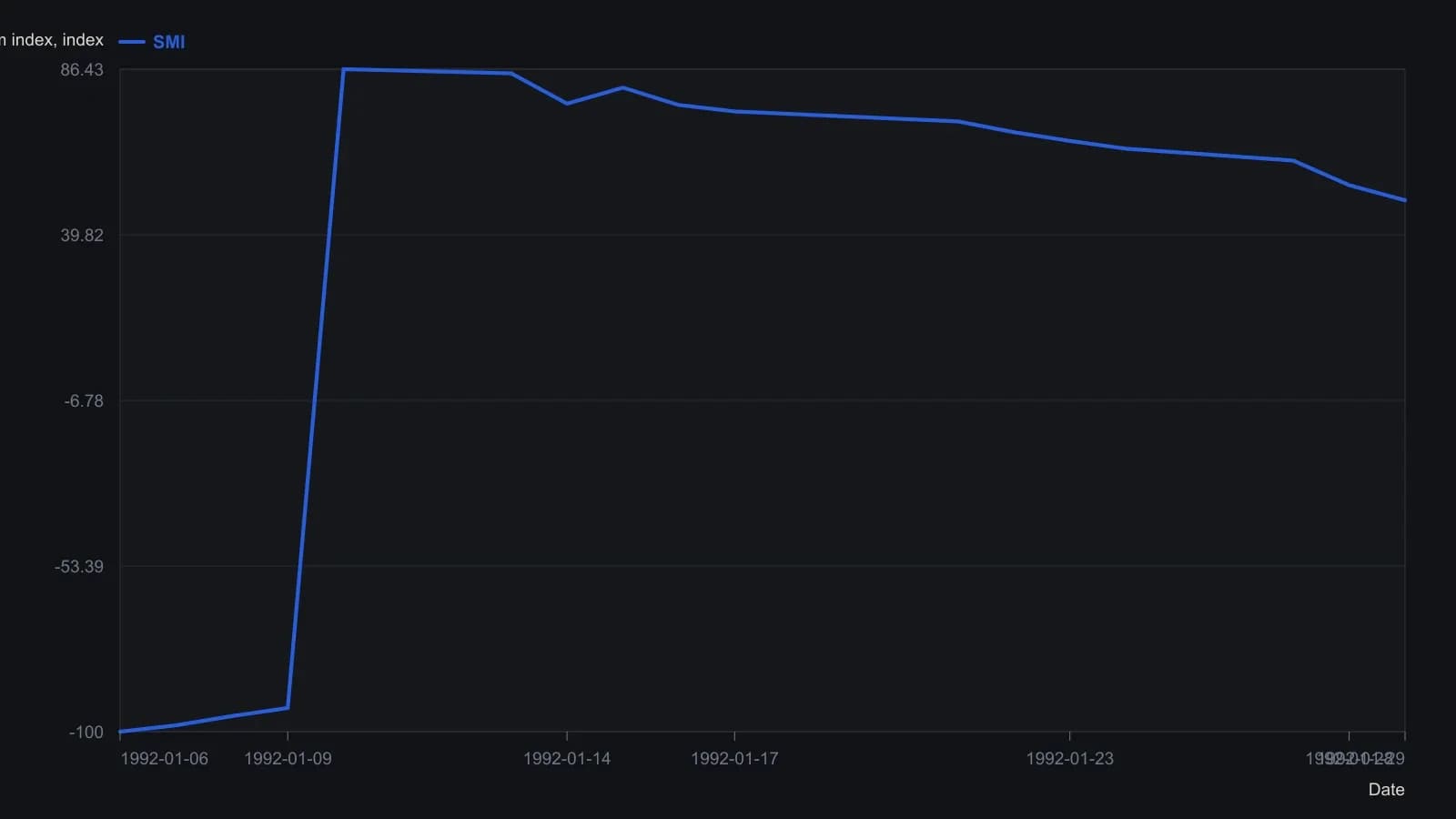
Lookback q=2; both smoothings use n=20 so alpha=2/(20+1)=0.095. First row seeds each EMA with the unsmoothed term; smoothing starts on the next bar.
All readings on this track · 41 readings
- 1984Matching average age across price filters
- 1984Residual-impact construction of exponential smoothers
- 1988Constructing simple and exponential moving averages as specified filters
- 1989Evaluating smoothed free reserves and funds-discount spreads
- 1990Integer construction of moving averages and exponential smoothing
- 1990Constructing incremental moving average filters
- 1991Constructing a double-smoothed stochastic oscillator
- 1991Constructing an exponential average from a smoothing weight
- 1991Constructing a double-smoothed momentum oscillator family
- 1991Competing certainty rules from exponential-average conditions
- 1991Hybrid construction of a mechanical timing system from smoothed signals
- 1991Constructing an exponential smoother from a moving-average length
- 1991Equivalent relative-strength-index constructions from a ratio and from smoothed momentum
- 1991Constructing the true strength index from double-smoothed momentum
- 1991True strength index from signed, double-smoothed momentum
- 1992Constructing exponential averages from simple lookbacks
- 1992Constructing exponential averages by the smoothing constant, startup length and lag
- 1992Nested range smoothing and windowed high-low damping
- 1992A weekly equity stance from the discount-bill spread
- 1993Double-smoothed stochastics momentum index construction
- 1993Constructing the true strength index with double exponential smoothing
- 1994Polarized fractal efficiency with a shared exponential smoother
- 1994Five-interval exponential smoothing of ten-interval signed path-efficiency
- 1994Hand-ranked price-volume series with stacked smoothing and stochastic
- 1995Range expansion filter on multi-horizon averages
- 1995The exponential smoothing constant from averaging lag
- 1997Construct a nested-average rainbow band and oscillator
- 1998Filter stacks that combine a moving average with exponential smoothing
- 2002Smoothed relative-strength construction from wilder-averaging and a price prefilter
- 2003Reverse-engineered RSI price targets
- 2004Piecewise trend quality from moving-average reversals
- 2004Nested smoothing recipes versus unaudited oscillator experiments
- 2008Weight construction beyond the N-day label
- 2010A consensus filter for objective RSI and smoothing construction
- 2012Sentiment-zone oscillator from signed closes
- 2012Classic RSI one-over-N smoothing versus the standard exponential average
- 2013Why exponential smoothing uses two over n plus one
- 2015Constructing ratio indicators with moving-average and exponential-smoothing weights
- 2015Slow relative-strength index from an exponentially smoothed price
- 2017Rebuilding the relative strength index as open-scale buy-sell pressure
- 2017Comparing Wilder and exponential smoothing inside a relative-strength index