1999issue C111-7
Lagged trend filters for neural-network inputs
Neural-network systems need filtered price inputs that respond consistently to similar patterns. Lagged moving averages and other lagged trend filters do that more reliably than zero-lag smoothers, and the network can learn to map those lagged outputs onto a less-lagged target.
- Mechanical and neural-network systems are more sensitive to small, inconsistent filter changes than discretionary use of the same indicators.
- Lagged moving averages and other lagged trend filters respond more reliably to similar events than zero-lag smoothers that leak frequency or shift phase.
- No digital filter can pass the wanted frequencies, block the rest, stay stable, and remove lag at the same time.
- A network can map lagged filter outputs onto a less-lagged target, so the preprocessor itself does not need to be zero-lag.
Why networks need consistent filters
Mechanical and neural-network systems are more sensitive to small, inconsistent changes in filtered inputs than discretionary use of the same indicators. Neural-network inputs need consistent filter responses to similar patterns, especially when the training set is small enough that the model can memorize history instead of generalizing.
Market price series contain a wide mix of frequencies, so raw prices are harder to interpret in the frequency domain than simpler natural signals and benefit from filtering.
How trend filters and smoothers reshape the series
A trend filter isolates slower price components so a model can treat the remaining variation as a forecast input rather than raw noise. Differencing is a high-pass trend filter that removes slow nonstationary movement and leaves variation, but the resulting spectrum can still look noisy.
A moving average is a low-pass smoother that keeps slower variation and rejects faster fluctuations, at the cost of lag in the filtered series. A moving-average-style low-pass filter keeps components below a frequency threshold. A high-pass filter does the opposite. A bandpass filter keeps only a chosen band.
A Kalman filter is a recursive estimator that updates a state forecast from sequential observations. It is used here as a quantitative preprocessing alternative to simple smoothers.
Why lag can stay in the preprocessor
No perfect digital filter exists that simultaneously passes desired frequencies, blocks the rest, stays stable, and has no lag. Lag-reduction designs that react to recent error or forecast recent points can make filter outputs inconsistent across similar patterns.
Lagged moving averages and other lagged trend filters respond more reliably to similar events than zero-lag smoothers that leak frequency or shift phase. A neural net can be trained to map lagged filter outputs onto a less-lagged target, so designers need not force the preprocessor itself to be zero-lag.
MEM spectrum of differenced S&P 500 prices
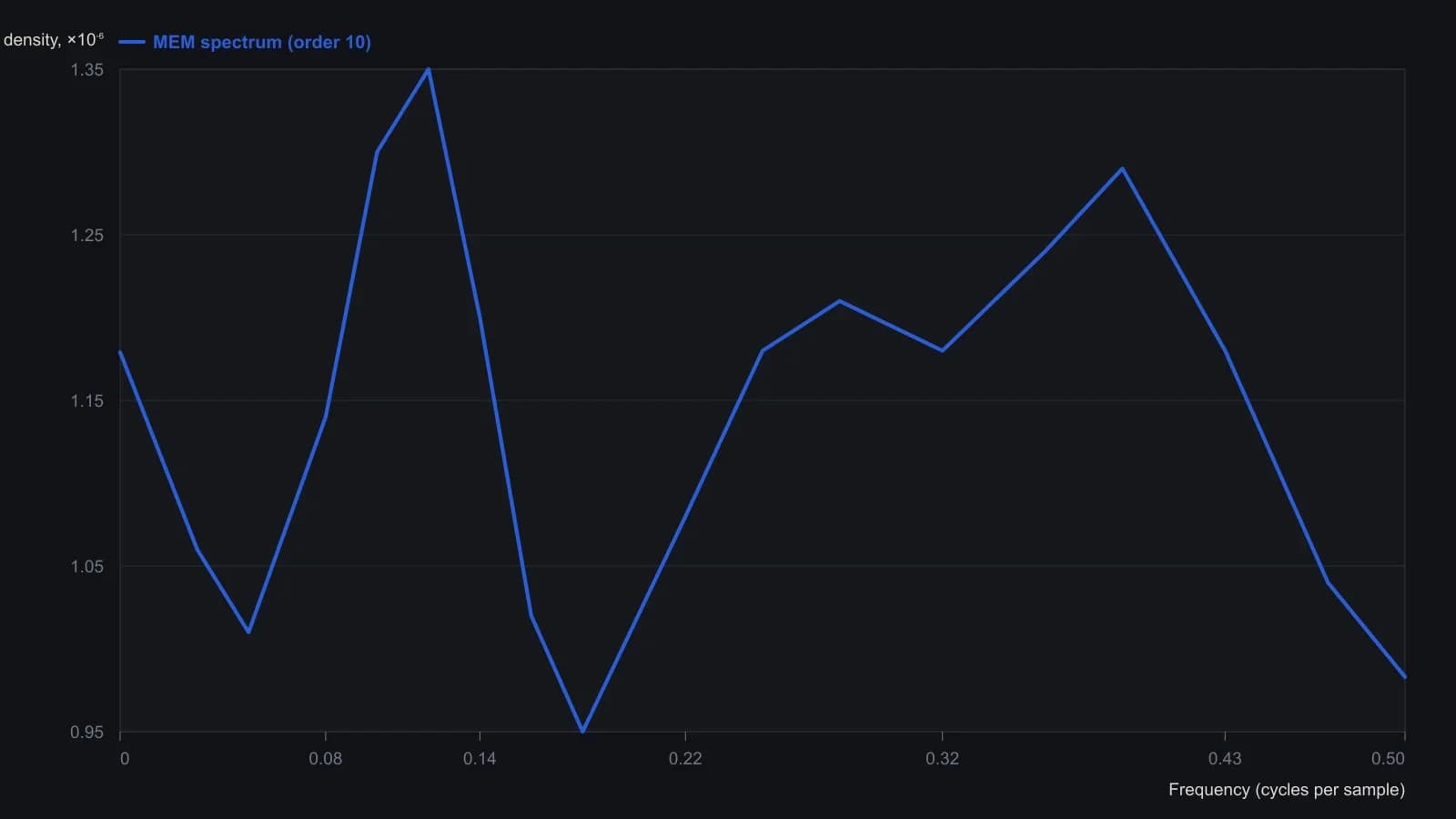
MEM order 10, Nfft 1024 as set in the Spectrum Viewer. Endpoints are the on-screen ruler readings; interior points are read from the curve. Peak locations agree with the article's stated frequencies of about 0.12, 0.28 and 0.39.
All readings on this track · 5 readings
- 1998T3 adaptive smoothing from regression benchmarks
- 1999Lagged trend filters for neural-network inputs
- 2006Linear forecast versus buy-and-hold when price changes cluster
- 2010Treat a market as a transfer device before completing a price path
- 2018Constructing predictive filters with RSI and walk-forward tests