2016issue C0839-44
Combining RSI, moving averages, and money flow
A screening workflow can combine relative-strength, money-flow, and moving-average conditions in one pass. Editorial reading treats that pass as one checklist when a news-driven volume spike appears.
- A screening workflow can combine relative-strength, money-flow, and moving-average conditions in one pass rather than as separate studies.
- Price-level filters in that workflow include overbought or oversold states and a cross above or below a moving average.
- The same technicals group exposes money-flow and relative-strength choices that can be scored by strength and persistency over time.
- Editorial reading: treat RSI, a moving average, and the Money Flow Index as one checklist so a news-driven volume spike is a testable setup rather than a story.
A single screening pass
A screening workflow can combine relative-strength, money-flow, and moving-average conditions in one pass rather than as separate studies.
In this article the Relative Strength Index is a bounded oscillator built from ordered price observations over a defined lookback, used here as a forecast-style baseline for overbought or oversold conditions. A moving average is a smoothed price baseline over a defined sampling interval, used here to compare whether price is holding above or below an explicit trend filter. The Money Flow Index is a volume-aware oscillator that turns price-and-volume structure into a buy or sell signal, used here as a falsifiable chart condition rather than a standalone forecast.
Price-level filters and scored choices
Price-level filters in that workflow include overbought or oversold states and a cross above or below a moving average. Those checks sit with the money-flow signal and the relative-strength baseline, so the pass is reading a shared price level and a shared trend filter instead of three separate studies.
The same technicals group also exposes money-flow and relative-strength choices that can be scored by strength and persistency over time. Those scores describe how firmly the oscillator choices have held. They do not replace the moving-average cross.
Last sale of the 20 names left by the Chaikin combined screen
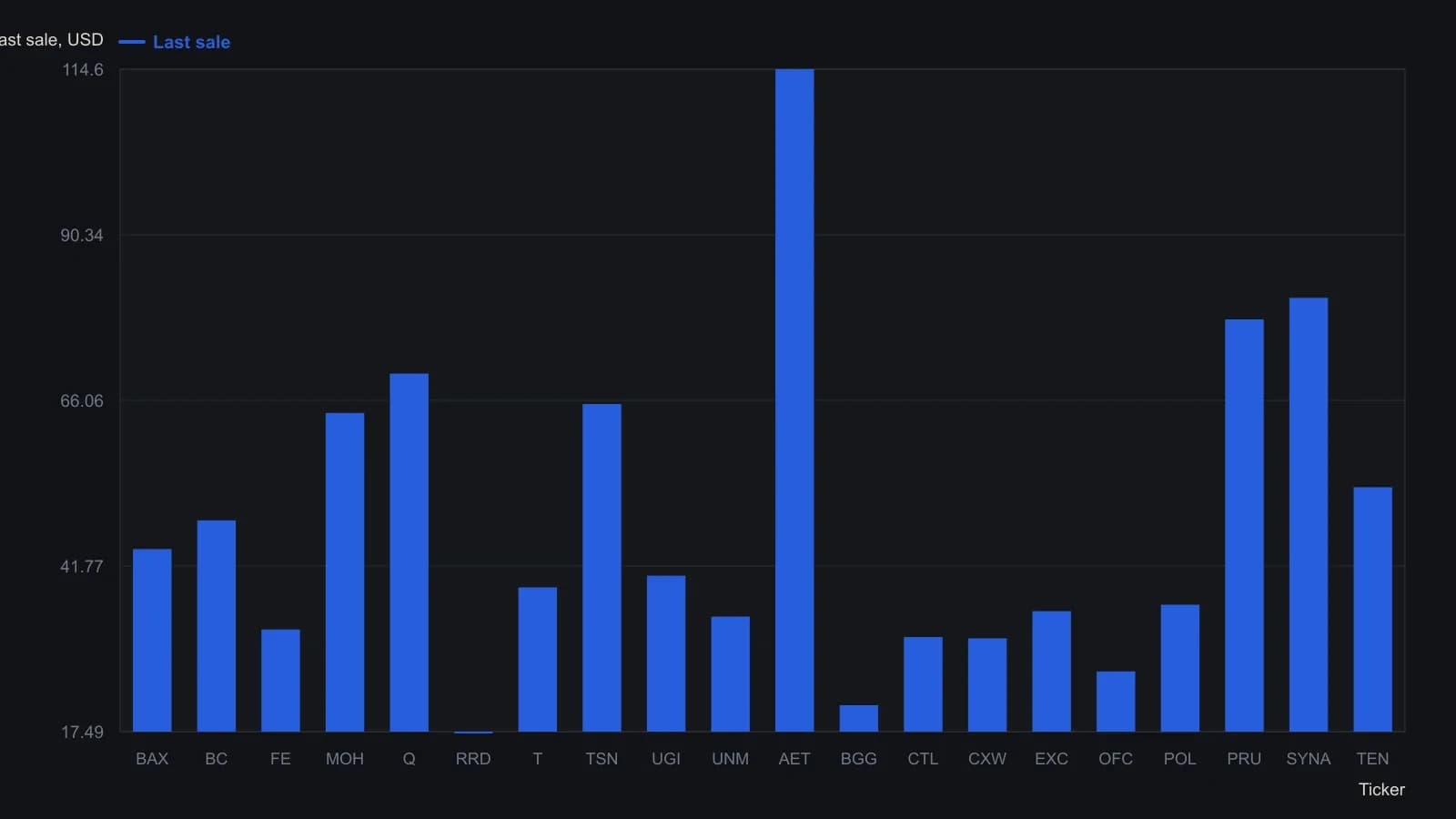
Money-flow and moving-average price-level filters were left unset on this pass; relative strength was the technical that cut the list to 20. Unum printed 34.35 with no readable session percent on the card, so this series uses last sale for every name rather than percent change.
Editorial reading of a volume spike
Editorial reading: treat the Relative Strength Index, a moving average, and the Money Flow Index as one checklist instead of three isolated signals. A news-driven volume spike is then a testable setup rather than a story.
On that editorial reading, the spike becomes a setup only when the same pass can mark an overbought or oversold state, a cross above or below the moving average, and a money-flow buy or sell condition. If those items are not present together, the spike remains a story without a completed checklist.
All readings on this track · 13 readings
- 1988Constructing tick-weighted money flow and price divergences
- 1989Four-state money-flow-index as permission for a next-bar breakout-system
- 1989Constructing a suggest-then-confirm Money Flow Index
- 1993Five-rung money flow from signed print volume
- 1993Physics analogies for building cycle and money flow indicators
- 1994Keep a wave count as a draft until money flow and a trendline agree
- 1999Take the rectangular-base breakout from money-flow confirmation, not from a late strength average
- 2004Constructing a volume-flow rule from money flow
- 2006Classify the regime before the bar read
- 2015Constructing a bounded money-flow oscillator from range and volume
- 2016Combining RSI, moving averages, and money flow
- 2018Five-rule technical rating as a rotation filter
- 2020Combining money-flow, RSI, and breadth for dynamic pressure zones