2001issue C031-4
Confirming rate of change divergences with price
Treat momentum as an oscillator family and read a weaker rate-of-change extreme against a later price extreme as a divergence alert. The archive workflow is complete only after a price-confirmation event.
- Size the rate-of-change window and the spacing of disagreements to the swing under study.
- Treat a price and oscillator disagreement as an alert, not as a completed reversal.
- Wait for a price-confirmation event, such as a completed pattern, a moving-average crossover, or a trendline break.
- Score significance by the number of disagreements, their spacing in time, and how close the last oscillator reading sits to the equilibrium level.
Momentum as a family of oscillators
Momentum is used as a generic label for oscillators that track the speed or change of price rather than the price level itself. Rate of change is one such construction: it compares the latest price with the price a fixed number of periods earlier. Disagreement between that series and price is treated as a core reading rule.
How a divergence is classified
An oscillator can crest or trough before price. A later price extreme against an earlier, weaker oscillator extreme is classified as a divergence.
Price making a later high while the oscillator prints a weaker peak is a negative divergence, so the advance is losing thrust. Price making a later low while the oscillator prints a higher trough is a positive divergence, so the decline is losing thrust.
Disagreements at peaks are described as more common and typically leading by more time than those at troughs. Trough cases still occur and are labeled positive.
Price confirmation completes the reading
A divergence is not treated as a completed reversal. The procedure waits for a price-confirmation event taken from price itself, such as a pattern completion, a moving-average crossover, or a trendline break.
Several disagreements can unwind without a trend change, so a rule that acts on the oscillator alert alone is specified as incomplete.
Three construction checks
Significance is scored with three construction checks: how many disagreements appear, how far apart they sit in time, and how close the last oscillator reading is to its equilibrium level. The equilibrium level is the oscillator baseline, often the zero line on a rate-of-change series, used to judge how much thrust remains at the last disagreement.
Match the window to the swing
Oscillator length and the spacing of disagreements are supposed to match the swing under study, from short-term windows to intermediate spans of six weeks to nine months and primary spans of nine months to two years.
A walking series still waits for price
A rate-of-change series that keeps deteriorating while price merely stalls can be handled like a formal lower-low divergence for alert purposes. That walking series is still awaiting a price break.
CRB Spot Raw Industrials 13-week rate of change, 1992–1997
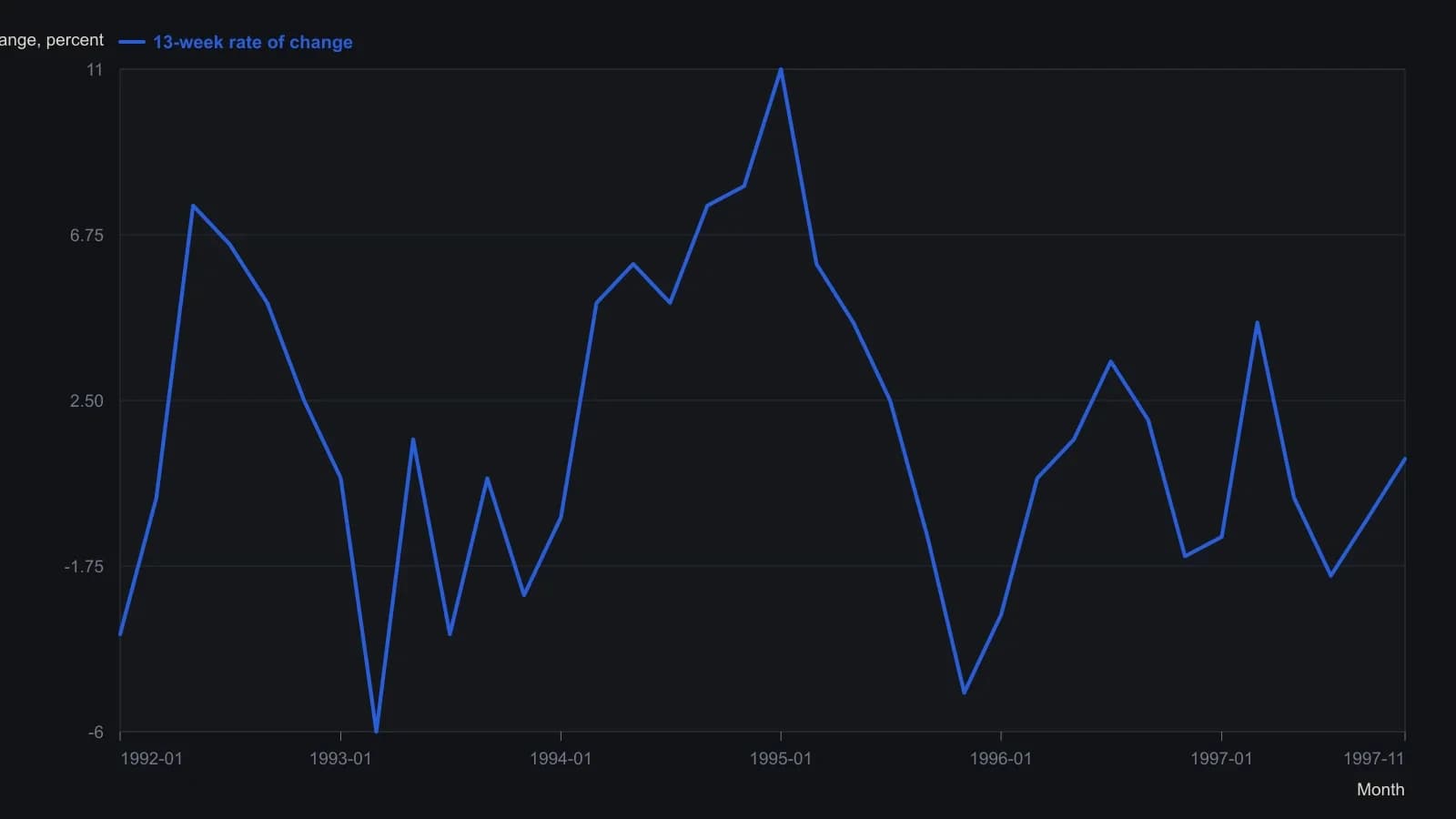
Approximate readings from the printed chart, to the nearest half-point. Pring notes the 1995–97 episode is not a strict lower-low divergence because the last oscillator low sits near its two predecessors.
A last disagreement near equilibrium
When the last disagreement occurs near the oscillator's equilibrium level or zero line and price then confirms, the construction is presented as a warning to expect a larger-than-usual subsequent move. That outcome is not treated as certain.
All readings on this track · 46 readings
- 1985Constructing excess and momentum difference-curve oscillators
- 1988Five reading rules for smoothed indicator charts
- 1989Momentum overlays that speed moving-average oscillators
- 1990A laboratory template that constructs Rate of Change as a pane module
- 1991Volume-scaled rate of change as a momentum construction
- 1991Three-indicator market overview from tape, sentiment and rates
- 1991Three-component trend model with rate-of-change filters
- 1992A KST oscillator from a weighted rate-of-change stack
- 1992Four-window weighted rate-of-change composite
- 1992Constructing multi-span smoothed rate-of-change filters
- 1992Constructing a four-horizon summed rate of change
- 1992Constructing KST from four weighted smoothed rates of change
- 1992Constructing a composite from weighted smoothed rates of change
- 1992Three-horizon KST maturity alignment
- 1992Construct a bond-led dividend-to-bond-yield regime first
- 1992Constructing relative-strength KST from weighted rate-of-change
- 1993Constructing a volume oscillator from average ratios and smoothed rate of change
- 1994Gold as a cycle clock for commodities and yields
- 1994Constructing a composite from weighted, smoothed rate-of-change windows
- 1994Constructing gold-mining rate-of-change tripwires for Treasury bonds
- 1994A capacity-stress checklist across commodities, bonds, and breadth
- 1994Rate of change parameters for testable entries
- 1994Constructing rate-of-change midpoints, lookbacks and divergence
- 1994Lead oscillator breaks need price trendline confirmation
- 1994Nested averages for an annual momentum curve
- 1994Evaluating a Coppock-style rate of change as a bottom-regime filter
- 1995A weighted eleven-month Dow rate of change as one testable timing procedure
- 1996Named lookbacks, thresholds, and streaks for entry rules
- 1997A midpoint rate-of-change test for bond trend follow-through
- 1997Constructing a short-rate-adjusted equity momentum filter
- 1998Daily momentum rank-churn as a portfolio-construction problem
- 1999Constructing a lagged rate of change cycle system
- 2000A triple delay line then a one-bar elliptic oscillator
- 2001Confirming rate of change divergences with price
- 2001Momentum trendline breaks need price confirmation
- 2001Market breadth, On-balance volume, and Rate of Change as a combined timing framework
- 2001Know Sure Thing with stacked horizons and trendline confirmation
- 2003Constructing a mechanical system from a rate of change condition
- 2003Constructing momentum from two closes and spotting divergence
- 2003Formula choice tilts which momentum mismatches count as divergences
- 2004RSI and momentum agreement as an asymmetric filter
- 2005Constructing price-normalized moving-slope hybrids
- 2005Unsigned speed gates on a fixed average-cross pair
- 2007Rebuilding rate of change as a path-weighted oscillator
- 2008Construct Special K so short-horizon signals stay inside the primary trend
- 2013Restore volume balance before adding another price-time indicator