1991issue C081-6
Inverting relative-strength-index closes for same-session rules
A planned next relative-strength-index reading can be inverted into a required close-to-close change. Binding that change with a close-only-stop keeps entry, exit, and abstention inside one same-session rule-based-entry instead of waiting for the following session.
- The relative-strength-index is constructed as one hundred minus one hundred divided by one plus the relative-strength-ratio of the up-close-average to the down-close-average, with a conventional first window of fourteen periods.
- After the first reading, an exponential-update and a simple-window-update can diverge on the same new close, because the first is smoother and slower to react and the second uses only the latest lookback.
- A planned next reading maps to a target-relative-strength that inverts into a required close-to-close change.
- That required change can be placed as a close-only-stop so a rule-based-entry can enter, exit, or stand aside on the same session.
Construct the oscillator from close changes
The relative-strength-index is a bounded oscillator built from the relative-strength-ratio of the up-close-average to the down-close-average over a chosen lookback. Unchanged periods are counted as zero in both averages.
The oscillator is constructed as one hundred minus one hundred divided by one plus that ratio, with a conventional first window of fourteen periods.
Refresh the averages after the first reading
After the first reading, the two averages may be refreshed either by an exponential-update that blends each prior average with the newest change using a thirteen-of-fourteen weight, or by a simple-window-update that recomputes a simple fourteen-period mean of the signed close changes.
In the supplied fourteen-period close-change series the first up-close-average was 22.86, the first down-close-average was 14.29, the first relative-strength-ratio was 1.6, and the first oscillator reading rounded from 61.54 to 62.
A next-period up-change of 19 moved the exponential-update to about 63 and the simple-window-update to about 68, so the two updates diverge on the same increment. The exponential-update is described as smoother and slower to react. The simple-window-update does not depend on the length of the prior series and responds more quickly to new closes.
Set the lookback from a cycle
The conventional fourteen-period lookback is presented as a half-cycle-lookback of an observed average trading cycle near twenty-eight days, and a nine-period lookback as about half of a near-monthly cycle. When no cycle is identified both lengths can be run until one is retained for style consistency. Nearby lengths such as thirteen or fifteen are treated as nearly interchangeable with fourteen.
On a comparison of nine-period and fourteen-period readings, the indicator extremes differed in absolute level but lined up in timing and in how those extremes related to one another.
Solve a planned reading for a close
A planned next oscillator reading can be inverted into a required close-to-close change by combining the current up-close-average and down-close-average with the matching target-relative-strength from an oscillator-to-ratio translation table, using a residual count of lookback minus one, or the last lookback of raw changes if the simple-window-update is in use.
In the worked downside case a next reading of 71 or lower implied a target-relative-strength of 2.4483 or less. With prior averages 31.73 and 12.34 the required change was 8.06, so a drop of nine or more points would confirm.
When the next reading must rise, the complementary change is the residual times the down-close-average times the target-relative-strength, minus the residual times the up-close-average. In the worked case a target of 32 implied a target-relative-strength of 0.4706 and a required rise of 7.92, or eight points.
Bind the close as one same-session rule
That downside threshold can be placed as a close-only-stop, optionally widened to ten points to allow for closing-range variance. The close-only-stop can fill only if the session close reaches the precomputed distance from the prior close, so the loss or confirmation decision stays bounded until that close.
The same-session close can then complete one rule-based-entry for entry, exit, or abstention instead of waiting for the following session. Editorial reading: keep the inverted close and the close-only-stop together as a single testable procedure rather than as a next-day chart reading.
Relative strength implied by each integer RSI reading
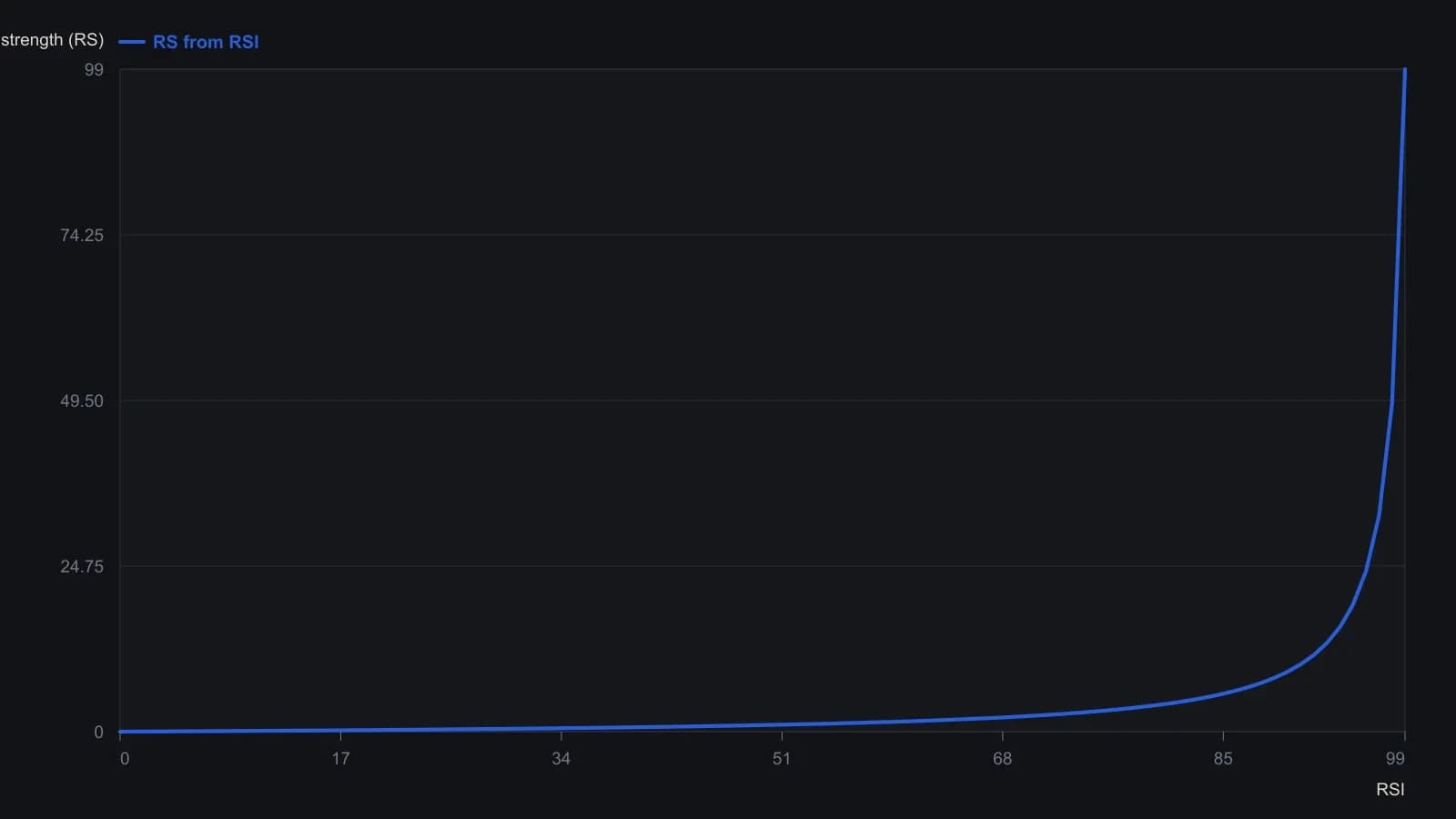
The table stops at RSI 99 because RS is undefined at 100. Turning a looked-up RS into a required close still needs the prior up-close and down-close averages and N = lookback − 1.
All readings on this track · 26 readings
- 1991Constructing the relative strength index from seed and recursive averages
- 1991Inverting relative-strength-index closes for same-session rules
- 1991Seeded averages and the recursive-update
- 1993Restating relative-strength-index parameters after a smoothing change
- 1993Relative momentum construction by stretching the relative strength lookback
- 1994Constructing relative strength index lookbacks, bands, and confirmation filters
- 1994Building the relative-strength-index from signed close changes
- 1997Constructing the relative strength index as a bounded up-down close oscillator
- 2002Four-line oscillator construction for rule-based entries
- 2004Assembling a bounded RSI path
- 2004Constructing RSI on highs, lows, and reverse targets
- 2004Reverse-engineered RSI as an explicit next-bar price target
- 2006Self-adjusting RSI thresholds from the oscillator's own spread
- 2006Constructing adaptive overbought and oversold levels for a relative strength index
- 2006Relative Strength Index 50-line entry beyond the 70 and 30 extremes
- 2007Lock a followable rule set before testing RSI exits
- 2008RSI bands as a one-day shift of reverse-engineered levels
- 2008Constructing an asymmetrical RSI from adaptive up and down averages
- 2010Building a bounded oscillator from a rainbow smoother, relative strength, and inverse Fisher
- 2011Two-horizon weekly RSI with moving averages and stops
- 2011Percent-offset simple moving average bands with relative-strength confirmation
- 2011Fast and slow relative strength index as one mechanical rule book
- 2011Price-zone oscillator construction from signed closes
- 2015Constructing a zero-lag oscillator against a relative strength index baseline
- 2015Relative Strength Index as a baseline in 2015 software listings
- 2018Building a Fisherized deviation-scaled oscillator