2019issue C0428-29
Constructing a 50-200 sma-channel for swing entries and exits
This archive article reconstructs a swing sma-channel from a 50-period simple-moving-average and a 200-period simple-moving-average. TradersWeek editorial interpretation: the construction is taught so a moving-average forecast states entry, exit, width, stop, and invalidation rules instead of treating a crossover as a finished model.
- The model is an sma-channel between a 50-period simple-moving-average used as the entry reference and a 200-period simple-moving-average used as the exit reference.
- A long is treated as valid only after price is already above the shorter average and then clears an entry-buffer of about 0.50 currency units, with a large up candle as a false-breakout-filter.
- The sma-channel is unused unless the prior range is at least 5 currency units and a channel-width-filter finds a gap of at least five points between the two averages.
- The exit sits within about 1 currency unit of the longer average, and an invalidation-rule closes the position if price stays sideways for several days after the shorter-average cross.
What an sma-channel is
A moving-average is a lookback average of ordered price observations used as a forecast baseline over a defined sampling interval. A simple-moving-average is an unweighted moving average of closing prices over a fixed number of bars.
The described model is built as an sma-channel, the band between a shorter and a longer simple-moving-average used together as entry and exit references. Here those lookbacks are a 50-period simple-moving-average and a 200-period simple-moving-average.
A simple-moving-average crossover by itself does not supply an exit target. Pairing the 50-period average as an entry reference with the 200-period average as an exit reference is the construction used to fill that gap.
Long entry and the entry-buffer
The long-entry rule waits until price has already moved above the 50-period simple-moving-average and then requires an entry-buffer of about 0.50 currency units. That small increment beyond the shorter average is what turns a cross into a valid long under this construction.
False-breakout-filter and channel-width-filter tests
A false-breakout-filter looks for a large up candle at or near the 50-period simple-moving-average before the channel cross is treated as valid. The candle-quality check is meant to discard weak crosses.
Two width filters are required before the sma-channel is used. The first is a prior price range of at least 5 currency units before the 50-period average is crossed. The second is a channel-width-filter: a gap of at least five points between the 50-period and 200-period averages.
Exit target, stop, and an illustrated setup
The exit construction places a target within about 1 currency unit of the 200-period simple-moving-average. After that level is reached, the position may be closed or a trailing stop of about 1 unit applied.
In the illustrated construction, the prior range is 31 minus 25 equals 6 units, the specified long is 29.50 plus 0.50 equals 30, and the initial stop is 2 units below that entry at 28.
Chemours daily closes versus the 50-day and 200-day SMA channel
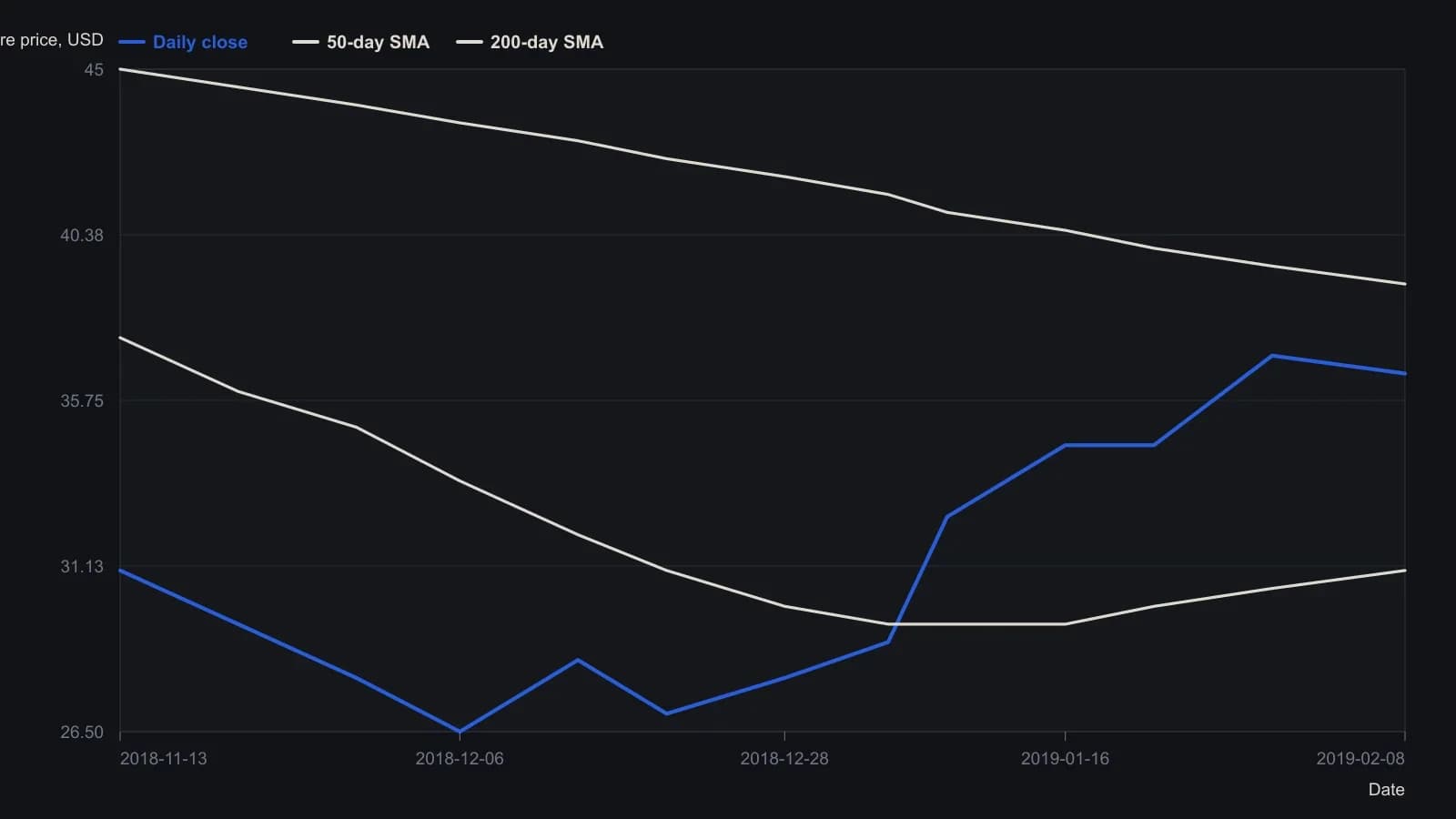
Rounded to the nearest half-dollar from the 90-day daily chart. The source states the 50-day average at the entry as $29.50 and the planned fill as $30.
Invalidation-rule after a sideways stall
If price moves above the 50-period simple-moving-average and then remains sideways for several days, the invalidation-rule treats the setup as invalid and closes the position. The test is a time-and-behavior check that retires the setup if price does not continue after the shorter-average cross.
All readings on this track · 15 readings
- 1990Building a percent-difference moving-average oscillator
- 1991Ease of movement oscillator construction
- 1993A twelve-month moving-average filter for inflation direction
- 1993Constructing two-endpoint JSA moving averages
- 1999Centered moving averages for trend construction
- 2000Constructing a slope-corrected moving average
- 2000Lookback length as a construction check for the modified moving average
- 2001Smoothing balance of market power with a moving average
- 2005Three-state moving-average directional breakout construction
- 2005Constructing a move-adjusted moving average
- 2005Moving-average construction: windows, weights and stops
- 2008Constructing stacked moving-average filters
- 2011Constructing percentage-offset moving-average bands
- 2015Linearity, commutation, and ratio smoothing in moving averages
- 2019Constructing a 50-200 sma-channel for swing entries and exits