1989issue C041-2
Alpha-beta lag parameters versus moving-average windows
Once lag is defined as delay versus a straight-line trend, a trading-filter-lag of 15, a channel-filter-lag of 6, a zero-lag trend-channel-midpoint, and exponential-alpha can be compared with moving-average windows that share the same delay.
- The alpha-beta construction does not use moving averages. Lag is the delay of a filter relative to a linear-trend input.
- An N-sample moving average has lag (N-1)/2 on a linear trend, so a lag of 15 matches N=31. The supplied defaults are a trading-filter-lag of 15 and a channel-filter-lag of 6.
- An exponential smoother that adds exponential-alpha times the latest residual can be matched to an N-sample average by giving it the same lag (N-1)/2.
- The trend-channel-midpoint is specified at zero lag with a second-order recursion on data through the current sample. Channel-width-scale at ML=15 has lag 14 and is lag-equivalent to a 29-sample average.
Lag is delay on a linear trend
The alpha-beta construction does not use moving averages. Lag is the delay between a filter output and the steady-state path it would follow if the input were a straight-line trend.
The moving-average window that matches a lag
An N-sample moving average has lag (N-1)/2 on a linear trend, so a lag of 15 matches N=31.
Default alpha-beta lags are a trading-filter-lag of ML=15 on the trading filter and a channel-filter-lag of MS=6 on the shorter setting.
Exponential-alpha on the same delay scale
An exponential smoother that adds exponential-alpha times the latest residual can be matched to an N-sample average by giving it the same lag (N-1)/2.
Zero lag at the trend-channel-midpoint
The trend filter for the trend-channel-midpoint is specified at zero lag and is described as roughly like a 13-sample average shifted back by 6 samples.
A second-order recursion is used so the trend-channel-midpoint can be estimated from data available only through the current sample, which an ordinary moving average cannot do without lag.
Channel-width-scale as another lag choice
Channel-width-scale is an exponential smooth of the squared error between the trend filter and the current close, with exponential-alpha equal to 1/ML. When ML=15 that deviation smoother has lag 14 and is lag-equivalent to a 29-sample average, following N=2*ML-1.
Default alpha-beta lags as matching moving-average windows
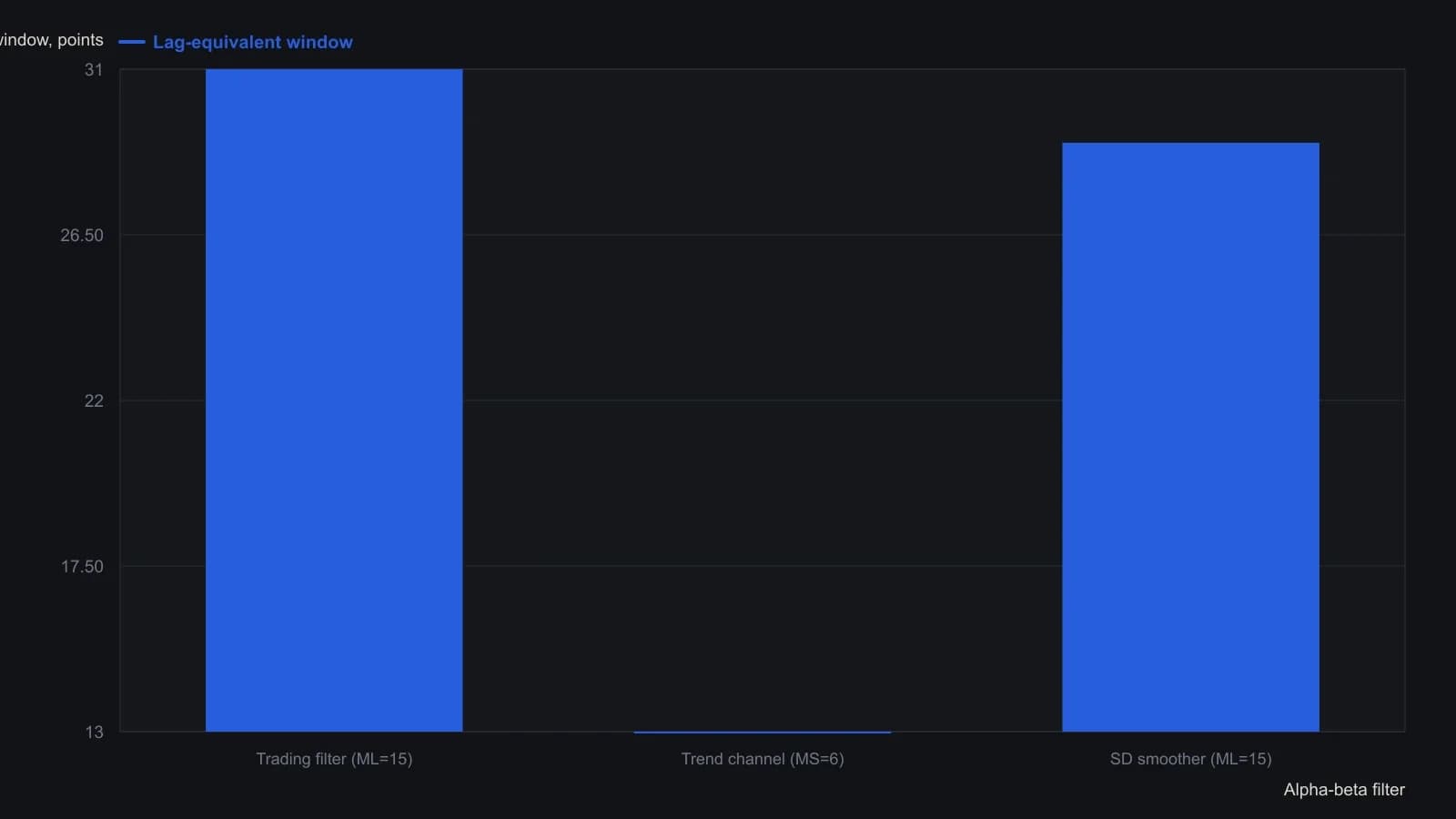
The alpha-beta method itself uses no moving averages. Warren calls the N=13 channel match rough, then shifts that average backward 6 points so midpoint lag is zero. The SD window follows N=2·ML−1, not 2·ML+1.
All readings on this track · 7 readings
- 1985Constructing a recursive two-gain price smoother
- 1989Constructing alpha-beta price channels and trend filters
- 1989Alpha-beta lag parameters versus moving-average windows
- 1995Constructing a reproducible alpha-beta price channel
- 2006Shared coefficient construction for recursive price filters
- 2010How to judge a Kalman filter forecast as a Trend filter
- 2019Constructing a calendar-conditioned trend filter