2000issue C071-6
A triple delay line then a one-bar elliptic oscillator
Subtracting price N bars ago from current price leaves a zero-mean residual, but a single rate-of-change still makes residual height depend on cycle length. Differencing a filtered series at six and twelve bars evens those amplitudes; an elliptic smoother under a one-bar lag cap, then a second smooth, makes the oscillator a two-line cross.
- A rate-of-change subtracts price N bars ago from current price so components that stay nearly constant cancel, leaving a zero-mean residual instead of a trending price level.
- A six-bar rate-of-change only partly removes longer cycles and also cancels harmonics of six bars; shortening to four bars passes more short-cycle energy but is weaker at removing trend.
- A triple delay-line canceller that differences a filtered series at six and twelve bars produces residuals whose cycle amplitudes are nearly uniform.
- After the detrend, an elliptic smoother under a one-bar lag cap is applied, then that output is smoothed once more, and crossings of the two lines are the read events.
Cancel near-constant components first
Subtracting price N bars ago from current price cancels components that stay nearly constant over that interval, leaving a zero-mean residual instead of a trending price level. That N-bar difference is the rate-of-change used as the first canceling stage.
A single lookback leaves uneven residual height
A six-bar rate-of-change only partly removes cycles much longer than six bars and also cancels harmonics of six bars, so residual amplitude varies by cycle length.
A shorter window does not even the heights
Shortening the lookback to four bars passes more short-cycle energy but is weaker at removing trend. Longer-cycle residual height falls to about plus or minus 2 versus about plus or minus 4 at six bars.
Finish cancellation with a triple delay line
A triple delay-line canceller that differences a filtered series at six and twelve bars produces residuals whose cycle amplitudes are nearly uniform across the periods of interest.
Feed the detrend the midpoint price
The price input to the detrend is the midpoint of each bar's high and low. That midpoint price is the input series so the detrend and the elliptic smoothing filter see the bar body rather than a single print.
Spend the one-bar lag budget on elliptic smoothing
After the detrend, an elliptic smoother is designed under a one-bar lag cap, with out-of-band attenuation set to -20 dB and a notch at 0.5 cycles per day, a two-bar period. Substituting a one-bar momentum prediction, twice current price minus the prior price, for raw price in the elliptic filter is used to offset remaining lag.
Read crossings of two smoothed lines
The oscillator is built by sending the detrend into the elliptic smoother and then smoothing that output once more. Crossings of the two smoothed lines are the read events. Under trend-mode caution, those crossings are less trustworthy when price is in a persistent trend than when it is cycling, because residual long-cycle energy still leaks through. The detrend is also framed as a first stage for later Hilbert-transform and polynomial-predictive filters.
Two-line elliptic detrend, daily prices into March 1996
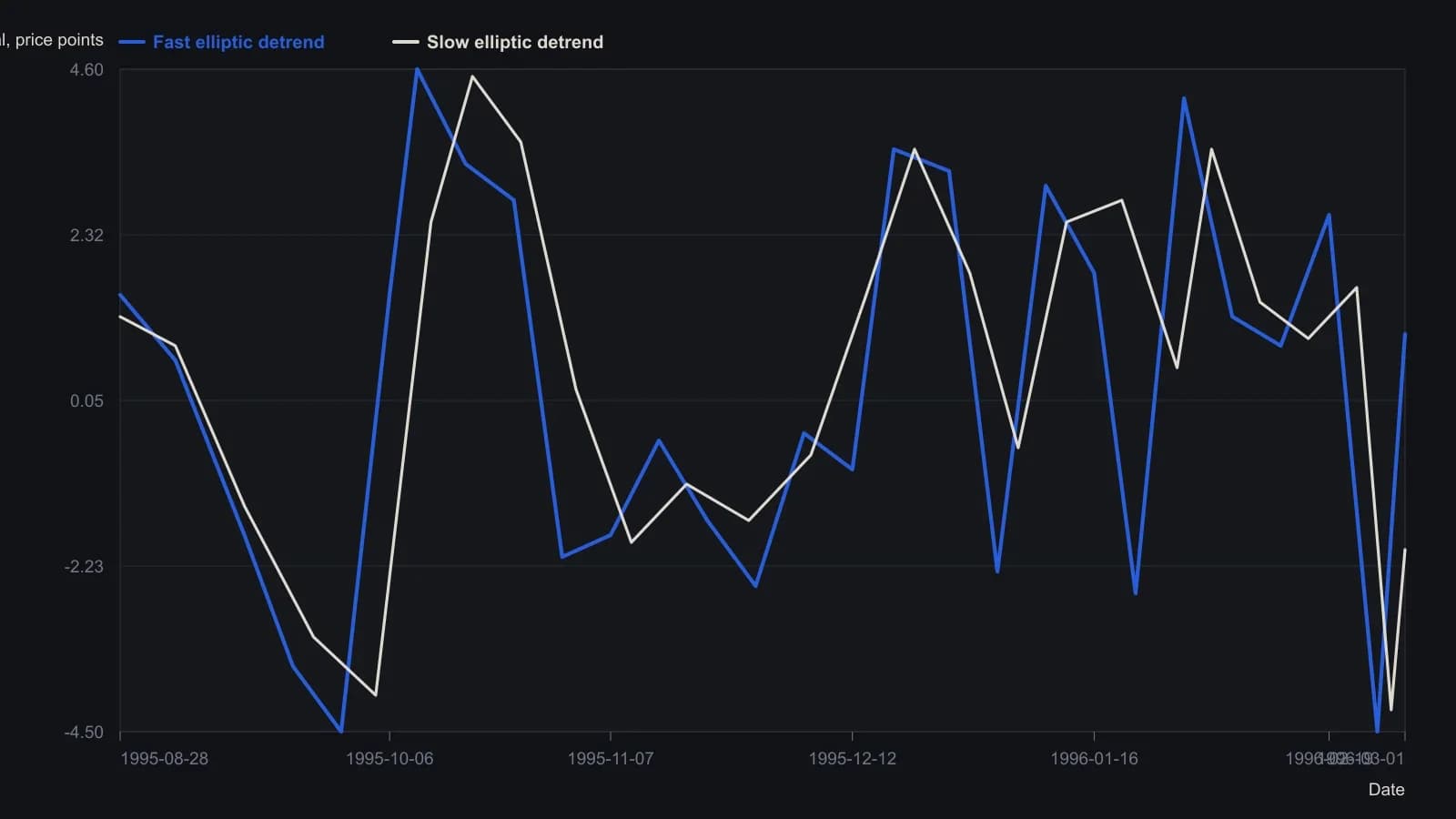
Y-scale inferred from the quoted finishes (0.96 and −2.00) against the zero line; interior points are approximate to about 0.3 oscillator units because the screenshot prints no y-axis. Daily bars, late August 1995 through 1 March 1996.
All readings on this track · 46 readings
- 1985Constructing excess and momentum difference-curve oscillators
- 1988Five reading rules for smoothed indicator charts
- 1989Momentum overlays that speed moving-average oscillators
- 1990A laboratory template that constructs Rate of Change as a pane module
- 1991Volume-scaled rate of change as a momentum construction
- 1991Three-indicator market overview from tape, sentiment and rates
- 1991Three-component trend model with rate-of-change filters
- 1992A KST oscillator from a weighted rate-of-change stack
- 1992Four-window weighted rate-of-change composite
- 1992Constructing multi-span smoothed rate-of-change filters
- 1992Constructing a four-horizon summed rate of change
- 1992Constructing KST from four weighted smoothed rates of change
- 1992Constructing a composite from weighted smoothed rates of change
- 1992Three-horizon KST maturity alignment
- 1992Construct a bond-led dividend-to-bond-yield regime first
- 1992Constructing relative-strength KST from weighted rate-of-change
- 1993Constructing a volume oscillator from average ratios and smoothed rate of change
- 1994Gold as a cycle clock for commodities and yields
- 1994Constructing a composite from weighted, smoothed rate-of-change windows
- 1994Constructing gold-mining rate-of-change tripwires for Treasury bonds
- 1994A capacity-stress checklist across commodities, bonds, and breadth
- 1994Rate of change parameters for testable entries
- 1994Constructing rate-of-change midpoints, lookbacks and divergence
- 1994Lead oscillator breaks need price trendline confirmation
- 1994Nested averages for an annual momentum curve
- 1994Evaluating a Coppock-style rate of change as a bottom-regime filter
- 1995A weighted eleven-month Dow rate of change as one testable timing procedure
- 1996Named lookbacks, thresholds, and streaks for entry rules
- 1997A midpoint rate-of-change test for bond trend follow-through
- 1997Constructing a short-rate-adjusted equity momentum filter
- 1998Daily momentum rank-churn as a portfolio-construction problem
- 1999Constructing a lagged rate of change cycle system
- 2000A triple delay line then a one-bar elliptic oscillator
- 2001Confirming rate of change divergences with price
- 2001Momentum trendline breaks need price confirmation
- 2001Market breadth, On-balance volume, and Rate of Change as a combined timing framework
- 2001Know Sure Thing with stacked horizons and trendline confirmation
- 2003Constructing a mechanical system from a rate of change condition
- 2003Constructing momentum from two closes and spotting divergence
- 2003Formula choice tilts which momentum mismatches count as divergences
- 2004RSI and momentum agreement as an asymmetric filter
- 2005Constructing price-normalized moving-slope hybrids
- 2005Unsigned speed gates on a fixed average-cross pair
- 2007Rebuilding rate of change as a path-weighted oscillator
- 2008Construct Special K so short-horizon signals stay inside the primary trend
- 2013Restore volume balance before adding another price-time indicator