1992issue C121-8
TRIX lookback and momentum derivative parameters
TRIX applies triple exponential smoothing to a closing-price series and then reads the period-to-period change of that smooth as a filtered trend. This archive article keeps the lookback period as a cycle cutoff and treats the choice between a moving-average cross and TRIX momentum as a separate timing control, both held inside one system optimization and a forward window.
- Two constructions of TRIX apply triple exponential smoothing to closes and then take either a period-to-period percentage change or a scaled one-period difference of a smoothed logarithm. They are described as producing nearly identical curves.
- The lookback period is the exponential-average length that sets which shorter cycles the oscillator is meant to ignore, illustrated with a 14-period setting.
- A momentum-strategy may fire on a 3-period moving-average cross of TRIX, or on reversals of TRIX momentum against a 3-period simple average while that difference stays on the opposite side of zero.
- System optimization searched TRIX length from 5 to 21 in steps of 4 for both rules. A forward window on four illustrated names was then used to compare signal count, character, and series personality.
Two constructions of the same curve
TRIX is a triple-smoothed exponential average of an ordered price series whose period-to-period change is read as a filtered trend oscillator.
One construction applies three successive exponential averages to a closing-price series and then takes the period-to-period percentage change of the final smooth.
A second construction takes the one-period difference of a triple-exponentially-smoothed logarithm of closes and scales that difference by 10000 for display. The two constructions are described as producing nearly identical curves.
Lookback period as a cycle cutoff
Each extra exponential average further damps short fluctuations. Triple exponential smoothing is intended to remove cycles shorter than the chosen average length, illustrated with a 14-period setting.
The lookback period is that exponential-average length. It sets which shorter cycles the oscillator is meant to ignore.
Positive TRIX readings are treated as a rising filtered trend and negative readings as a falling filtered trend.
Two timing rules on the same smooth
One momentum-strategy rule fires when TRIX crosses a 3-period moving average of itself, illustrated on a 14-period TRIX.
The first difference of TRIX is TRIX momentum, treated as a second derivative of the triple-smoothed average. Peaks of that series mark a slowing of the filtered trend.
One coded rule takes reversals of that difference against a 3-period simple average while the difference is still on the opposite side of zero. In that rule, the opposite side of zero is the signal level the reversal must still meet.
The moving-average cross of TRIX is described as lagging turns by two to five sessions. First-difference turns arrived earlier in the illustrated comparisons, in some cases by as much as a week.
One search and a forward window
System optimization searched TRIX length from 5 to 21 in steps of 4 for both the cross rule and the first-difference rule. The lookback stays inside one entry-and-exit procedure.
After in-sample optimization, four illustrated names were checked in a later window. That forward window produced a similar count and character of signals, offered as support that a series oscillator personality can persist.
The same oscillator rules were described as aligning more cleanly with turns on a cyclical series than on a more persistently trending series. Series personality is the tendency of one market series to stay more cyclical or more trending across adjacent samples.
Apple Computer price across the TRIX back-test and forward-test windows
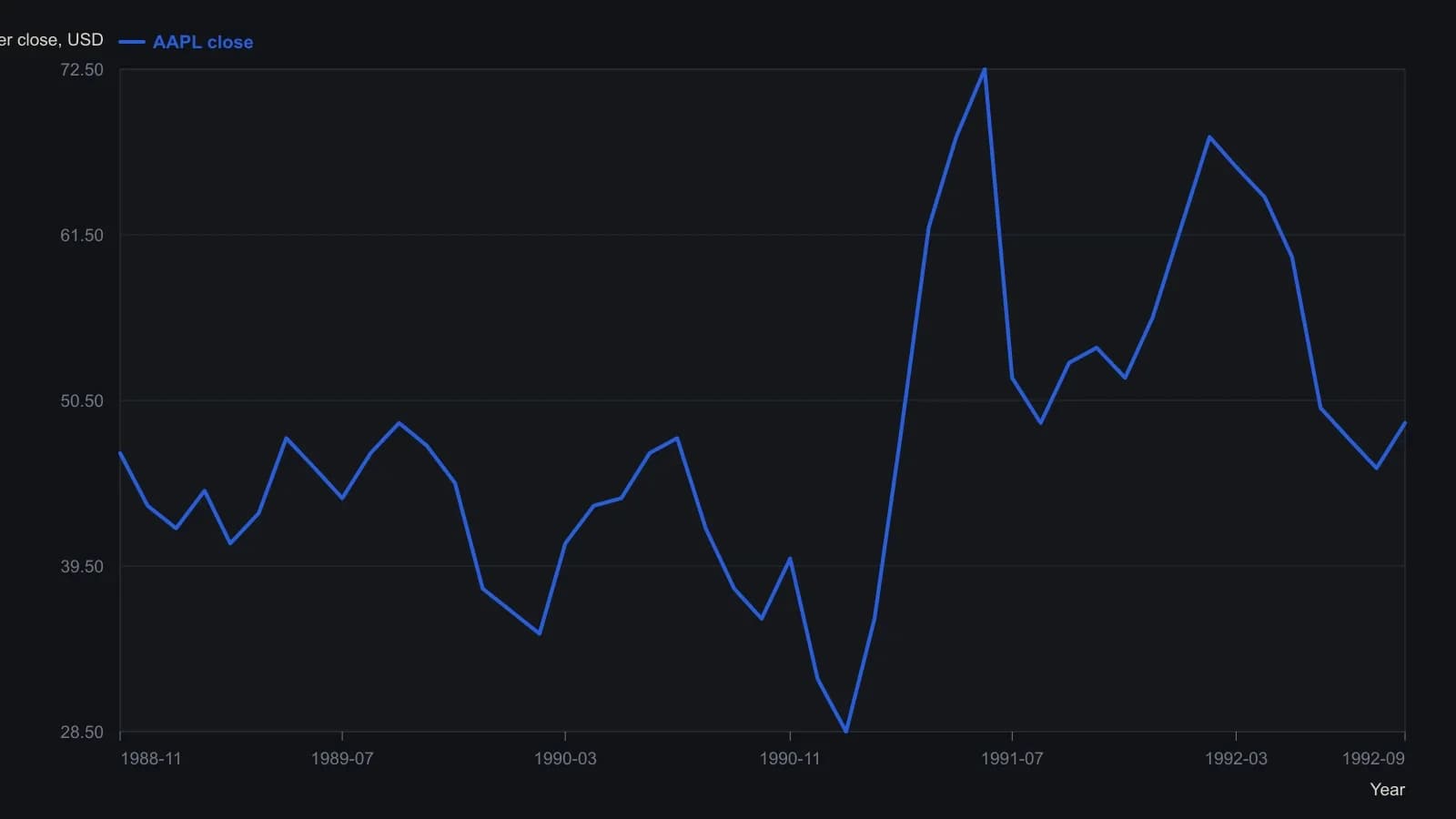
Values are approximate weekly closes digitized from the printed raster; prices are rounded to the nearest half dollar, which is as fine as the scan will support. Volume bars and the upper TRIX-momentum pane were not transferred.
All readings on this track · 15 readings
- 1984Constructing TRIX from a cutoff to one shared alpha
- 1988Isolate nested formulas before judging signals
- 1992Constructing TRIX from triple exponential smoothing
- 1992Constructing a TRIX oscillator from daily declines
- 1992A pre-trade checklist that stays flat until weekly support and TRIX agree
- 1992Constructing TRIX as triple-smoothed log-price momentum
- 1992Building TRIX crossover and momentum entries on a period grid
- 1992TRIX lookback and momentum derivative parameters
- 1994Seeding TEMA and DEMA with time-trend regression
- 1997Constructing the TRIX oscillator from triple smoothing
- 2002Constructing TRIX from triple-smoothing to signal rules
- 2002Lock the TRIX construction before reading a zero-line cross
- 2003Constructing TRIX from nested exponential averages
- 2004Construct TRIX entry, exit, and rest windows as one recipe
- 2004TRIX momentum and fundamental overlays for medium-term stock selection