2001issue C101-6
Inner weights are part of the candlestick signal
A candlestick can be reduced to a weighted candle score by coding the body and both shadows and combining those codes with inner weights. Those coefficients are free parameters for a stated market and rule set. Change them and a mechanical rule is no longer scoring the same candlestick events.
- A weighted candle score codes the body, upper shadow, and lower shadow into size bins, applies a bullish or bearish sign, and combines the three parts with inner weights.
- Inner weights are free parameters chosen for a stated market and rule set, not a single coding that applies to every market.
- After those coefficients change, coding collapse can give the same score to candles that rank differently in a descriptive candle ranking, while similar-looking candles can receive substantially different scores.
- The source treats the choice of weights as a question for a full entry-and-exit procedure, shown as a band-cross rule on a once-smoothed weighted candle score.
A candle becomes one number
A candlestick can be reduced to one numeric score by separately coding the body, upper shadow, and lower shadow and combining those codes with three weights. The resulting weighted candle score is a single number: each coded part is multiplied by its own coefficient, and the three products are added.
Size bins and signed parts
Each of the three candle elements is placed in one of four size bins: absent, small, medium, or large. That ranking is then scaled by a bullish or bearish sign. Upper shadows and rising bodies receive a positive sign. Lower shadows and falling bodies receive a negative sign.
Inner weights are free parameters
The three inner weights are presented as free parameters to be chosen for a stated market and rule set. They are not presented as a single coding that applies to every market.
Ranking is not a signal
An unweighted linear ranking of candles by bullishness is a descriptive candle ranking. It is a way to arrange bars from most bearish to most bullish, not a procedure that by itself generates trade signals.
A band-cross rule uses the score
One complete mechanical procedure is a band-cross rule. It enters long or short when a once-smoothed weighted candle score crosses the lower or upper line of a matching statistical band.
What changes when the weights change
After the inner weights are changed, two candles that sit at different ranks in the unweighted ordering can receive the same numeric score. That case is coding collapse. After the inner weights are changed, candles that look similarly bullish or bearish can receive substantially different scores when a modest shadow difference moves the weighted total.
Adjustable CandleCode on selected hourly spot-yen bars
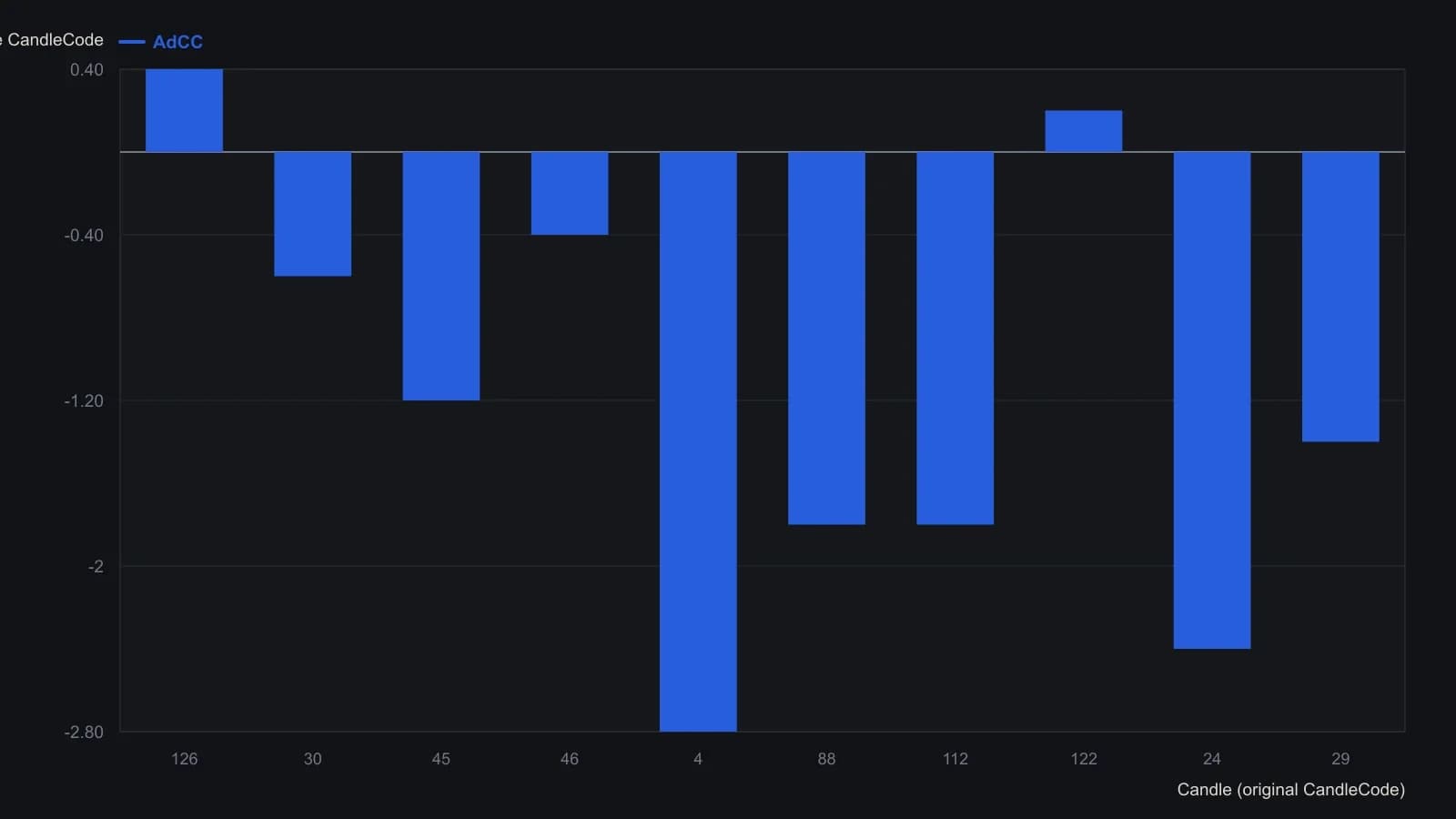
Printed callouts on the figure that uses U=0.2, B=0.2, L=0.8, not the equal 0.33 weights of Figure 1 or the U=0.5, B=0.2, L=0.8 set behind the 1,390-pip test. Likhovidov notes this weight set cut AdCC-Bol profitability by 10%.
Weights belong to the full procedure
Because many weight triples can manufacture almost any coding, the source treats the choice of weights as a question for a full entry-and-exit procedure rather than as a debate about which visual encoding looks better. The weighted construction is described as more convincing on short-term bars than when the same idea was tried as a daytrading application.
All readings on this track · 23 readings
- 1984Evaluating mechanical systems beyond net profit
- 1987Mechanical systems need more than pretty charts
- 1987Evaluating silver moving averages and RSI by scoring rule
- 1988Simple systems over optimized complexity
- 1988Cycle rule inputs until the parameter search stops
- 1990Split-sample tests for stochastic parameter grids
- 1993Four-subsystem trading system construction
- 1993Randomized price paths for stock system parameters
- 1994Mechanical timing with out-of-sample and filter checks
- 1995Evaluating asymmetric percent-reversal trading rules
- 1996Evaluating a daily volume-strength and new-high new-low timing procedure
- 1997Rule-based intraday system design with genetic search
- 1997Evolving three-rule systems with genetic templates
- 1997Audit the holdout and the exposure before the fitted entries
- 2001Inner weights are part of the candlestick signal
- 2003Mechanical short-term rules for news-sensitive rallies
- 2004Band construction as a testable trading procedure
- 2006Layered day-session automation from brackets to rules
- 2006Why mechanical rules must be retuned per security
- 2006A linear-regression next-bar forecast needs a searchable cutoff
- 2015Construct if-then rules, then backtest and optimize
- 2015Mechanical system design as a critique of discretion
- 2025Joint channel design with a trend filter and stop-loss orders