1991issue C051-8
Constructing a double-smoothed momentum oscillator family
Double-smoothed momenta locate the latest close between the highest and lowest closes in an integer lookback, smooth those distances twice, and multiply the ratio by 100 so the series stays on a 0-to-100 range. Changing the lookback and the two average lengths produces a family that includes the relative-strength index and can be shown beside a slow stochastic oscillator.
- The oscillator measures the current close against the highest close and the lowest close inside an integer lookback window labeled a.
- Each up-distance and down-distance is smoothed with a y-period exponential average and then a z-period exponential average, and each average uses the constant 2 divided by one plus its length.
- The same 0-to-100 reading can be the double-smoothed up-distance over the sum of the double-smoothed up and down distances, or that up-distance over the double-smoothed span between the highest and lowest closes.
- A two-close lookback with one exponential pass recovers the relative-strength index; both passes give double-smoothed relative-strength, and comparison panels place the series beside a slow stochastic oscillator.
What the oscillator is
Double-smoothed momenta are a close-only oscillator. The reading locates the latest close between recent closing extremes and then applies two successive moving averages before the ratio is scaled.
The close-extremes lookback is the integer window, labeled a, that supplies the highest close and the lowest close used in the current reading.
Distances from the close to the extremes
The up-distance is how far the current close sits above the lowest close in the lookback window. The down-distance is how far the highest close in the lookback window sits above the current close.
When the lookback is two closes, an up move is today's close minus the lower of the two closes, and a down move is the higher of the two closes minus today's close.
One smoothing pass or two
Each close-to-extreme distance is smoothed first with a y-period exponential average and then with a z-period exponential average. That pairing is nested exponential smoothing: an exponential average of an exponential average, and each stage uses the constant 2 divided by one plus its length.
Setting y or z to 1 leaves only one exponential pass. The two passes may be exponential, arithmetic, or weighted, including mixed pairings.
A finite 0-to-100 range
The same reading can be formed in two ways. One way divides the double-smoothed up-distance by the sum of the double-smoothed up-distance and the double-smoothed down-distance. The other divides the double-smoothed up-distance by the double-smoothed span between the highest and lowest closes.
After that ratio is multiplied by 100, the series is confined to a finite 0-to-100 range.
One expression, a family of curves
The integers a, y, and z may start from small whole numbers, with a from 2 upward and y and z from 1 upward, so one expression defines a family of curves.
Substituting the two-close up and down pieces into a single exponential average recovers the relative-strength index as the special case with a equal to 2 and the inner average length equal to 1.
Passing the same two-close up and down pieces through both the y and z averages produces double-smoothed relative-strength, which is the family member with a equal to 2.
S&P 500 cash versus DM2,5,25 through the 1987 crash
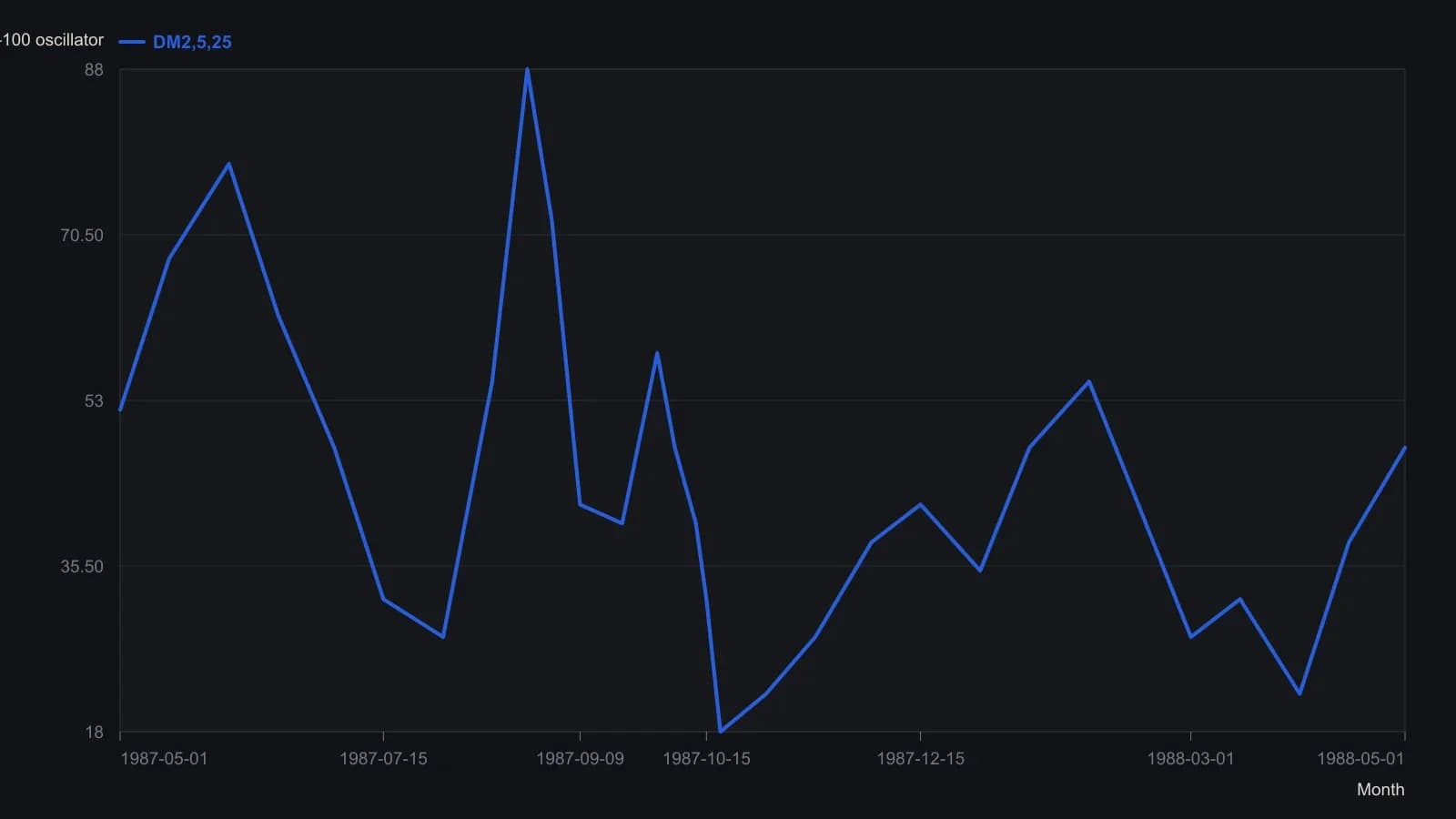
Raster is a rotated magazine scan; weekly samples are approximate. The article names the lower series DM2,5,25 (also DRSI5,25) and states the October support break near 40.
What the comparison panels place beside it
Comparison panels place the double-smoothed series beside a 9-period relative-strength index, a 3-period simple average of that 9-period series, a 12-period slow stochastic oscillator, and a 12-period inverted percent-range oscillator.
The slow stochastic oscillator is a high-low range oscillator shown beside the close-range double-smoothed series.
All readings on this track · 41 readings
- 1984Matching average age across price filters
- 1984Residual-impact construction of exponential smoothers
- 1988Constructing simple and exponential moving averages as specified filters
- 1989Evaluating smoothed free reserves and funds-discount spreads
- 1990Integer construction of moving averages and exponential smoothing
- 1990Constructing incremental moving average filters
- 1991Constructing a double-smoothed stochastic oscillator
- 1991Constructing an exponential average from a smoothing weight
- 1991Constructing a double-smoothed momentum oscillator family
- 1991Competing certainty rules from exponential-average conditions
- 1991Hybrid construction of a mechanical timing system from smoothed signals
- 1991Constructing an exponential smoother from a moving-average length
- 1991Equivalent relative-strength-index constructions from a ratio and from smoothed momentum
- 1991Constructing the true strength index from double-smoothed momentum
- 1991True strength index from signed, double-smoothed momentum
- 1992Constructing exponential averages from simple lookbacks
- 1992Constructing exponential averages by the smoothing constant, startup length and lag
- 1992Nested range smoothing and windowed high-low damping
- 1992A weekly equity stance from the discount-bill spread
- 1993Double-smoothed stochastics momentum index construction
- 1993Constructing the true strength index with double exponential smoothing
- 1994Polarized fractal efficiency with a shared exponential smoother
- 1994Five-interval exponential smoothing of ten-interval signed path-efficiency
- 1994Hand-ranked price-volume series with stacked smoothing and stochastic
- 1995Range expansion filter on multi-horizon averages
- 1995The exponential smoothing constant from averaging lag
- 1997Construct a nested-average rainbow band and oscillator
- 1998Filter stacks that combine a moving average with exponential smoothing
- 2002Smoothed relative-strength construction from wilder-averaging and a price prefilter
- 2003Reverse-engineered RSI price targets
- 2004Piecewise trend quality from moving-average reversals
- 2004Nested smoothing recipes versus unaudited oscillator experiments
- 2008Weight construction beyond the N-day label
- 2010A consensus filter for objective RSI and smoothing construction
- 2012Sentiment-zone oscillator from signed closes
- 2012Classic RSI one-over-N smoothing versus the standard exponential average
- 2013Why exponential smoothing uses two over n plus one
- 2015Constructing ratio indicators with moving-average and exponential-smoothing weights
- 2015Slow relative-strength index from an exponentially smoothed price
- 2017Rebuilding the relative strength index as open-scale buy-sell pressure
- 2017Comparing Wilder and exponential smoothing inside a relative-strength index