2006issue C101-3
Market condition as a permission layer for moving averages and oscillators
The archive identifies market condition before any indicator or strategy is chosen. This TradersWeek editorial reading treats that screen as a permission layer: a moving-average confirmation is eligible only after a trending or momentum regime is established, and a relative strength index or stochastic oscillator reading is eligible only after a wide sideways regime is established.
- Market condition is identified first, because the prevailing regime, not the strategy, is said to decide which tools fit.
- A moving average is a lagging, smoothed price series used to confirm that a trend remains intact, and it is treated as a fit only in trending and momentum regimes.
- The relative strength index and the stochastic oscillator are overbought-oversold tools reserved for a wide sideways range; in a momentum regime they can stay pinned near an extreme and flash an early exit.
- A small toolkit pairs quality indicators that apply in every regime with oscillators for sideways markets and velocity plus trend tools for trending or momentum phases.
Identify market condition first
The archive treats market condition as the first screen. The prevailing price-behavior regime is identified before indicators or a strategy are chosen, because condition rather than strategy is said to determine which tools fit.
Five market-condition types are listed: an uptrend or downtrend, a wide sideways range, a tight horizontal consolidation, a dull market, and a momentum market.
When a moving average is eligible
Moving averages are described as smoothed price series used to confirm that a trend remains intact. They are said to work best in trending and momentum regimes and to fail in consolidating and dull regimes.
A moving average is said to lag because smoothing delays the signal. Price can reverse against the primary trend before the average indicates that a turn has started.
Editorial reading: the average is allowed to confirm only after a trend or momentum regime has already been established. In a tight horizontal consolidation or a dull market, the average is treated as ineligible rather than as a late signal to interpret.
When oscillators are eligible
The stochastic oscillator and the relative strength index are described as overbought-oversold tools designed for wide sideways markets. They are described as poor fits in strong trends or momentum regimes, where they can flash an overbought or exit reading too early.
During a momentum regime, oscillators can remain near an overbought or oversold boundary in a horizontal pattern for the length of the move. That pattern is a horizontal oscillator pin.
Editorial reading: a relative strength index or stochastic oscillator reading is eligible only after a wide sideways regime has been established. In a momentum regime the same reading is withheld, because the oscillator can stay pinned at an extreme for the length of the move.
Daily stochastic (10, 8, 6) through a trend and a later stall
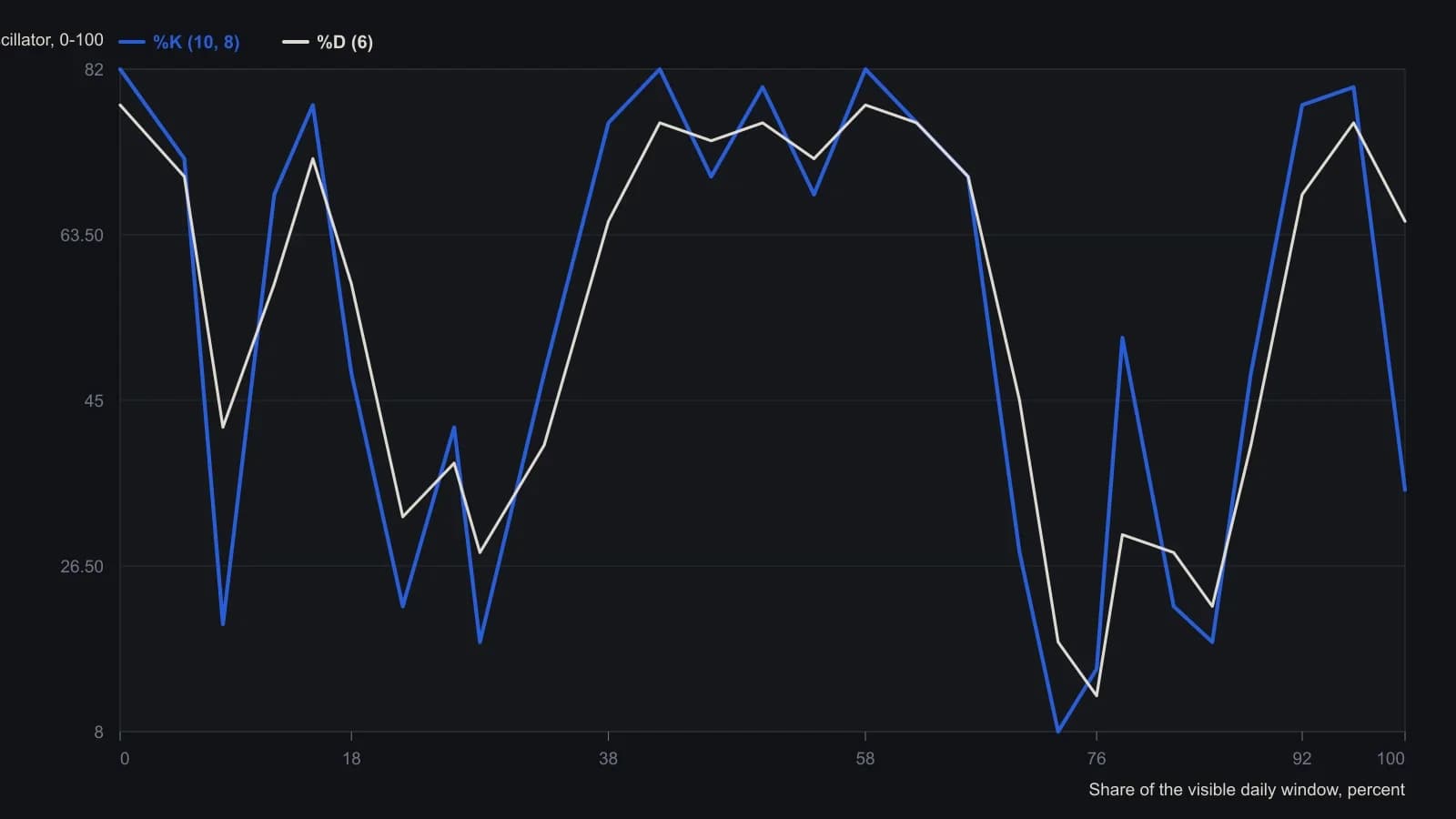
Pane label is Stochastics 10,8,6. Vertical scale is the standard 0–100 stochastic range; the traces repeatedly reach the top and bottom of the pane, but no 20/80 rails are numbered. Dates are not printed, so x is percent of the visible window from the left. Expect about ±5 oscillator points of reading error.
A regime-sorted toolkit
The archive describes a toolkit of five to seven indicators. It includes quality indicators usable in every regime, two to three oscillators reserved for sideways markets, and velocity indicators plus trend tools during trending or momentum phases. Oscillators are to be avoided in momentum regimes.
A quality indicator is a leading measure, often volume-based, of whether price action looks durable and reliable across regimes. A velocity indicator is reserved for trending and momentum regimes, where it is used to track price acceleration and to judge the strength and probable duration of a move.
All readings on this track · 42 readings
- 1987Stochastic fast and slow construction as a rebuildable stack
- 1989Building the stochastic oscillator from close location
- 1990Monthly stochastics as a multi-year bond regime filter
- 1990Walk-forward screen for yen indicator rules
- 1990Slow stochastic construction for index pullback entries
- 1991Random Walk Index construction with an adaptive lookback
- 1991Building a two-stage stochastic oscillator from close location
- 1992Constructing fast and slow stochastic oscillator lines
- 1992Constructing nested stochastic lookbacks
- 1994Construct the four-state price-volume rank before filtering it
- 1996Crowded stochastics, false breakouts, and hidden stops
- 1997Fade and follow entries from stochastic extremes
- 1998Oversold confirmation as a staged rule-based-entry case
- 1999Constructing regular and slow stochastic oscillators
- 2001Construct a variable-interval simple moving average from stacked extremes
- 2001Threshold RSI and stochastic setups with next-bar stops
- 2001Two tests of a rate-adjusted earnings-yield gap
- 2002Constructing a two-line stochastic from a range-normalized close
- 2002Inspect mechanical stochastic daytrade rules on one bar
- 2003Constructing an adaptive stochastic RSI
- 2003Four parameters that construct a stochastic oscillator
- 2004Volume breakout as signal, pullback as entry
- 2004A first currency-market checklist with two averages and a slow stochastic
- 2005Shared-scale cycle indexes with companion oscillators
- 2005Current-bar versus prior-bar range construction for the stochastic oscillator
- 2005Two-session moving-average pullback short
- 2006Market condition as a permission layer for moving averages and oscillators
- 2008Lock the stop at support before sizing a stochastic entry
- 2010Construct a center-line volume oscillator and read it with a stochastic oscillator
- 2010Sharpened RSI turns with rainbow averages and a slow stochastic
- 2011Build a Spearman rank oscillator from ordered closes
- 2012Gold as a regime-dependent hedge in the euro-area crisis
- 2012Pairing moving averages with variable-length stochastics
- 2014Two-leg stochastic stress oscillator as a rebuild drill
- 2014Ingress dates as price bases for relative strength, stochastics, and moving averages
- 2017Constructing a dual EMA stochastic from range normalization
- 2018Constructing a two-stage stochastic RSI for comparable price-oscillator divergences
- 2018Combining a weekly stochastic, a long moving average, and two-day resistance
- 2018Weekly and daily stochastic readings with a long moving average and support
- 2018A confirming workflow for rotating from discretionary to staples
- 2019Stochastic scan thresholds, averages, and formula syntax
- 2020Constructing Slow %K as a two-stage helper