2005issue C021
Constructing a move-adjusted moving average
A simple moving average is the equal-weight baseline for a fixed lookback period. The same window can be rebuilt so each observation is scaled by the absolute change that preceded it. That contrast shows how a smoother can be turned into an explicit next-interval forecast.
- A simple moving average can dampen noise in an ordered series, but it only describes values already observed.
- A move-adjusted moving average scales each lookback observation by an absolute-change weight, the share of the window's total absolute period-to-period change assigned to that observation.
- The finished average is the sum of each window value multiplied by its absolute-change share. For a four-period lookback, the denominator is the sum of the four successive absolute period-to-period changes.
- The same weighting recipe can be applied at other fixed windows, including 10-period and 20-period versions, under the premise that a large move in one direction can precede further movement in that same direction.
The equal-weight baseline
A simple moving average is an equal-weight average of ordered observations over a fixed lookback period. It can dampen noise in an ordered series. It only describes values already observed, so it remains a summary of the path already seen.
That equal-weight reading is the baseline. The lookback period stays fixed. What changes in the construction below is how each observation in that window is funded.
A lookback funded by absolute change
One construction adds directional information by scaling each lookback observation by the absolute change that preceded it, as a share of the sum of those absolute changes in the window. That share is the absolute-change weight.
The finished move-adjusted moving average is the sum of each window value multiplied by its absolute-change share. For a four-period lookback, the denominator of those weights is the sum of the four successive absolute period-to-period changes.
The same weighting recipe can be applied at other fixed windows, including 10-period and 20-period versions. In each case the lookback period is the fixed count of successive observations used both to form the weights and to compute the average.
Close versus 4-period move-adjusted moving average, January–February 1978
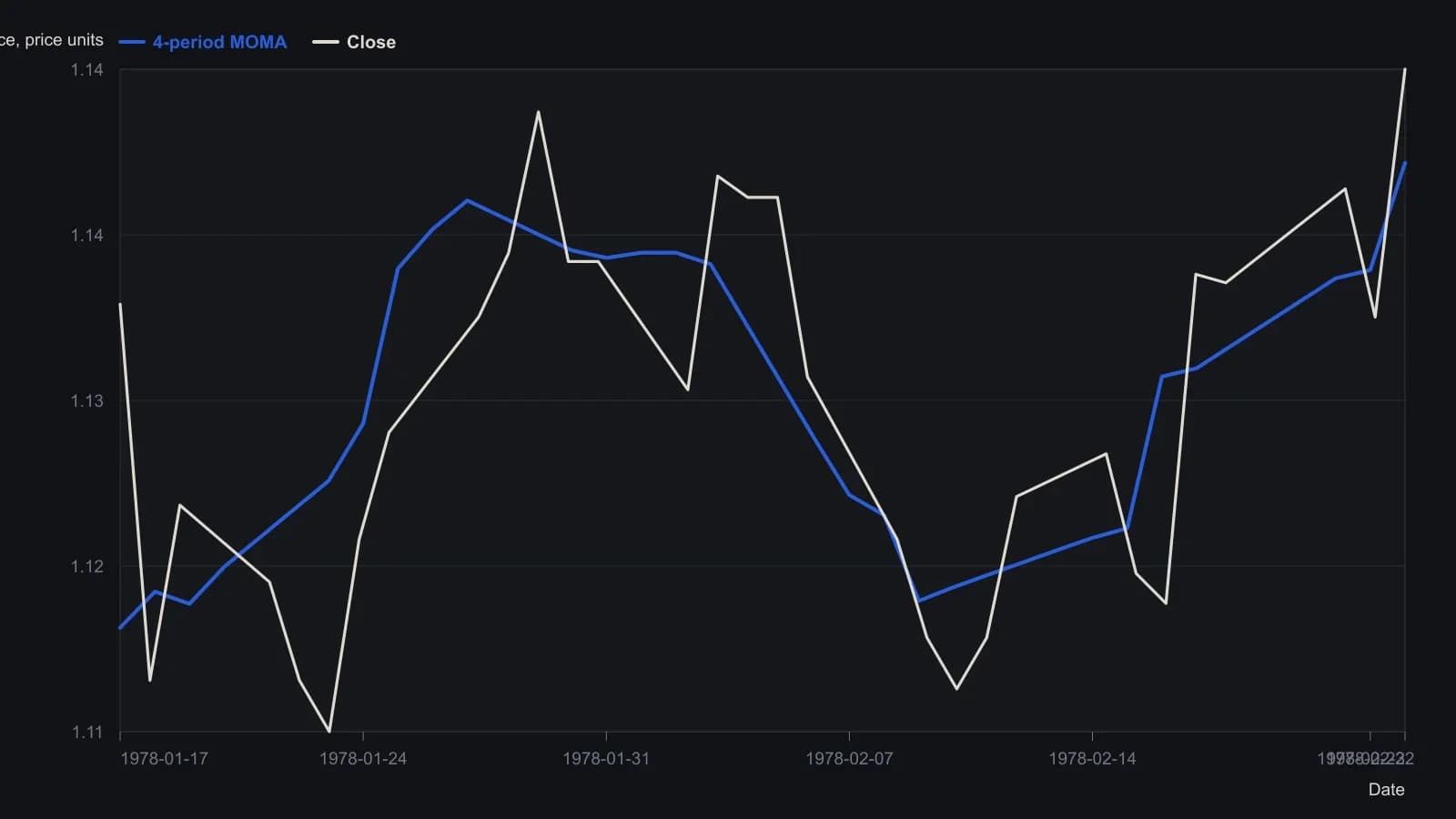
Four-period lookback as in cells F7 and G7: F is the sum of the last four absolute close-to-close changes; G weights each of the last four closes by that change’s share of F. The first four rows have no MOMA because the window is incomplete.
Why the weights follow the large move
The design premise is that a large move in one direction can precede further movement in that same direction. Under that premise, an observation funded by a larger absolute change receives more of the average than an observation funded by a smaller one.
Editorial interpretation: that is the step that turns a smoother into a next-interval forecast. The equal-weight baseline still only describes the path already seen. The move-adjusted average uses the same observations, but it lets the larger changes dominate the value that is carried forward.
All readings on this track · 15 readings
- 1990Building a percent-difference moving-average oscillator
- 1991Ease of movement oscillator construction
- 1993A twelve-month moving-average filter for inflation direction
- 1993Constructing two-endpoint JSA moving averages
- 1999Centered moving averages for trend construction
- 2000Constructing a slope-corrected moving average
- 2000Lookback length as a construction check for the modified moving average
- 2001Smoothing balance of market power with a moving average
- 2005Three-state moving-average directional breakout construction
- 2005Constructing a move-adjusted moving average
- 2005Moving-average construction: windows, weights and stops
- 2008Constructing stacked moving-average filters
- 2011Constructing percentage-offset moving-average bands
- 2015Linearity, commutation, and ratio smoothing in moving averages
- 2019Constructing a 50-200 sma-channel for swing entries and exits