2003issue C021-6
Zigzag target zones from a normalized deviation oscillator
A zigzag swing map and a lookback-normalized deviation oscillator can be paired so each completed move is split into early, mid-trend, and late target zones. Oscillator-bin transitions then record which zone is observed, turning the overlay into one inspectable procedure.
- A zigzag map isolates large or small swings by requiring a chosen minimum reversal before a new trend segment is drawn.
- The deviation oscillator is price minus a 40-bar exponential average, then scaled to a plus-or-minus 100 percent range with an 80-bar lookback.
- Each completed zig or zag is split into a first 20 percent for early positioning, a middle 60 percent for holding, and a last 20 percent for reducing or exiting.
- A correlation matrix records a target-zone observation each time the oscillator leaves one tenth of its range, split by rising versus falling paths.
Scale swings with a reversal threshold
A zigzag map isolates large or small price swings by requiring a chosen minimum reversal before a new trend segment is drawn. The same construction can be scaled to shorter or longer holding styles.
Editorial reading: TradersWeek treats that swing map as the move outline. The construction pairs it with a lookback-normalized price-versus-average oscillator so early, mid-trend, and late segments can be inspected as one testable procedure rather than as visual guesswork.
Normalize signed deviation against a lookback
The archive deviation oscillator is price minus a 40-bar exponential average, then scaled to a plus-or-minus 100 percent range. The 80-bar lookback is chosen as twice that average, or one implied cycle of the smoother.
Normalization divides the current signed deviation by the lookback maximum when the deviation is positive and by the absolute lookback minimum when it is negative, then multiplies by 100. Here z-score normalization means that lookback min-max scaling of signed deviation into a bounded percentage range, so the current oscillator level is compared against recent extremes.
Tutorial close versus the 40-bar EMA used to build raw deviation
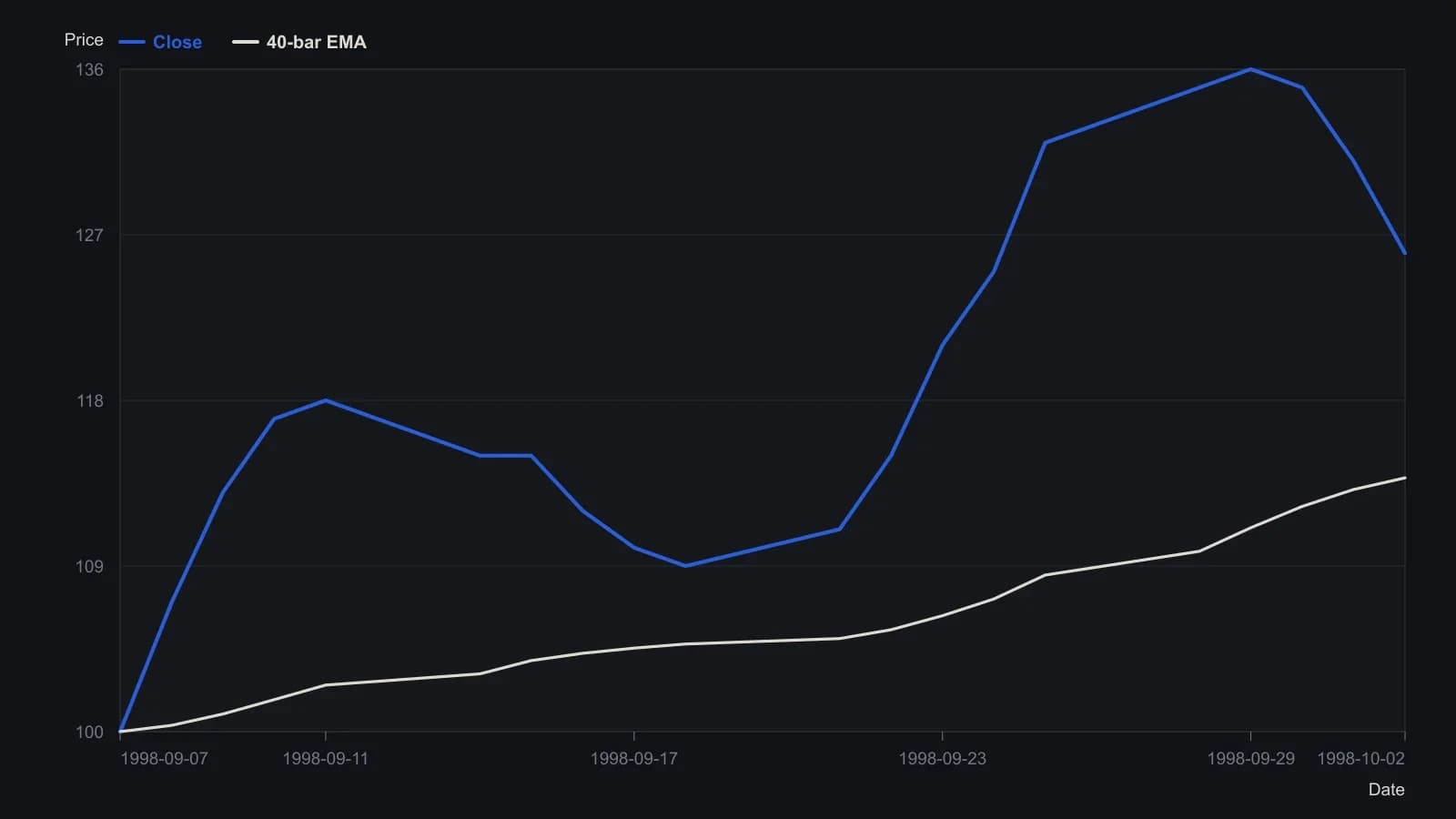
Exponential factor is 2/(40+1). The normalised-deviation column is still empty because the 80-bar lookback has not filled.
Split each completed move into target zones
Each completed zig or zag is split into three target zones: a first 20 percent of the move for early positioning, a middle 60 percent for holding, and a last 20 percent for reducing or exiting. The zone width can be widened up to a 50 percent half-and-half split.
The worked example defines swings with an 8 percent zigzag threshold and labels upward segments B2, Long, and S1 and downward segments S2, Short, and B1. The momentum strategy is the combined entry, hold, and exit procedure that treats those three zigzag segments as one rule set rather than as separate discretionary calls.
Match oscillator bins to zone counts
A correlation matrix bins the oscillator into 11 tenths of the plus-or-minus 100 range, records a zone observation each time the oscillator leaves one bin for another, and splits those transitions into rising versus falling paths.
Linear regression, in this workflow, is the quantitative pairing of oscillator bins with zone counts. It is used to inspect which zone is more frequent given an indicator value.
Decreasing-deviation observations in the archive
On a multi-decade S&P 500 history the oscillator crossed between its positive and negative extremes about 200 times. The archive treats a longer sample of swings as more reliable than a short one.
In the decreasing-deviation half of the matrix, values still above minus 20 favored further price advances, the minus-20 to minus-40 band was mixed, and values below minus 40 favored downward moves by about two to one.
All readings on this track · 11 readings
- 1991Constructing standardized sentiment trend filters
- 1995Market z-score residuals for style pair construction
- 1995Constructing scaled z-score normalization for model inputs
- 1996Normalize price and volume onto a common scale
- 2001Constructing pair spreads with z-score triggers
- 2003Rebuilding band distance as a z-score crossover
- 2003Constructing price z-scores with dual averages and bands
- 2003Zigzag target zones from a normalized deviation oscillator
- 2005Constructing a z-score scored range-breakout filter
- 2006Constructing a trend system from Bollinger Bands and z-scores
- 2011How an adjustable-bands z-test resizes the no-trade zone