1987issue C031-6
Evaluating silver moving averages and RSI by scoring rule
A historical silver evaluation ranked moving-average and relative-strength-index rules only after a lookback grid and a single optimization criterion were named. The selected sets are incomplete without the trade counts, holding days, and market side that produced those rankings.
- Name the lookback grid of sampling windows and thresholds before any ranking is computed.
- Name the single optimization criterion used to pick one parameter set from that grid.
- Report how many trades, how many winners, and how many days the selected set stayed in the market.
- Name which side of the market produced the ranking, because only a few reported combinations showed any long-side net, and those totals were described as nearly negligible next to the short side.
What this evaluation records
Simulated trades used only the nearby contract of COMEX silver from 2 December 1980 through 1 December 1985. The nearby contract is the front listed silver futures month used for simulated fills, with a scheduled roll on the first trading day of the expiration month. The sample used the March, May, July, September, and December series, filled at the open, and charged a $100 commission per turn.
A moving average here is a lookback mean of ordered prices used as a crossover or stacked-average baseline whose short, long, or triple windows are searched as discrete combinations. The relative strength index is an oscillator on ordered closes whose lookback and buy and sell thresholds are treated as one rule set and scored under the same objectives as the averages.
Name the lookback grid
The lookback grid is the discrete set of sampling windows and thresholds enumerated before any ranking is computed. The two-average search tested 266 lookback pairs by stepping the short average from 2 to 15 days by one day and the long average from 6 to 60 days by three days. Relative-strength-index rules entered the same style of search as one combined lookback and buy and sell threshold set.
Name the scoring rule
System optimization is the procedure of scoring a complete entry, exit, and hold specification across a parameter grid and ranking combinations by one explicit objective. An optimization criterion is that single numeric objective, used to pick one parameter set from a grid.
Each indicator grid was optimized separately on five criteria: total net, short-side net, long-side net, average winning trade, and average losing trade.
Report the trades and the market side
On the total-net criterion, a 13-, 28-, and 48-day three-average rule was the reported top set among six indicator families. That set produced 36 trades, of which 21 were winners, and held positions on 1,236 of 1,260 tradable days.
On the average-winning-trade criterion, a 16-day relative strength index with a buy parameter of 4 and a sell parameter of 76 produced only three trades over the five-year window, two of them winners. A 6-day relative strength index setting produced only two trades in the same window, both winners, and was the reported selection when scoring by average losing trade.
Across the optimized indicator-and-parameter sets reported for those scoring rules, only five combinations showed any long-side net. Those long-side totals were described as nearly negligible compared with short-side results.
What the ranking does not settle
Editorial. The archive facts name grids, criteria, selected sets, trade counts, and market side. They do not say which optimization criterion a later reader should prefer.
Net P&L by silver indicator under the average-winning-trade rule
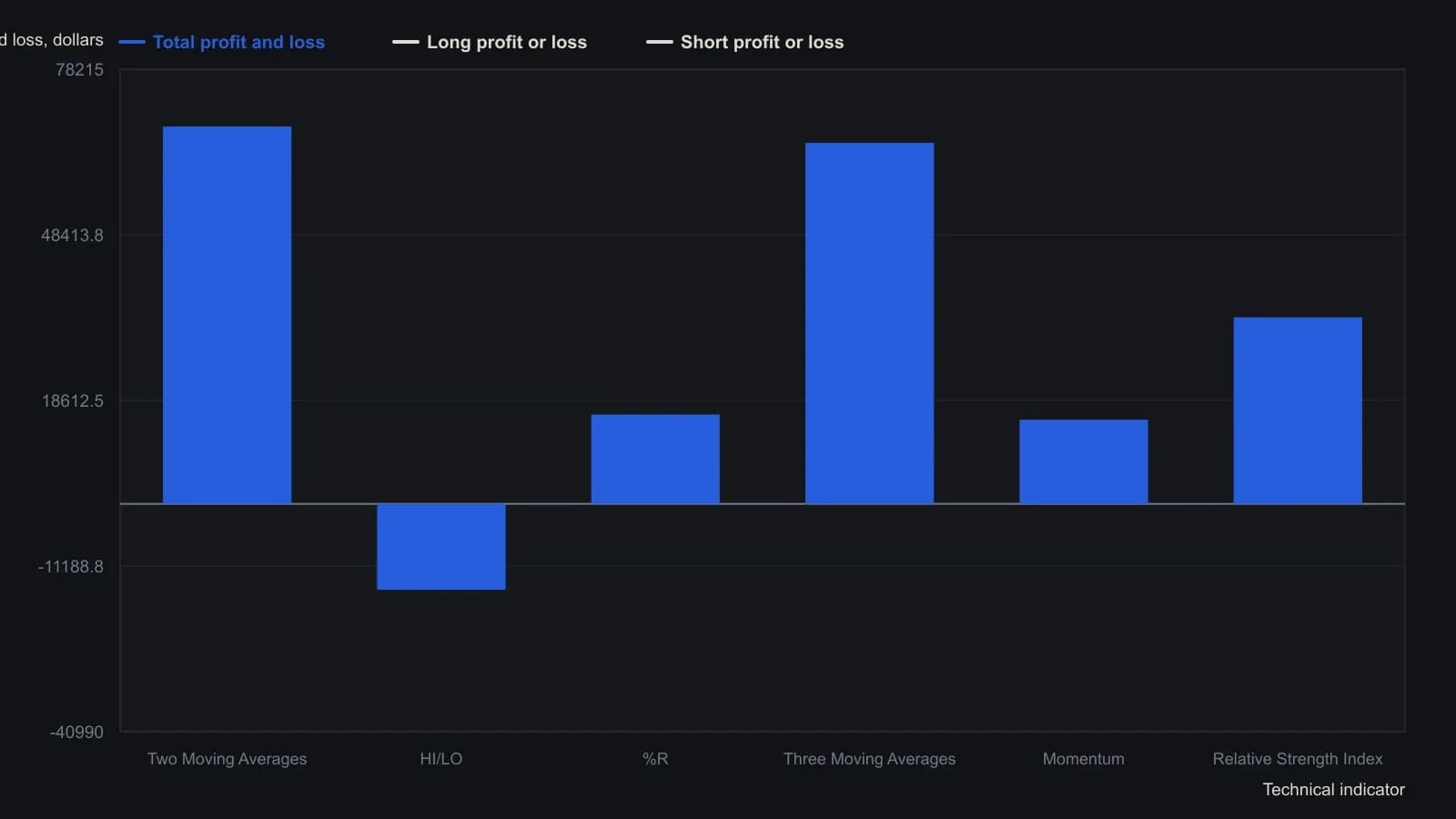
Each column is the single parameter set that maximized average winning trade on the lookback grid. Simulations used the nearby COMEX silver contract with rollover on the first trading day of the expiration month, fills at the open, and a $100 round-turn commission.
All readings on this track · 23 readings
- 1984Evaluating mechanical systems beyond net profit
- 1987Mechanical systems need more than pretty charts
- 1987Evaluating silver moving averages and RSI by scoring rule
- 1988Simple systems over optimized complexity
- 1988Cycle rule inputs until the parameter search stops
- 1990Split-sample tests for stochastic parameter grids
- 1993Four-subsystem trading system construction
- 1993Randomized price paths for stock system parameters
- 1994Mechanical timing with out-of-sample and filter checks
- 1995Evaluating asymmetric percent-reversal trading rules
- 1996Evaluating a daily volume-strength and new-high new-low timing procedure
- 1997Rule-based intraday system design with genetic search
- 1997Evolving three-rule systems with genetic templates
- 1997Audit the holdout and the exposure before the fitted entries
- 2001Inner weights are part of the candlestick signal
- 2003Mechanical short-term rules for news-sensitive rallies
- 2004Band construction as a testable trading procedure
- 2006Layered day-session automation from brackets to rules
- 2006Why mechanical rules must be retuned per security
- 2006A linear-regression next-bar forecast needs a searchable cutoff
- 2015Construct if-then rules, then backtest and optimize
- 2015Mechanical system design as a critique of discretion
- 2025Joint channel design with a trend filter and stop-loss orders