1998issue C011-5
T3 adaptive smoothing from regression benchmarks
A moving linear-regression window supplies two anchors for a smoother: ILRS, quieter with lag of half the window, and EPMA, zero-lag on linear input but noisier. T3 is assembled by replacing a simple average of those anchors with a volume-damped residual correction applied three times.
- ILRS and EPMA sit at opposite ends of the same regression window: one is smoother with lag of half the window, the other has zero lag on a linear input and more noise.
- IE/2 averages those anchors and still inherits endpoint noise. Twicing an exponential average produces DEMA, which cuts phase-lag while remaining about as noisy.
- Cascading DEMA or EPMA worsens overshoot because gain exceeds one. GD lowers the volume factor below one to damp that gain, at the cost of extra delay.
- T3 applies GD three times and is treated as an adaptive moving average that uses the exponential-average residual to track large moves more aggressively.
Start from one moving regression line
A moving-average is a low-pass smoother that averages ordered prices over a lookback to suppress high-frequency noise and expose trend. The construction begins with a moving linear-regression line of length n.
A simple moving average of length n is the midpoint of that line. ILRS, the integral of linear-regression slope, integrates the same line's slope. ILRS is smoother than the simple average and still shares the same phase-lag of n/2 on a unit-slope line.
EPMA, the end-point moving average, is the last point on that line. It has zero lag on linear input and tracks the series more tightly than a simple or exponential average of the same length. It is noisier than ILRS and more prone to overshoot.
A midpoint compromise still carries endpoint noise
Averaging ILRS(n) with EPMA(n) produces IE/2. That compromise smoother has phase-lag of n/4 and still inherits substantial noise from EPMA.
Hewlett-Packard with 15-bar EPMA, IE/2 and ILRS
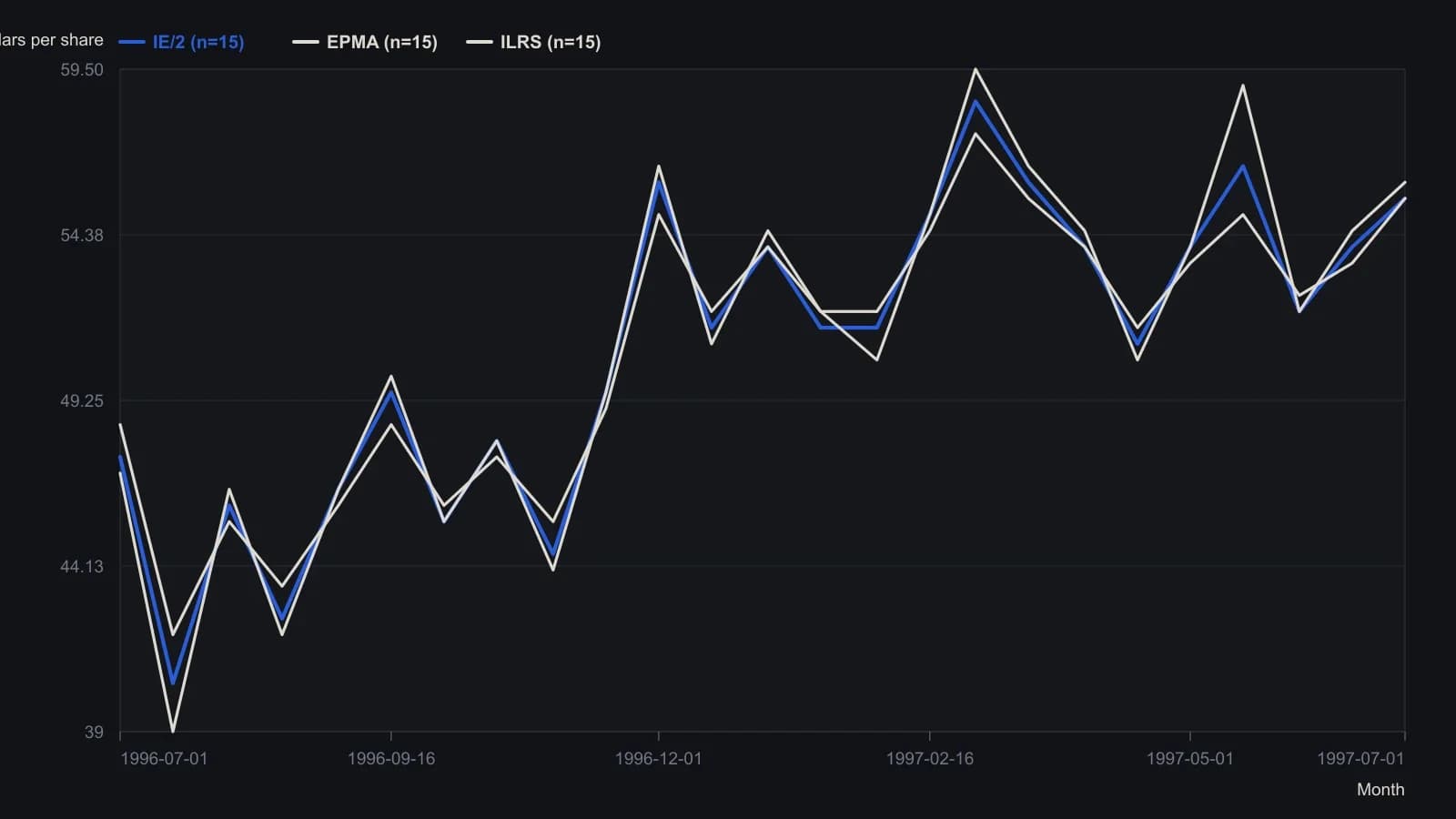
All three averages use the source window n = 15. Digitized from the raster; turning points are good to about half a price point.
Twicing cuts lag without quieting the filter
Twicing a low-pass operator L yields 2L minus L of L. That residual-correction construction is identified as DEMA, the double exponential moving average. DEMA reduces phase-lag relative to a single pass and remains comparably noisy to IE/2.
An n-day exponential average has smoothing constant 2/(n+1) and lag (n-1)/2. EMA(3) therefore lags by 1 day and EMA(11) by 5 days. Five successive EMA(3) passes are smoother than one EMA(11) at the same five-day lag. Cascading a quiet operator can improve smoothness at a fixed delay.
Repeated high-gain filters overshoot
Repeating DEMA or EPMA three times worsens overshoot. Those filters have amplitude response greater than 1 at some frequencies, so cascaded gain exceeds 1. Overshoot is the tendency of such a filter to run past the series when it is applied to its own output.
A volume factor lets the cascade stay smooth
GD, generalized DEMA, interpolates between an exponential average when the volume factor v equals 0 and DEMA when v equals 1. Setting v below 1 reduces the overshoot of cascaded DEMA at the cost of extra phase delay.
T3(n) is defined as GD applied three times. The archive describes that six-pole construction as a nonlinear Kalman filter. A Kalman filter is a recursive smoother that uses the residual between the series and its current estimate to correct the next estimate. In this setting T3 is an adaptive moving average: it tracks large moves more aggressively by feeding the residual from the exponential average back into the filter.
The stated construction goal
On a chart comparison, T3(6) sits near IE/2(15) and DEMA while appearing smoother than both. That appearance was the stated construction goal.
All readings on this track · 5 readings
- 1998T3 adaptive smoothing from regression benchmarks
- 1999Lagged trend filters for neural-network inputs
- 2006Linear forecast versus buy-and-hold when price changes cluster
- 2010Treat a market as a transfer device before completing a price path
- 2018Constructing predictive filters with RSI and walk-forward tests