1996issue C071
Smoothed alpha from paired log-change regression
Two aligned daily close series are restated as log-changes. A nine-observation linear-regression keeps only its intercept, and a 12-period simple moving average turns that intercept into the finished indicator.
- The build starts from two aligned daily close series that are each restated as log-changes before any regression is run.
- The unsmoothed reading is the y-intercept of a short linear-regression of one log-change series on the other. Slope and extra statistical output are discarded.
- The alpha-coefficient is that intercept treated as a raw residual. A later moving-average of those intercepts is a separate step.
- Editorial reading: keep the intercept choice and the smoothing choice separate when the series is rebuilt.
Aligned closes become log-changes
The build begins with two aligned daily close series, one Treasury bond futures series and one chemical-sector equity-fund series. Each series is converted into a log-change, the natural logarithm of the ratio of consecutive closes. Those log-changes are the observations that enter the regression for each series.
A short regression emits only its intercept
The unsmoothed series is the intercept from a linear-regression of one of those log-change series on the other over a short lookback. Linear-regression here is a short-window fit of one ordered log-change series on the other, used only so its constant term can be read out as a residual.
The worked layout retrieves only that intercept and discards the rest of the regression output. The regression in the worked example is specified to include a constant term and to omit extra statistical output. The lookback uses nine consecutive log-change observations.
The alpha-coefficient is that y-intercept: the constant term isolated from the regression so slope and extra diagnostics are discarded, then treated as the unsmoothed indicator before the averaging step.
A later average finishes the indicator
A moving-average is applied after the intercept has been isolated. The moving-average is a simple average of a fixed number of prior intercept values that turns the raw residual into a smoother indicator series. A 12-period simple moving average of the intercept series is the final smoothing step that produces the indicator.
Nine-day alpha intercept and its 12-day average
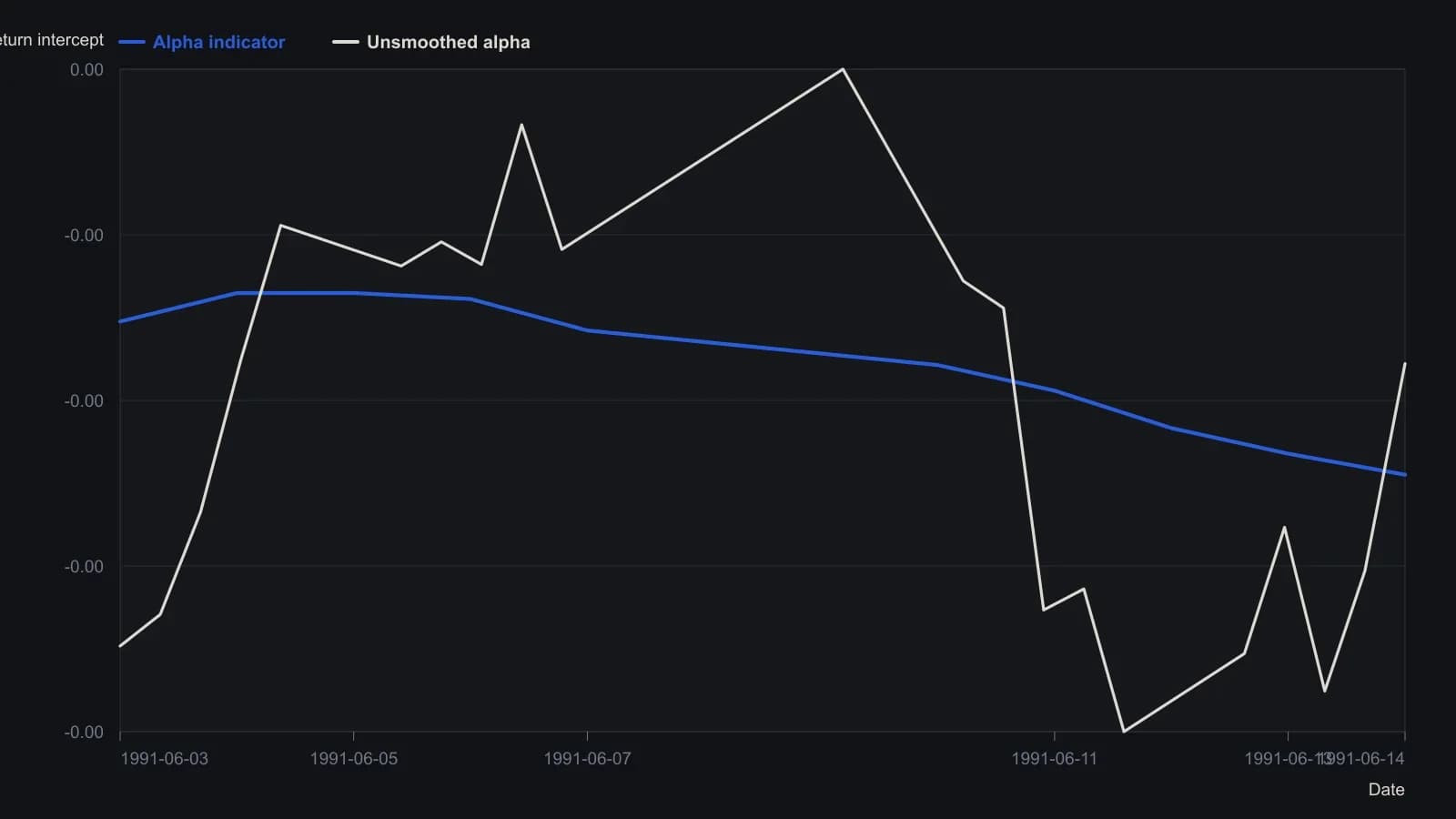
Each intercept is the y-intercept only from a 9-observation LINEST of T-bond log-changes on FSCHX log-changes. The finished reading is a 12-period simple average of that intercept, so it first appears on 3 June 1991.