2007issue C011-4
Directional movement as a filter plus trigger
Directional movement is a 0-to-100 screen for how one-sided recent price travel has been. Split the family by job: the average directional index decides whether a trend model is in play, the plus and minus directional lines vote for side, and the extreme-point rule waits for price follow-through so a line cross is not automatically an order.
- Directional movement scores how one-sided recent price travel has been on a 0-to-100 scale, so a trend-following method can stay with high readings and a method built for choppy markets can stay with low readings.
- Use the average directional index as a trend-presence filter: it rises as the spread between the plus and minus directional lines widens, and a turn-up from a low reading can mark a market leaving a lull.
- Treat a rise of the plus directional line through the minus directional line as a long-side vote and the opposite cross as a short-side vote, then wait for the extreme-point rule before the cross becomes a trade.
- An average directional index cross of the lower directional line can confirm an earlier directional-line vote, with entry optionally delayed to a later pullback or bounce.
A three-job stack
TradersWeek editorial: directional movement is easier to handle when it is treated as a three-job stack rather than a single buy-or-sell line. Use the average directional index to decide whether a trend model is even in play. Use the plus directional line and the minus directional line only to vote for side. Delay action until an extreme-point price trigger confirms follow-through. Combining those jobs inside one indicator family is how every line cross is kept from becoming an order.
Directional movement can be scored from 0 to 100. A trend-following method can restrict attention to high readings, while a method built for choppy markets can restrict attention to low readings.
The same directional-movement family is commonly used as a screen for whether a tradable trend is present, rather than as a standalone buy-or-sell switch.
The average directional index as a trend-presence filter
The average directional index is the spread between the two directional lines. It rises when that spread widens and is then read as a reason to follow the higher line with a trend-following method.
A falling average directional index, produced as the spread between the directional lines narrows, is read as the dominant side losing strength while the weaker side gains.
A trend-presence filter uses a low or falling average directional index to mark a lull, and a turn-up through the lower directional line to mark a market leaving that lull.
One complementary rule looks for the average directional index to turn up from a low reading, preferably below 20, and then cross the lower directional line as evidence that a forceful trend is forming.
Another stated alert, the four-step advance, looks for the average directional index to remain below both directional lines and then rise four steps from that low. That sequence is interpreted as a market leaving a lull.
Directional lines vote for side
A standard directional-line rule treats a rise of the plus directional line through the minus directional line as a long-side signal and the opposite cross as a short-side signal.
TradersWeek editorial: those crosses are side votes. They are not, by themselves, implementation instructions.
The extreme-point rule as the later trigger
The extreme-point rule notes the high of the day the plus directional line crosses above the minus directional line, or the low of the day the plus directional line crosses below it, and uses that price as the later trigger so fewer crosses become trades.
Dow 30 daily path through the May–July 2006 DI-line shorts
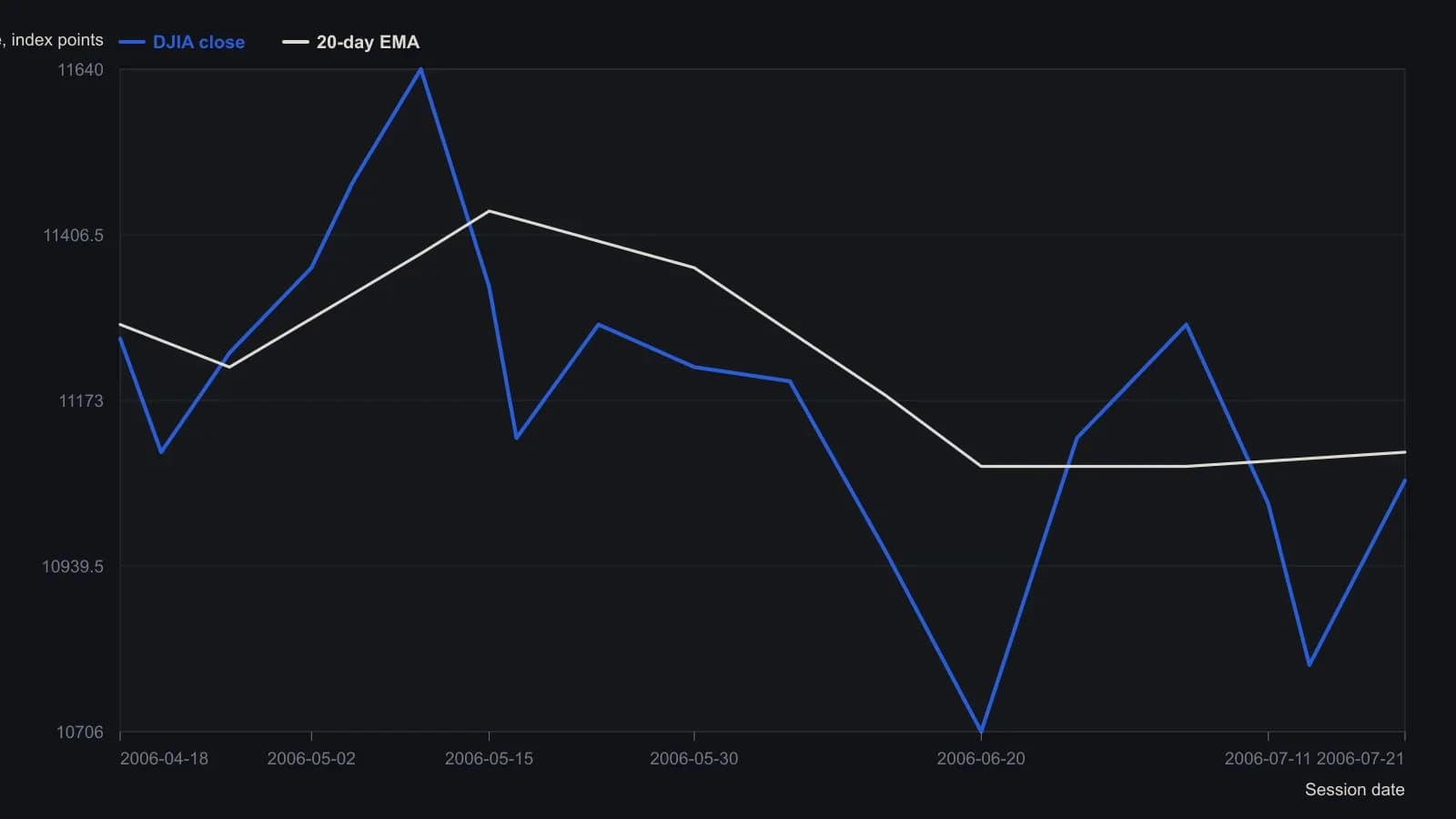
Daily candles. Only the price path and 20-day EMA were digitized from the upper pane; the 14-period DMI pane was not resampled. 11333 is the article’s own approximation for the 15 May low. Digitised closes are rounded to about 20 index points, which is the resolution the raster will bear.
Confirmation versus entry
In a worked composite-index example, an average directional index cross of the lower directional line was treated as confirmation of an earlier directional-line crossover, with the option to wait for a later pullback or bounce instead of acting on the confirmation print.
That is confirmation versus entry: the average directional index cross checks an earlier directional-line vote, while actual entry can be postponed to a later pullback or bounce.
The same directional-system readings can first scan indexes or sector products for a low average directional index or a fresh directional signal, then be followed by closer inspection of constituents or by unrelated price-structure setups.
All readings on this track · 56 readings
- 1986Cycle-aligned directional trend indicator
- 1987What crossover and directional entry rules actually compare
- 1988A directional-line cross needs a trend filter, an extreme-point rule, and a dollar stop
- 1988Constructing true range by offset addressing
- 1988Constructing directional movement from bar range
- 1988Average directional index construction: recursive smoothing and lookback offset
- 1988Staged Average Directional Index construction with Relative Strength Index confirmation and stop alerts
- 1988Average Directional Index construction with frozen true range and directional rules
- 1991Constructing the average directional index from range expansion and true range
- 1991Constructing five-session forecasts from stochastic, ADX, and MACD inputs
- 1993Constructing the average directional index from directional movement and true range
- 1993Confirming n-bar breakouts with ADX and DX filters
- 1994Constructing a Bollinger band-width trend filter
- 1994A pre-trade checklist that can refuse a long three ways
- 1997An ADX threshold and a moving average as a trend filter
- 1998Regime filters for mutated indicators
- 1999Building the average directional index from range extension and true range
- 2000Evaluating ADX, RSI, and moving averages in a multi-stock warehouse
- 2000Stochastic pop as a filtered continuation setup
- 2000Onset and exit from one average directional index
- 2002Joint ADX and MACD readout for trend strength and direction
- 2003Adaptive Donchian breakout with implied volatility and volume
- 2004The average directional index as a regime gate for the relative strength index and the stochastic oscillator
- 2004Constructing true-range-specified volume as a directional filter
- 2005Constructing a multi-filter penny stock breakout procedure
- 2005Construct one playbook that flips with session regime
- 2005Combining Bollinger Bands, the average directional index, and Fibonacci retracement on currency pairs
- 2006Assembling an adaptive price zone from double-smoothed averages
- 2006An ADX strength gate for MACD and the stochastic oscillator
- 2007Directional movement as a filter plus trigger
- 2007Constructing a veto-first trend permission stack
- 2007ADX gates for trend end, range, and reversal
- 2008Constructing a nine-cell directional-ratio grid
- 2008Average directional index and directional trend indicator lookbacks as trend-filter parameters
- 2008A holding-matched market lens from averages and directional-line crosses
- 2008A nine-cell directional scoreboard for multi-horizon entries
- 2010Building a Vortex Indicator from high-low distances
- 2010Constructing ADX, RSI, and MACD price filters
- 2011Constructing a volume zone oscillator with a moving-average and Average Directional Index regime filter
- 2011A volume zone oscillator conditioned by an Average Directional Index filter
- 2011Candlestick names need volume-price, ADX, and moving-average checks
- 2012Clustered average-directional-index traces as a trend-start filter
- 2012Average Directional Index cluster filters for trend-start signals
- 2012Confirming a trend start or turn with a triple ADX cluster
- 2013Constructing a late-entry stack from a signed DMI oscillator
- 2013A directional oscillator and its stochastic as a stacked timing filter
- 2013ADX cluster lookbacks are a locked specification, not a chart label
- 2013Combining moving averages, stochastics, and ADX in a daily scan
- 2015Assembling the Average Directional Index from directional movement
- 2016How an Average Directional Index filter and a breakout entry form one procedure
- 2016Score RSI and stochastic crossings only when ADX confirms the trend
- 2018Constructing an ADX filter for intraday breakouts
- 2018An ADX volatility gate for prior-day breakouts
- 2019Exponential deviation bands with a moving average, RSI and ADX
- 2020A normalized-slope trend filter from linear regression
- 2020Gating volatility-momentum divergences with a Trend filter