2001issue C061-4
An elastic volume-weighted moving average from a share-count lookback
The archive replaces a calendar-length volume-weighted window with a share-count lookback. It keeps an elastic volume-weighted moving average by recursively swapping a volume-sized slice of a float parameter, valued at the prior mean, for the newest price.
- A calendar-length volume-weighted average drops every observation older than a fixed bar count even when later volume still implies those prints belong in the average.
- A share-count lookback sets the window by a float parameter N, chosen near the volume typically printed over K bars and well below total shares outstanding, rather than by a fixed number of calendar bars.
- The elastic volume-weighted moving average replaces a volume-sized slice of that budget, assumed paid at the prior average, with the new price, so high-volume bars pull the series and low-volume declines leave it nearly unchanged.
- The same paid-price distribution used to justify the mean update can be reused to construct companion statistics such as standard deviation, moments, or kurtosis.
Calendar length versus a share-count lookback
A calendar-length volume-weighted average drops every observation older than a fixed bar count even when later volume still implies those prints belong in the average. An N-volume construction sets the window by a fixed share total rather than by K bars, with N chosen near the volume typically printed over those K periods.
The float parameter
N is set well below total shares outstanding because a large block of stock is often locked, and that choice controls sensitivity the way period length does in a K-bar average. In this construction the chosen share budget is the float parameter: a smaller budget makes the recurrence react faster, analogous to shortening a calendar window. The window itself is a share-count lookback, defined by a fixed quantity of shares rather than by a fixed number of calendar bars.
The elastic volume-weighted moving average
A hard N-volume window still forgets prices once cumulative volume exceeds N, so a recursive elastic update is introduced to keep a running approximation instead of truncating a tail. The elastic volume-weighted moving average updates after each trade or bar by replacing a volume-sized slice of that share budget, valued at the prior average, with the new price. The update assumes sellers of the next volume v paid the prior average and replaces that slice of a share budget N at the new price p by taking the prior value times N minus v, plus v times p, then dividing by N.
A worked path of prints
Starting from 1,000 shares issued at 10, successive prints of 100 at 15, 200 at 20, and 100 at 25 yield approximated paid averages of 10.50, 12.40, and 13.66 under that seller-paid-the-prior-mean assumption.
Seeding from daily close and volume
When trade-level prints are missing, daily close and daily volume can be treated as one aggregated trade and the recurrence can be seeded with that day's price.
Volume-backed jumps and low-volume undershoots
High-volume bars pull the elastic series toward the current price, while price declines that print little volume leave the series nearly unchanged. A 20-bar unweighted average can take 12 to 20 bars to absorb a volume-backed jump and can later show a delayed bump, on the order of 10 bars, after a low-volume undershoot that the elastic update barely records.
Companion statistics
The same paid-price distribution used to justify the mean update can be reused to construct companion statistics such as standard deviation, moments, or kurtosis.
Direktanlagebank close against the elastic VWMA
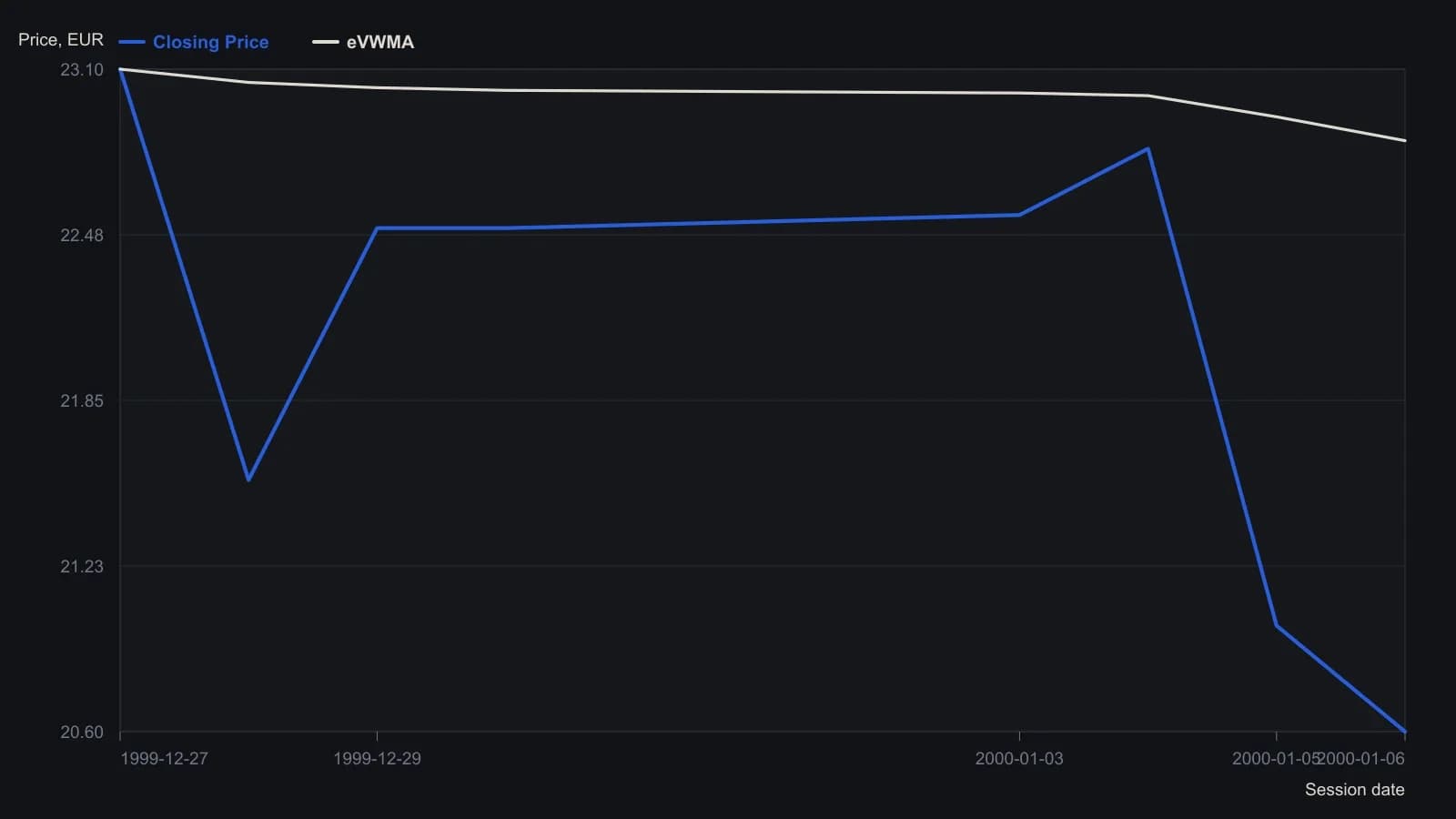
Float parameter N is fixed at 565,000 shares, one percent of the 56.5 million share count. The 20-session simple average is omitted because that window has not yet filled.
All readings on this track · 18 readings
- 2000Volume-weighted average price as a baseline for indicator construction
- 2001Constructing VWAP support and resistance from cumulative volume
- 2001An elastic volume-weighted moving average from a share-count lookback
- 2001Constructing an elastic volume-weighted average and volatility bands
- 2004Volume-weighted column averages and crossovers on point-and-figure charts
- 2004Session volume-weighted average for limit placement and listed routing
- 2008Building MIDAS curves from an anchored volume-weighted average
- 2008Construct a launch-point VWAP as support and resistance filters
- 2014Workstation order routing, VWAP, and session filters
- 2015Constructing price gravity and float turnover filters
- 2015Constructing four-stage cycles with anchored VWAP
- 2017Constructing a volume-weighted crossover and breakout as one swing rule set
- 2017Constructing a volume-weighted moving-average crossover
- 2017Constructing anchored volume-weighted average price maps for crowd-visible execution costs
- 2018Order book heatmaps, VWAP, and flow for execution
- 2018Constructing futures rolls ahead of first notice day
- 2019Evaluate a mechanical futures system as one procedure
- 2020Every bounce is a falsifiable regime test