1993issue C101-2
Constructing equal, linear and exponential moving averages
One five-price window is used to write an equal-weight mean, a rising-integer weighted mean, and a recursive smoother as rebuildable forecast baselines. A change-share construction on the same window reduces to the midpoint of the first and last prices.
- A simple moving average is the sum of the prices inside a lookback of n observations, divided by n. On the five-price window 0, 8, 9, 10, 15, that equal-weight construction equals 8.40.
- A linear weighted moving average assigns weight 1 to the oldest price, increases the weight by one on each newer price until the newest price receives weight n, then divides the weighted sum by the sum of the weights. On that same window the linear weighting equals 10.53.
- An exponential smoother sets the newest-price share to two divided by one plus the lookback. For a five-observation lookback that share is 0.333; combining it with latest price 15 and previous smoother 8.3 produces 10.53.
- A change-share construction weights each day's price increment by that increment's fraction of the net move from the first price to the last price. After those increments offset, the result equals the midpoint of the first and last prices, which is 7.50 when those prices are 0 and 15.
One short ordered price window
Editorial: treat one short ordered price window as a construction bench. Write the equal-weight mean, the rising-integer weighted mean, and the recursive smoother side by side so each line is an explicit forecast baseline a reader can rebuild before any later comparison.
The lookback is the observation count that sets the averaging window or the exponential newest-price share. The constructions below all use a five-observation lookback on the ordered prices 0, 8, 9, 10, 15.
Equal-weight mean
A moving average is the equal-weight mean of a fixed count of ordered prices. A simple moving average is the sum of the prices inside a lookback of n observations, divided by n.
On the five-price window 0, 8, 9, 10, 15, that equal-weight construction equals 8.40.
Rising-integer weighted mean
A weighted moving average is a mean that gives later prices larger integer weights and divides the weighted sum by the sum of those weights. A linear weighted moving average assigns weight 1 to the oldest price, increases the weight by one on each newer price until the newest price receives weight n, then divides the weighted sum by the sum of the weights.
On that same five-price window, the linear weighting equals 10.53.
Recursive newest-price blend
Exponential smoothing is a recursive blend of the latest price with the previous smoothed value, using a newest-price share set from the lookback length. The smoothing constant is the share applied to the newest price in an exponential update, equal to two divided by one plus the lookback.
An exponential smoother sets the newest-price share to 2 divided by one plus the lookback length, then combines that share times the latest price with one minus that share times the previous smoother.
For a five-observation lookback the newest-price share is 0.333; combining it with latest price 15 and previous smoother 8.3 produces 10.53.
Change-share line on the same window
A change-share average is a construction that weights each interval by its share of the net first-to-last price change and reduces to the midpoint of those two prices. A change-share construction weights each day's price increment by that increment's fraction of the net move from the first price to the last price, then multiplies by the average of the two adjacent prices in the interval.
After those increments offset, the change-share construction equals the midpoint of the first and last prices; with first price 0 and last price 15 that midpoint is 7.50.
Day-5 SMA, LMA, EMA and JSA on one five-price window
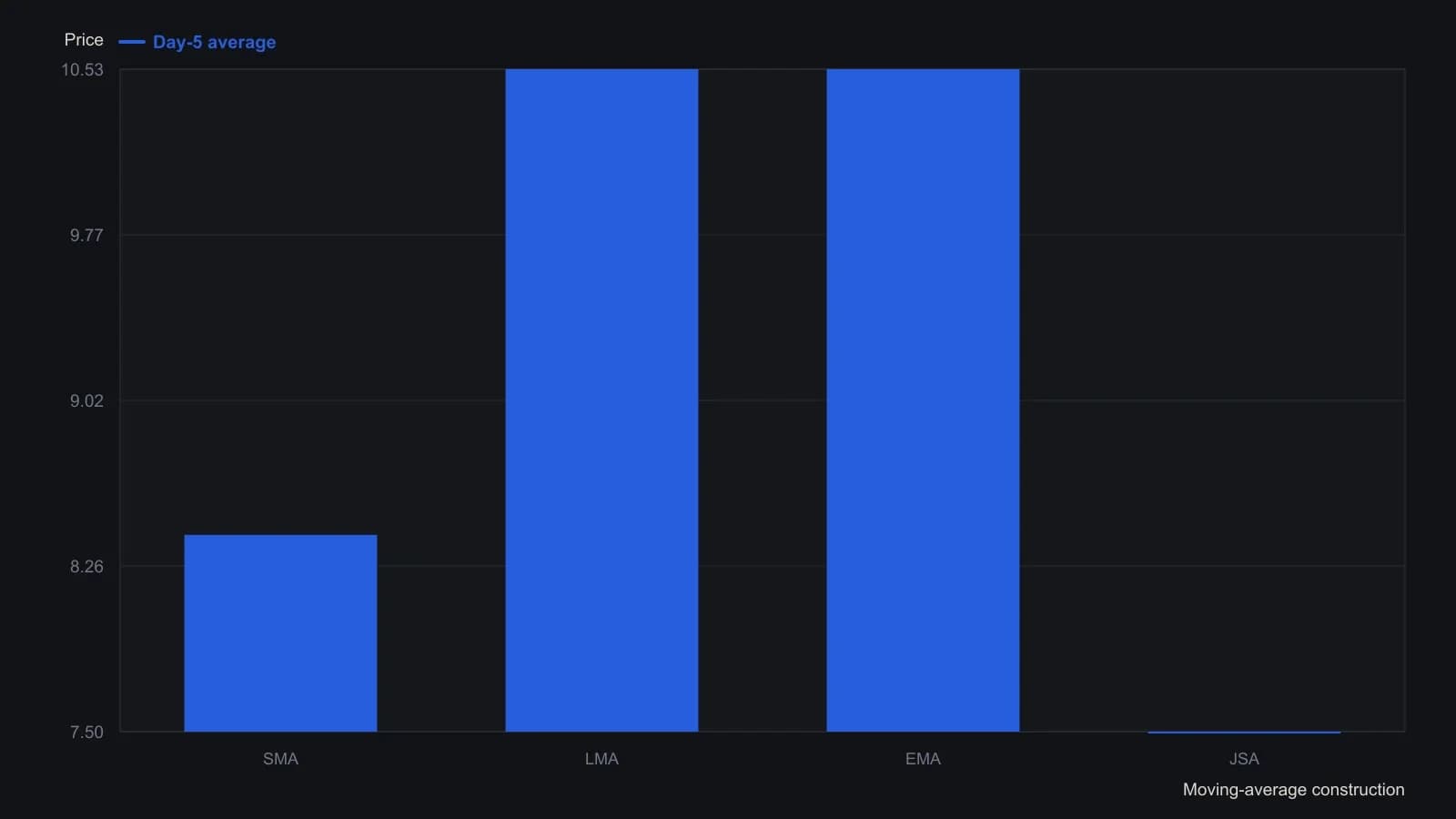
Window length n = 5. EMA uses a = 2/(n+1) ≈ 0.333 and the sidebar’s prior-day EMA of 8.3. LMA and EMA coincide only on this Day-5 snapshot.
All readings on this track · 20 readings
- 1988Indicator smoothing: lookback, weight, and scale
- 1990Recency weighting in simple, linear, and exponential moving averages
- 1990Seed and recurrence construction for moving averages
- 1990Constructing a five-day step-weighted moving average
- 1992Constructing simple, weighted, and exponential moving averages
- 1992Constructing moving averages with weighting schemes and extra filters
- 1992Constructing a weighted-average TRIN10 with Bollinger envelopes
- 1992Constructing a banded weighted open-TRIN oscillator
- 1993Evaluating a weighted dual rate-of-change momentum filter
- 1993Constructing equal, linear and exponential moving averages
- 1993Constructing a general weighted moving average from one exponent
- 1993Calibrating the weighted-moving-average exponent
- 1993Constructing an exponent-weighted average of put-call ratios
- 1994Cycle-tuned momentum with spectral peaks
- 1999How a five-bar sine-weighted average is assembled
- 2003Same-scale trend filter from a rolling least-squares endpoint
- 2003How a rolling linear-regression endpoint is assembled as a moving-trend
- 2004Constructing a volume-weighted moving average as a forecast baseline
- 2005Constructing a move, volume and recency weighted average
- 2016MACD as a zero-line filter with dual moving averages