2015issue C1048-54
Money flow oscillator construction from volume pressure
A construction lesson on assembling a signed volume multiplier from consecutive bar ranges, then reading zero-line persistence and price-oscillator disagreement as separate hypotheses.
- The money flow oscillator is a lookback-period ratio of signed money-flow volume to volume, intended as an alternative measure of buying and selling pressure.
- The signed multiplier is taken from consecutive-bar high and low ranges, with a zero-range guard before division.
- Archive code uses a confirm-bars stay on one side of zero, and a separate pairing of centerline position with price-oscillator divergence, as two different reading rules.
- The same pressure-measurement idea is reused as a function or study across charting platforms, taking volume from the bar when available.
How the signed multiplier is assembled
The money flow oscillator is constructed as a lookback-period ratio of signed money-flow volume to volume. It is intended as an alternative measure of buying and selling pressure.
The signed multiplier is derived from consecutive-bar high and low ranges. The construction compares the current high with the prior low, and the prior high with the current low, and it applies a zero-range guard before division.
A common platform default for the oscillator lookback is 20 bars, and the plotted series is shown against a zero reference line. A positive reading is described as buying pressure and a negative reading as selling pressure.
Zero-line persistence and oscillator disagreement
One coded strategy treats persistence above or below zero for a confirm-bars count, defaulting to 2, as the condition for a next-bar market entry.
Another construction combines centerline position with price-oscillator divergence. A bullish divergence plus a below-zero reading is used as a long setup, and a later cross above zero is the exit.
TradersWeek editorial view: the first rule asks whether the sign of pressure holds for a short confirm count. The second asks whether price and the oscillator disagree while the reading is still below zero, then uses a later zero cross as the exit. Those are independent claims about the same plotted series.
Daily DJIA money flow oscillator against Chaikin money flow
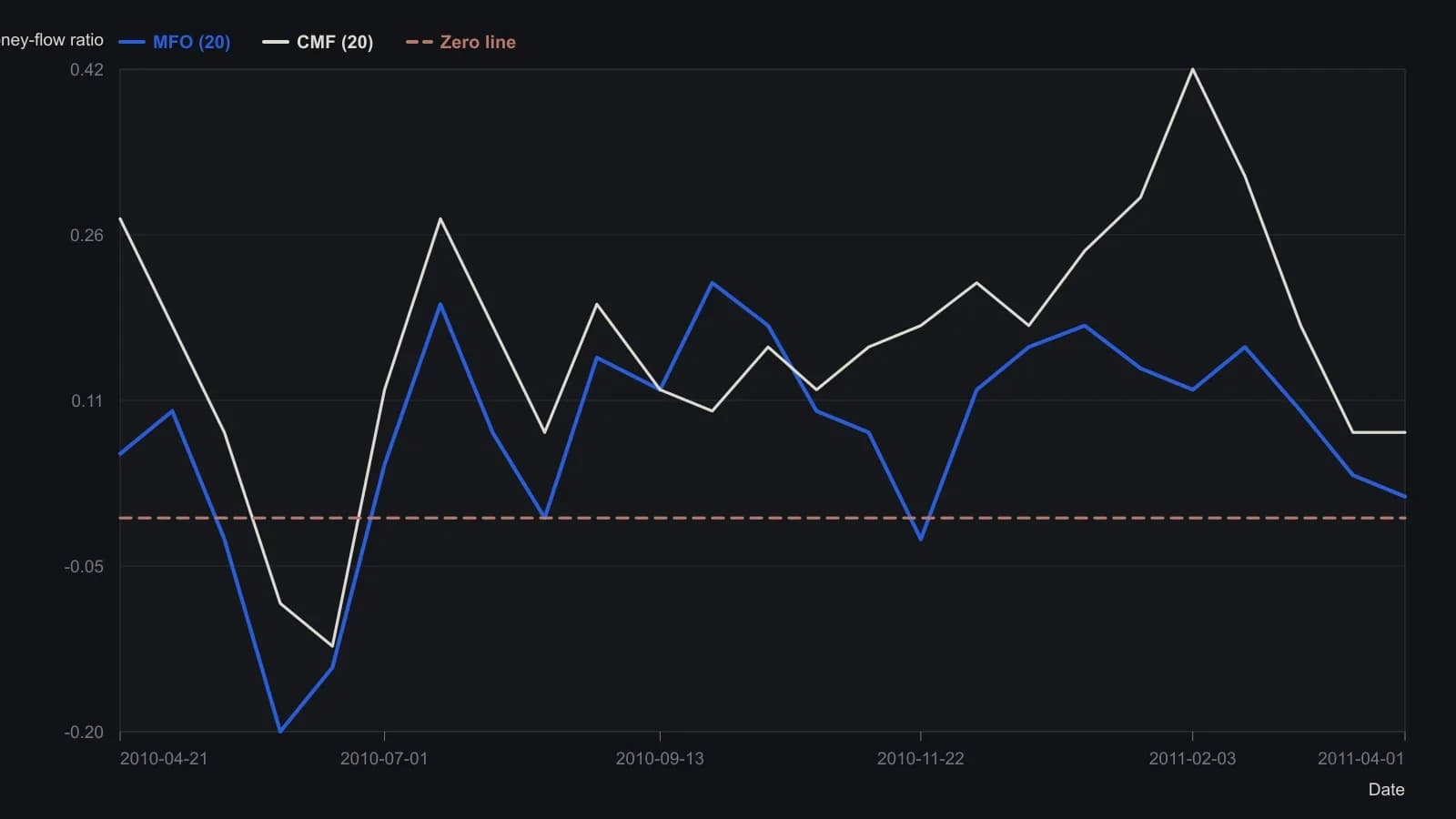
Both oscillators use a 20-session lookback on the Excel recreation of Apirine’s daily DJIA example (19 April 2010–1 April 2011). Readings are approximate; the raster resolves about 0.05 on a −0.4 to 0.6 scale.
Reuse on platforms and in spreadsheets
The same pressure-measurement idea is implemented as a reusable function or study across multiple charting platforms, with volume taken from the bar when available.
Spreadsheet reconstructions of the oscillator are presented as less sensitive to price gaps than some alternative pressure measures. In the illustrated windows they are also presented as remaining aligned with trending price stretches.
TradersWeek editorial note: this construction belongs with other pressure readings such as the Money Flow Index, the Chaikin oscillator, and On-balance volume. The archive describes the oscillator workflow, not a ranking or a substitution among those series.
All readings on this track · 9 readings
- 1992Fitting oscillator parameters to stock personality
- 1994Constructing the Chaikin oscillator from close-in-range volume
- 1994Constructing Chaikin money flow and a double-exponential smoother
- 1994A three-lock reversal drill: line, oscillator, and volume
- 2000Constructing a Chaikin oscillator from the accumulation-distribution line
- 2005Volume-spike alerts versus direction from follow-through
- 2014A 2014 research stack as a classroom for volume-flow hypotheses
- 2015Money flow oscillator construction from volume pressure
- 2017Small-cap swing entries that wait for accumulation and Chaikin to clear