1997issue C051-3
Constructing a short-rate-adjusted equity momentum filter
Build a rate-adjusted equity series by dividing a broad equity index by the three-month commercial-paper yield, put both legs through the same rate-of-change window, and treat pace divergence and the difference oscillator's zero line as the readings that have to stay falsifiable.
- Divide a broad equity index by the three-month commercial-paper yield to form the rate-adjusted equity series.
- Convert both the unadjusted index and the rate-adjusted series to a six-month moving average of a nine-month rate of change so their pace can be compared.
- Subtracting rate-adjusted momentum from equity-index momentum gives a difference oscillator whose zero-line crossings mark the same events as crossovers between the two series.
- The rate-adjusted series can decelerate before the index even when their turns coincide, and the equity-to-cash return ratio can stay flat while both short-term rates and equities rise.
Form the rate-adjusted equity series
A rate-adjusted equity series is built by dividing a broad equity index by the yield on three-month commercial paper. The short-rate overlay then sits in one line.
The construction assumes that turns in short-term interest rates tend to lead equity turning points. The rate-adjusted series is therefore intended to change direction before the unadjusted index.
From trendline breaks to a momentum comparison
A validated trendline break on the rate-adjusted series is read either as confirmation that an equity move is already underway or as a warning that one is about to start.
On a chart spanning almost 20 years, that reading produced only five signals, which is why a momentum comparison is offered as an alternative.
Compare pace with matched rate-of-change
Both the equity index and the rate-adjusted series are converted to a six-month moving average of a nine-month rate of change. That matched rate-of-change lets their pace be compared directly.
Subtracting rate-adjusted momentum from equity-index momentum produces a difference oscillator. Its zero-line crossings mark the same events as crossovers between the two momentum series.
Pace divergence can appear without a lead in the level
Even when the rate-adjusted series and the equity index turn at nearly the same time, the rate-adjusted series often decelerates sharply before the index. That pace divergence appeared around the 1987 peak.
The companion equity-to-cash return ratio
A companion context plot is the equity-to-cash return ratio, equity total return relative to the current cash yield. A rising reading means capital gain plus dividends are outrunning the current cash return.
When the 1976 equity peak arrived before the subsequent rate low, the difference oscillator crossed below zero nearer the 1978 trough than the 1976 peak.
During 1978 to 1979 both short-term rates and equities rose while the equity-to-cash return ratio stayed essentially flat, so the intermarket spread did not distinguish the two.
Money-flow momentum difference versus zero, 1980–1997
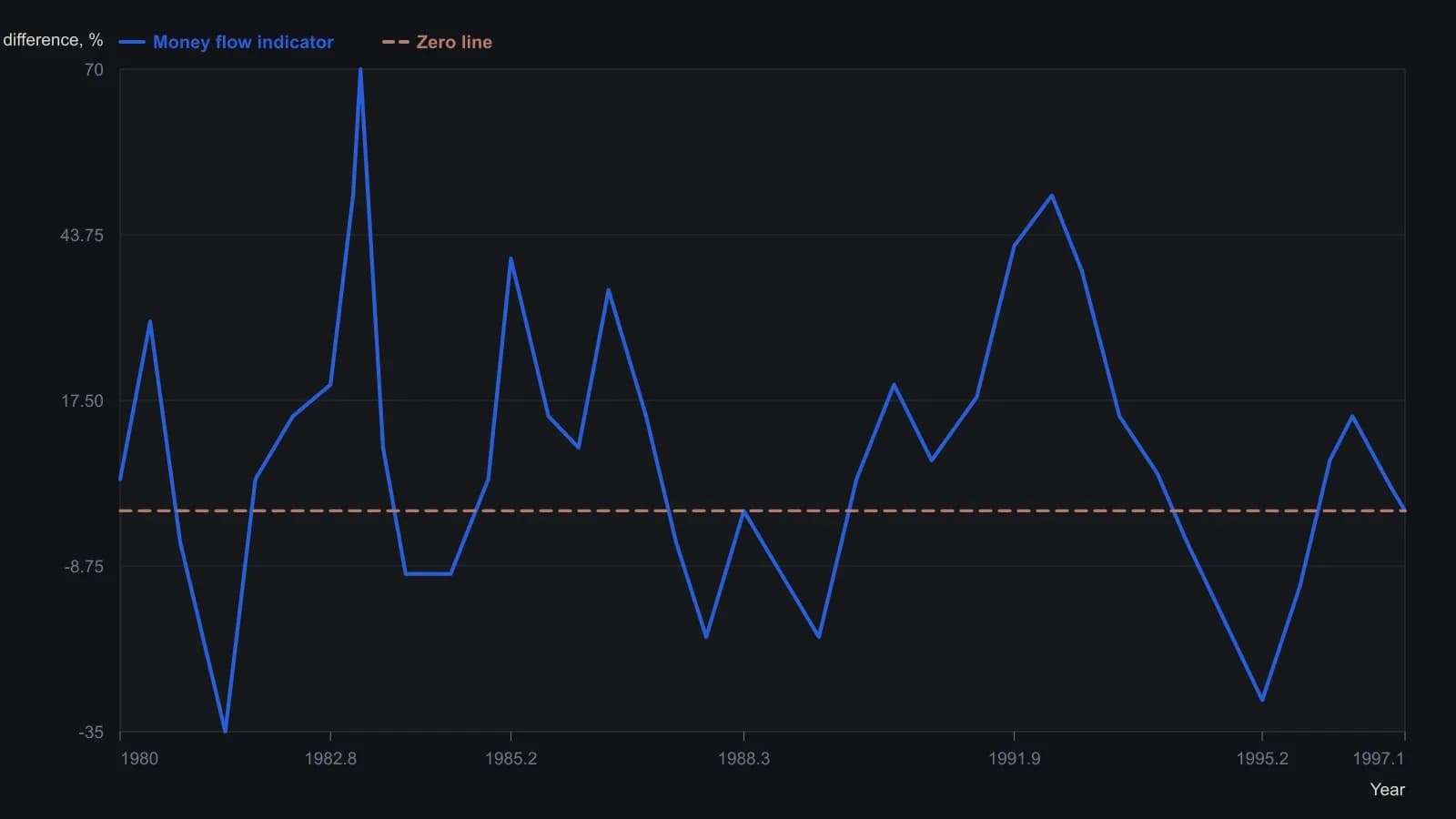
Each leg is a six-month moving average of a nine-month rate of change. Money flow is the S&P Composite divided by the three-month commercial-paper yield. The printed chart labels only 0 and 50 on this pane, so readings are approximate.
All readings on this track · 46 readings
- 1985Constructing excess and momentum difference-curve oscillators
- 1988Five reading rules for smoothed indicator charts
- 1989Momentum overlays that speed moving-average oscillators
- 1990A laboratory template that constructs Rate of Change as a pane module
- 1991Volume-scaled rate of change as a momentum construction
- 1991Three-indicator market overview from tape, sentiment and rates
- 1991Three-component trend model with rate-of-change filters
- 1992A KST oscillator from a weighted rate-of-change stack
- 1992Four-window weighted rate-of-change composite
- 1992Constructing multi-span smoothed rate-of-change filters
- 1992Constructing a four-horizon summed rate of change
- 1992Constructing KST from four weighted smoothed rates of change
- 1992Constructing a composite from weighted smoothed rates of change
- 1992Three-horizon KST maturity alignment
- 1992Construct a bond-led dividend-to-bond-yield regime first
- 1992Constructing relative-strength KST from weighted rate-of-change
- 1993Constructing a volume oscillator from average ratios and smoothed rate of change
- 1994Gold as a cycle clock for commodities and yields
- 1994Constructing a composite from weighted, smoothed rate-of-change windows
- 1994Constructing gold-mining rate-of-change tripwires for Treasury bonds
- 1994A capacity-stress checklist across commodities, bonds, and breadth
- 1994Rate of change parameters for testable entries
- 1994Constructing rate-of-change midpoints, lookbacks and divergence
- 1994Lead oscillator breaks need price trendline confirmation
- 1994Nested averages for an annual momentum curve
- 1994Evaluating a Coppock-style rate of change as a bottom-regime filter
- 1995A weighted eleven-month Dow rate of change as one testable timing procedure
- 1996Named lookbacks, thresholds, and streaks for entry rules
- 1997A midpoint rate-of-change test for bond trend follow-through
- 1997Constructing a short-rate-adjusted equity momentum filter
- 1998Daily momentum rank-churn as a portfolio-construction problem
- 1999Constructing a lagged rate of change cycle system
- 2000A triple delay line then a one-bar elliptic oscillator
- 2001Confirming rate of change divergences with price
- 2001Momentum trendline breaks need price confirmation
- 2001Market breadth, On-balance volume, and Rate of Change as a combined timing framework
- 2001Know Sure Thing with stacked horizons and trendline confirmation
- 2003Constructing a mechanical system from a rate of change condition
- 2003Constructing momentum from two closes and spotting divergence
- 2003Formula choice tilts which momentum mismatches count as divergences
- 2004RSI and momentum agreement as an asymmetric filter
- 2005Constructing price-normalized moving-slope hybrids
- 2005Unsigned speed gates on a fixed average-cross pair
- 2007Rebuilding rate of change as a path-weighted oscillator
- 2008Construct Special K so short-horizon signals stay inside the primary trend
- 2013Restore volume balance before adding another price-time indicator