1993issue C101-8
Constructing two-endpoint JSA moving averages
A JSA is the midpoint of the first and last prices in a chosen series. As an editorial classroom control, that two-endpoint construction makes window choice, endpoint substitution, and a second smoothing pass visible before the average is treated as a forecast.
- A JSA is the midpoint of the first and last prices in a chosen lookback, not a weighted blend of the interior observations.
- In an anchored-window, the JSA moves with the latest price change and stays unchanged when the latest price is unchanged, while simple, linear, and exponential averages can still move on retained interior history.
- Adding observations does not desensitize an anchored JSA. Lower sensitivity requires double-smoothing or a crawling-peg that replaces one or both endpoints with a short-term average.
- Simple, linear, and exponential averages are characterized as sufficient for small, typically one-directional price changes. The two-endpoint average is characterized as a faster constructed comparator when changes are sudden and large.
Only two prices enter the average
The JSA is a two-endpoint moving average equal to the midpoint of the first and last prices in a chosen lookback. It is not a weighted blend of the interior observations.
Anchored-window or rolling-window
The same price path can be averaged in an anchored-window that retains every observation from the first bar, or in a rolling-window that keeps only a fixed recent length. An anchored-window holds a fixed first observation and includes every later price as new bars arrive. A rolling-window drops the oldest observation when a new price is added.
Movement on a constructed reversal
On a constructed spike-and-reversal path, the JSA rises farther on a sharp advance and falls farther on a sharp decline than the simple, linear, and exponential averages shown with it.
When the series is anchored and the latest price is unchanged from the prior bar, the JSA is unchanged, while the simple, linear, and exponential averages can still move because they retain interior history. An anchored JSA always moves in the same direction as the latest price change and can turn with price while the other averages are still rising from stored inertia.
A zero start and a price that returns
If the first observation is anchored at zero, a given percentage change in the latest price produces the same percentage change in the JSA, the JSA equals half the current price, and its mean and standard deviation are half those of the price series. If the series is anchored, a price that reappears later maps to the same JSA index value as on the earlier occurrence.
Sensitivity stays in the endpoints
Adding more observations does not desensitize an anchored JSA because the construction uses only the first and last points. Reduced sensitivity instead requires double-smoothing, a second averaging pass applied to a JSA series, or a crawling-peg that substitutes a short-term average for one or both endpoints.
Simple, linear, and exponential averages are characterized as sufficient when price changes are small and typically one-directional, while the two-endpoint average is characterized as a faster constructed comparator when price changes are sudden and large.
Constructed price, JSA and SMA on a reversal
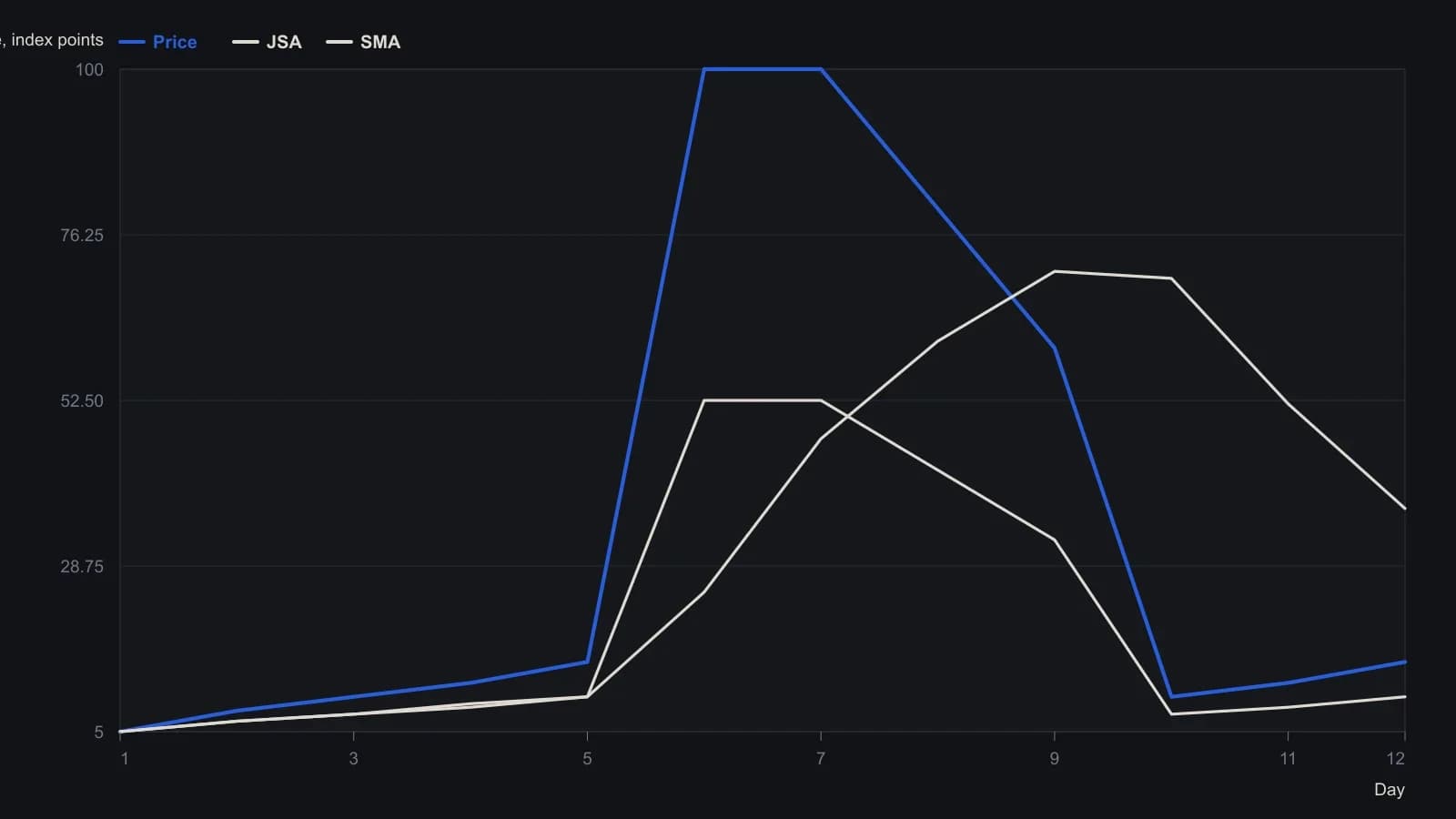
The source uses a constructed price path with an exaggerated Day-6 spike so window choice and endpoint substitution stay visible; the raster is coarse, so the series are approximate.
All readings on this track · 15 readings
- 1990Building a percent-difference moving-average oscillator
- 1991Ease of movement oscillator construction
- 1993A twelve-month moving-average filter for inflation direction
- 1993Constructing two-endpoint JSA moving averages
- 1999Centered moving averages for trend construction
- 2000Constructing a slope-corrected moving average
- 2000Lookback length as a construction check for the modified moving average
- 2001Smoothing balance of market power with a moving average
- 2005Three-state moving-average directional breakout construction
- 2005Constructing a move-adjusted moving average
- 2005Moving-average construction: windows, weights and stops
- 2008Constructing stacked moving-average filters
- 2011Constructing percentage-offset moving-average bands
- 2015Linearity, commutation, and ratio smoothing in moving averages
- 2019Constructing a 50-200 sma-channel for swing entries and exits