2017issue C048-11
Write a daily contrarian rule from the closed-end-fund discount
This construction turns yesterday’s closed-end-fund discount into today’s long or short stance. Entry, exit and fade are then tested as one daily procedure, not as a forecast of the next print.
- Sentiment gauges split into direct and indirect families, and this construction uses a closed-end-fund discount series as the indirect proxy.
- The daily discount percentage is the natural log of the prior mid-price divided by the prior net asset value, with mid-price as the average of open and close.
- The daily rule takes a long stance in the euro currency ETF when the prior mid-price sits below net asset value and a short stance when it sits above.
- Daily returns are used to predict the discount series because evidence that sentiment forecasts prices is not established.
Treat the discount as a construction problem
Sentiment gauges are split into direct and indirect families. This construction uses a closed-end-fund discount series as the indirect sentiment indicator, rather than a survey of stated investor views.
The closed-end-fund discount is treated as a contrarian indicator, in contrast to a coinciding options-sentiment style gauge. The workflow writes one daily rule that turns yesterday’s premium or discount into today’s stance.
Form yesterday’s gap
The daily discount percentage is the natural log of the prior mid-price divided by the prior net asset value. Mid-price is the average of a session’s open and close, and both the mid-price and the net asset value are taken from the prior day when the discount is computed.
Map the gap to today’s stance
The daily rule takes a long stance in the euro currency ETF when the prior mid-price sits below net asset value and a short stance when it sits above. In this contrarian strategy, a premium maps to a sell stance and a discount maps to a buy stance, fading the implied sentiment of that gap.
Which way the write-up looks
A scatter of daily euro-ETF returns against the lagged discount is described as slightly negatively sloped. A one-variable regression on 2518 observations reports a negative daily-return coefficient.
Daily returns are used to predict the discount series because the write-up states that evidence for the reverse direction, sentiment forecasting prices, is not established.
Read rising prices as crowding in
Rising prices are framed as a crowding-in effect that is later discounted, not as a reason for sentiment to become more bullish.
Editorial reading
Editorial: the object to keep is the full daily procedure. Once the prior premium or discount is written as today’s long or short stance, entry, exit and fade can be tested together instead of as separate calls on the next print.
FXE daily backtest with the CEFD rule versus the unfiltered path
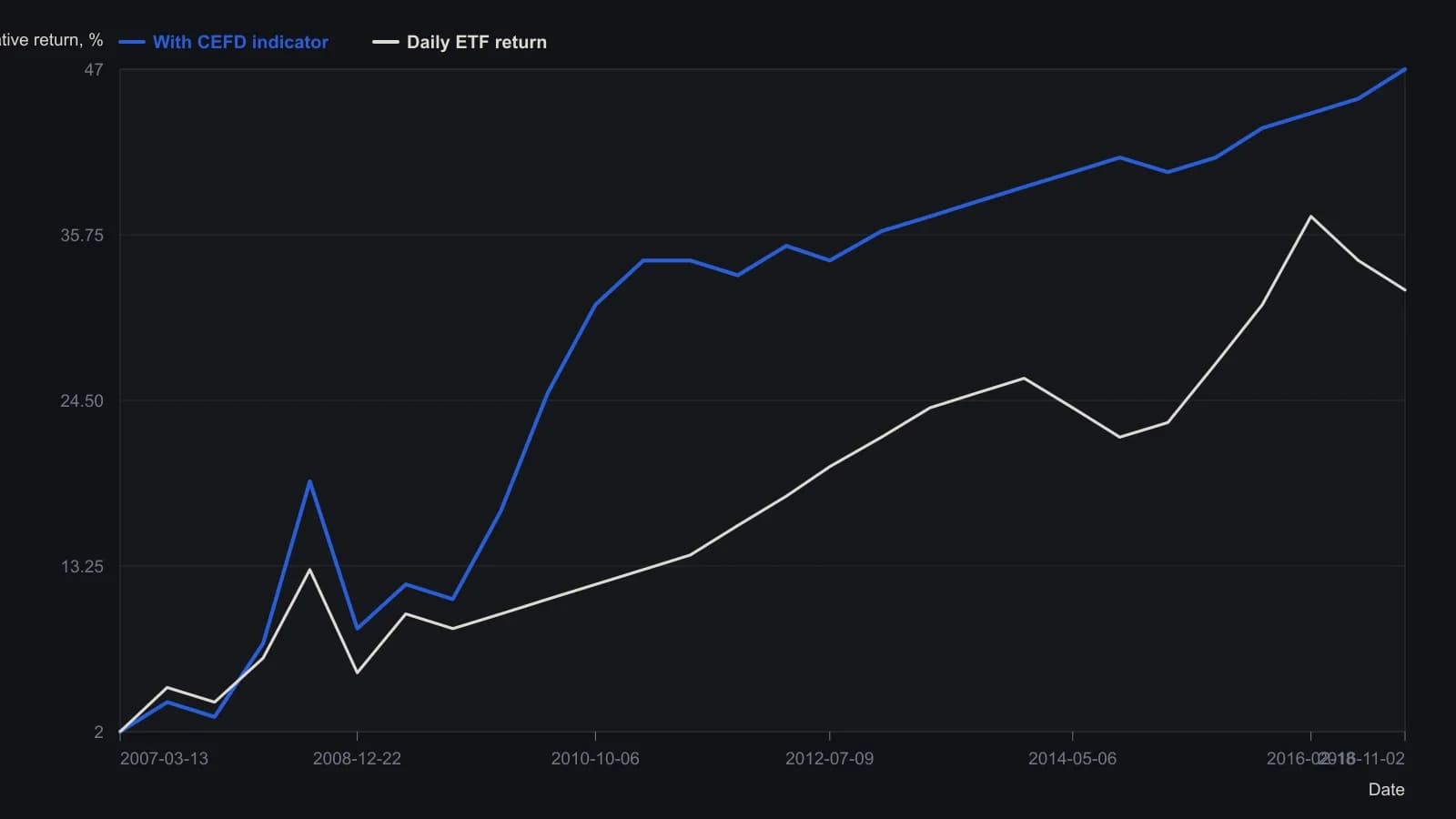
Digitized from the plotted curves against the printed date ticks (13 Mar 2007–2 Nov 2016) and the percent grid from −10 to 50. Vertical readings follow that 10-point grid and are approximate. The companion regression used 2,518 daily observations.
All readings on this track · 20 readings
- 1986A pre-trade checklist for crowded trading methods
- 1988Contrary decision process versus lagging bullish consensus
- 1988Constructing contrarian signals from polled consensus
- 1989Constructing a ten-input breadth diffusion score
- 1989Even-number first penetration as a construction problem
- 1991Joint strength and sentiment rules for entries and exits
- 1995Evaluating contrarian sentiment thresholds for bond futures
- 1998A weekly composite-score that classifies despair, euphoria, or neither
- 1998Lagged phase clocks for market cycles
- 2003Process rules when a correct view fails
- 2003Closing stops and equity-curve filters as one decision process
- 2003One procedure for entry, exit, and standing aside
- 2004Cross-index volatility gauges as a premium regime map
- 2005When trend rules need a losing filter
- 2006Evaluating sector breadth as a contrarian regime filter
- 2011Sideline patience versus crowd noise
- 2012Assembling a sentiment zone oscillator as one contrarian filter
- 2012Currency regime context for fading rallies
- 2014When late trend confirmation is a sideline signal
- 2017Write a daily contrarian rule from the closed-end-fund discount