2001issue C011-3
Shared lookback as the identity of a log range index
The range index is the logarithm of a lookback high-low difference divided by the logarithm of that same lookback length. Editorial reading: the construction is a parameter-identity problem, and the reading is finished only after the high window, the low window, and the log-period occupy one shared integer.
- Build the range index by dividing the logarithm of a lookback maximum-minus-minimum difference by the logarithm of that same lookback length.
- Bind the maximum window, the minimum window, and the log-period to one shared lookback so the three slots stay identical.
- Several constructions take the maximum from the high series and the minimum from the low series; at least one substitutes the close for both.
- Split the work into a named period coefficient and intermediate steps so the lookback changes in one place, then store the finished function for any series in a portfolio.
What the construction computes
The range index is built by dividing the logarithm of a lookback maximum-minus-minimum difference by the logarithm of that same lookback length. That ratio is the log-normalized range: the lookback high-low difference and the lookback length are both placed on a logarithmic scale.
Several constructions take the lookback maximum from the high series and the lookback minimum from the low series. At least one construction substitutes the close for both the lookback maximum and the lookback minimum.
One shared lookback in every slot
A shared lookback is a single integer period that must occupy every slot in the construction: the maximum window, the minimum window, and the logarithm in the denominator. If the three period slots can be searched separately, they should be bound to one shared parameter so the maximum, the minimum, and the log-period stay identical.
Multiple independent constructions set the shared lookback to 5. One spreadsheet construction applies the same formula with a shared lookback of 30.
A named period coefficient
The construction can be split into a named period coefficient plus intermediate highest-high, lowest-low, log-of-period, and difference steps so the lookback changes in one place. The period coefficient is that named lookback input. It feeds the maximum, the minimum, and the log-period together so the construction can be rebuilt by changing one value.
The finished function can be stored once and then applied to any series in a portfolio.
Five-bar GRI on the Nasdaq Composite in 2000
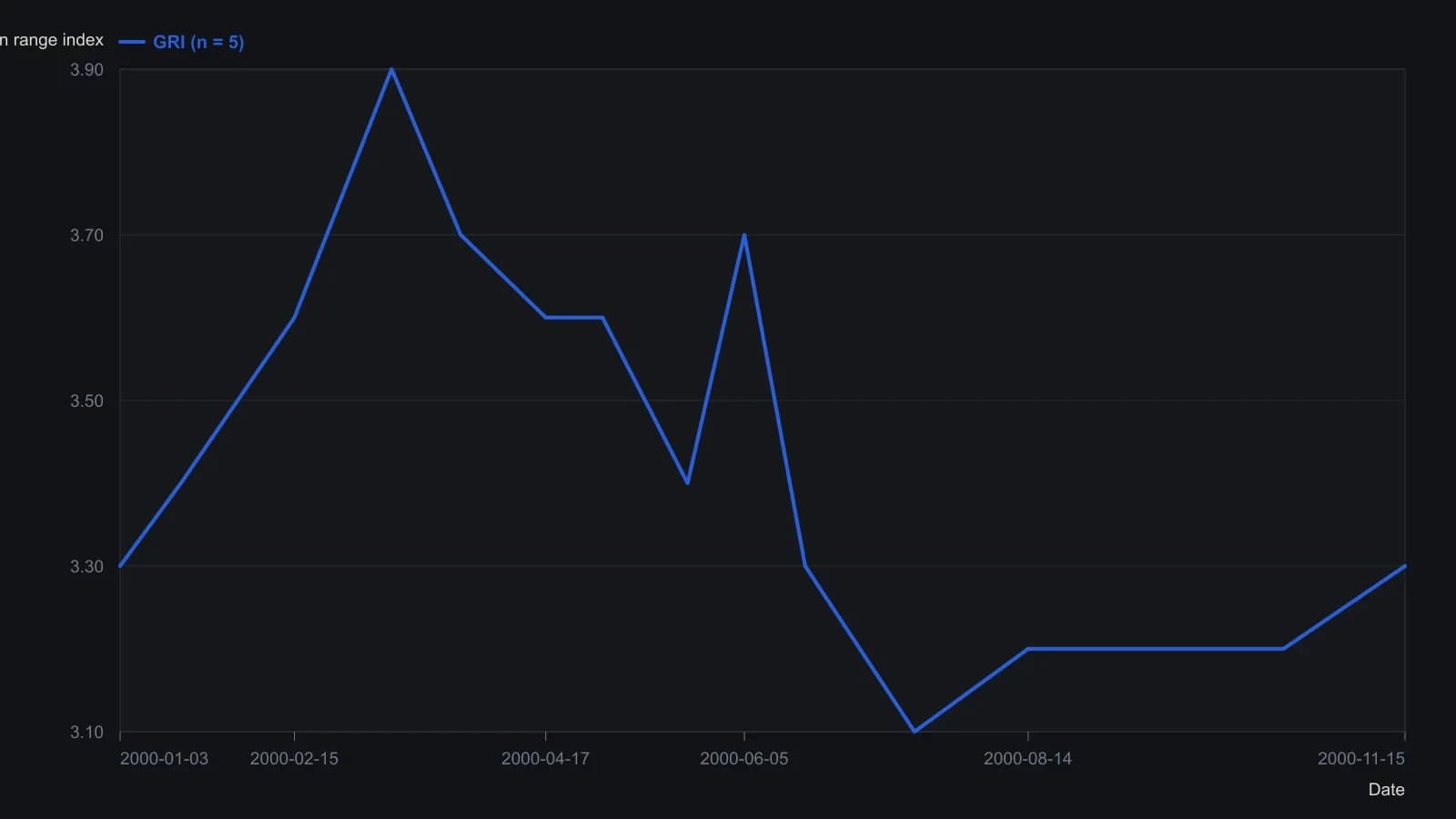
Lookback n = 5 on High and Low; GRI = log(highest high − lowest low) / log(n). The source pane only labels 3.0 and 4.0, so readings are to the nearest tenth and omit the intra-month wiggle of the five-bar oscillator.
Later uses of the finished reading
Editorial reading: a mean-deviation comparison measures how far an observed high-low span sits from an explicit lookback-length baseline after both sides are placed on a logarithmic scale. A trend filter is a regime reading taken from ordered highs and lows over a stated sampling interval, used to judge whether range is expanding or contracting before any later rule is applied. Range trading is a testable procedure that turns a constructed range reading, market state, and holding-period constraints into one set of entry, exit, and abstention rules. Once the shared lookback is locked, the same finished reading can serve each of those roles without rebuilding the identity of the object.