2004issue C021-12
Reconstructing Heikin-Ashi bars from smoothed OHLC
Archive listings rebuild Heikin-Ashi from the arithmetic mean of the raw open, high, low, and close, then write the modified open in several ways. The open may be a recursive midpoint, a half-weight adaptive moving average, or a short exponential average of that mean.
- The modified close is the arithmetic mean of the raw open, high, low, and close.
- The modified high is the maximum of the raw high and the modified open and close; the modified low is the matching minimum with the raw low.
- Listings write the modified open as the average of the prior modified pair, a 0.5-weight adaptive moving average of the prior modified close, a 3-period exponential average of the four-price mean, a one-bar-lagged exponential smoothing of the modified close, or the prior raw open and close.
- A companion series subtracts the modified open from the modified close and overlays a 3-period moving average of that difference; a discrete rule then marks buy, sell, or neutral against a 5-period simple moving average of the modified close.
A rebuilt candle
Archive listings treat Heikin-Ashi as a modified candle, not as the raw open, high, low, and close. The modified close is the arithmetic mean of those four raw prices. The modified high is the maximum of the raw high and the modified open and close. The modified low is the matching minimum with the raw low.
How the open is written
The modified open is the average of the previous modified open and the previous modified close. One listing writes the modified open as a 0.5-weight adaptive moving average of the prior modified close. Another listing writes the modified open as a 3-period exponential average of the four-price mean and treats that average as equivalent to averaging the prior modified open and close.
A further construction states that the modified open is a one-bar-lagged exponential smoothing of the modified close, and therefore of the whole bar. At least one listing sets the modified open from the prior raw open and close rather than from the prior modified pair.
ULTI Heikin-Ashi open versus the four-price close
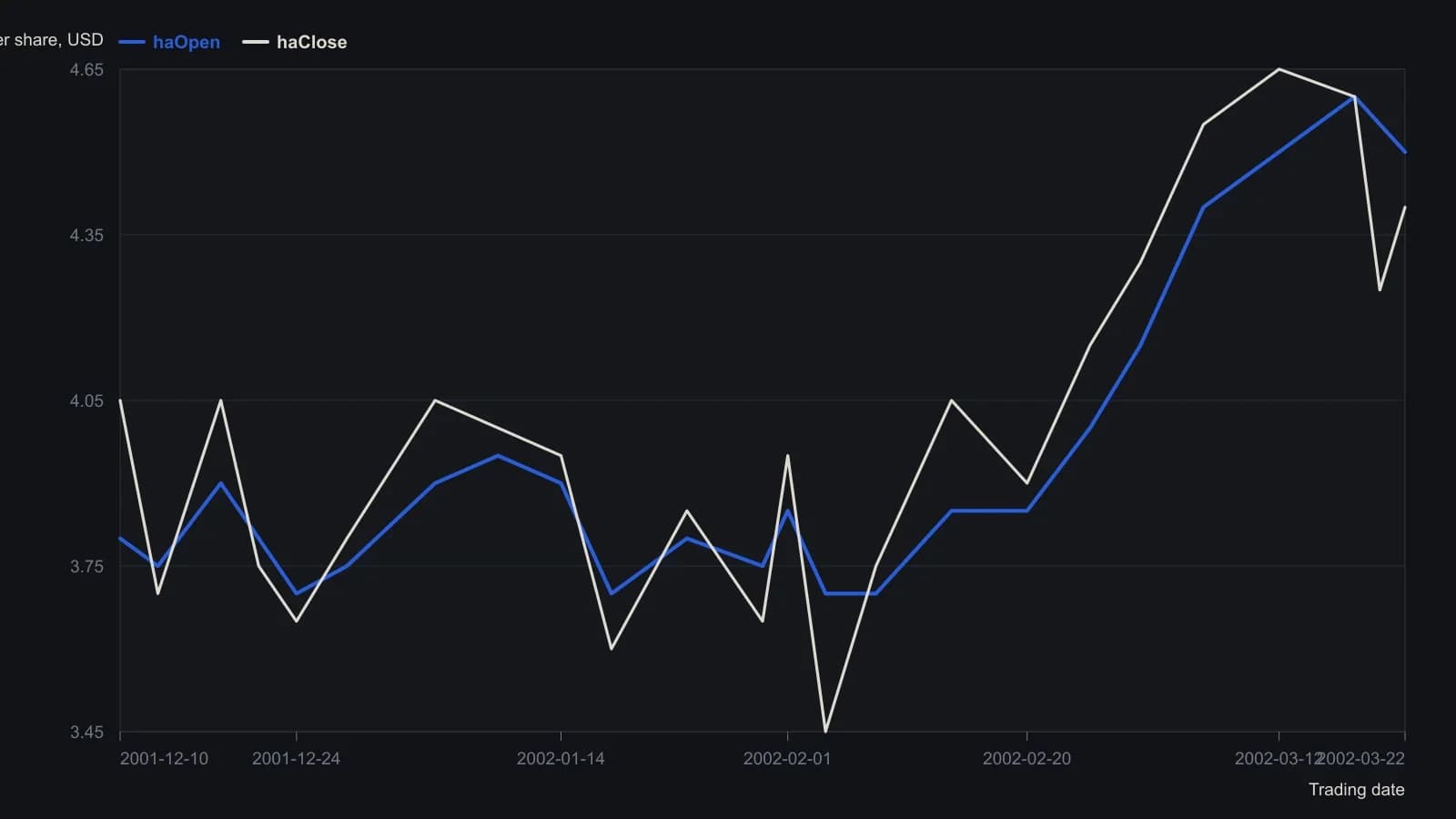
Digitized from the plotted lines to the nearest five cents. Listings write haClose as (O+H+L+C)/4 and haOpen as a one-bar recursive midpoint or half-weight average of that mean.
The overlay and the discrete rule
A companion series subtracts the modified open from the modified close and overlays a 3-period moving average of that difference. A discrete rule marks a buy when the modified close-open difference is positive and the modified close is above its 5-period simple moving average, a sell when both comparisons fail, and neutral when the two conditions disagree.
All readings on this track · 16 readings
- 2004Reconstructing Heikin-Ashi bars from smoothed OHLC
- 2004Heikin-Ashi candle construction as an OHLC transform
- 2004Stacking heikin-ashi, swing charts, and a moving average in strong trends
- 2007Constructing a Heikin-Ashi volume-price oscillator
- 2007A volume-price oscillator is a timing trigger, not a standalone entry
- 2008Heikin-Ashi OHLC construction and simplification
- 2008How a Heikin-Ashi candlestick oscillator is built from color, lag, and hold rules
- 2008Heikin-Ashi color-coded candles and smoothed trend filters
- 2010Heikin-Ashi smoothed percent b for divergence timing
- 2011Constructing Heikin-Ashi, moving-average, and MACD filters
- 2011Constructing candlestick, Elliott-wave, and Heikin-Ashi hypotheses
- 2012Constructing a three-state Heikin-Ashi trend filter
- 2012Heikin-ashi as a trend-state signal without candlestick-patterns
- 2013Heikin-Ashi volume gates, smoothing, and denominator floors
- 2013How Heikin-Ashi close and typical-price form a two-average crossover
- 2013Walk-forward tests for color-coded Heikin-Ashi crosses