1995issue C061-9
Range expansion filter on multi-horizon averages
Session range and price direction are handled as separate readings. A smoothed oscillator of true range versus interday close change can permit or retire a stacked exponential-average stance without replacing that stance.
- Quiet daily ranges are treated as typical range-bound trade, while a sharp expansion of daily true range relative to the interday close change is treated as a possible supply-demand shift, often but not always with higher volume.
- The range indicator is built in two stages: a stochastic range of the true-range-to-close-change ratio, or of true range alone when that change is not positive, followed by exponential smoothing of that stochastic.
- Low and still-rising range-indicator readings are a start-of-trend cue to pair with a separate trend measure. High readings are a possible end-of-trend or return-to-range cue.
- The same oscillator can act as a trend filter on entries after a rising low-zone cross, or as an exit overlay when it crosses the high zone, alongside a minimum holding period and an average reversal.
Separate readings for range and direction
The archive treats a quiet daily range as typical range-bound trade. A sharp expansion of the daily range relative to interday movement is treated as a possible supply-demand shift. That expansion is often, but not always, accompanied by higher volume.
True range is the one-bar range measure used for the session path, including gaps and limit moves against the prior close. Interday close change is the close-to-close displacement used when that session path is compared with overnight progress.
Building the range indicator
The range indicator is a smoothed oscillator that places the current true-range-to-close-change ratio on a bounded scale so unusually quiet or stressed readings can be flagged.
It is built in two stages. First a stochastic range rescales, over a short lookback, the true-range-to-close-change ratio into a bounded reading. When the interday close change is not positive, that stochastic is taken of true range alone. Exponential smoothing is then applied to the stochastic-range series to form the finished range indicator.
Illustrative settings use a short lookback for the stochastic range, a longer exponential smoother, and arbitrarily chosen quiet and stressed zones on the finished oscillator.
Low-zone and high-zone cues
A low zone is an arbitrarily chosen quiet threshold on the range indicator. A rising cross of that threshold is treated as possible trend initiation. A high zone is an arbitrarily chosen stressed threshold. A cross of that threshold is treated as possible trend exhaustion.
Low and still-rising oscillator readings are intended as a start-of-trend cue that can be paired with a separate trend measure. High readings are intended as a possible end-of-trend or return-to-range cue.
A stacked exponential baseline
A baseline directional engine buys when a short exponential average of the close crosses above a medium one, with the close also above both that medium average and a longer exponential average. Short rules are the mirror image.
The moving-average stack is that short, medium, and longer set of averages used together so a stance needs alignment across more than one horizon. Exponential smoothing is applied to the close to form those averages. The baseline was applied to currency futures series on continuous data.
Range as an entry trend filter
As an entry filter, the range indicator must be higher than on the prior bar and must cross above a predefined quiet zone, in addition to the exponential-average alignment. The same permission logic is applied on the short side.
That pairing is the trend filter. It allows or blocks a directional signal according to whether the range oscillator is leaving a quiet zone.
Range as an exit overlay
As an exit overlay, a stressed-zone cross of the range indicator is added to a minimum holding period and a short-versus-longer exponential-average reversal. The range reading is not used as a standalone exit.
TRI on September 1993 yen with 20/70 zones
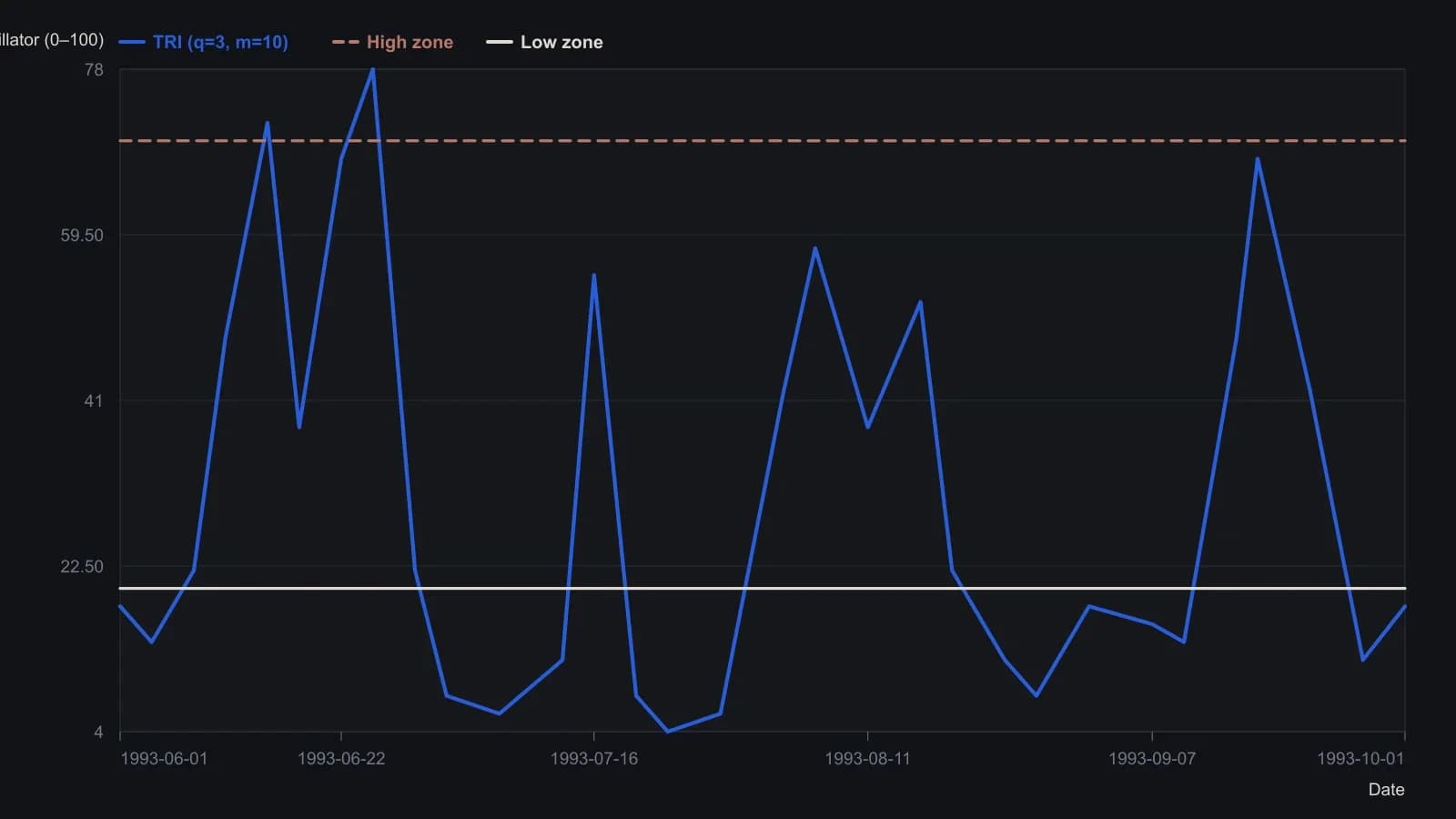
TRI uses q=3 and m=10 as in the source figure. Digitised from the lower pane only; prices in the upper pane were not transcribed. Approximate to the raster, not to the original tick series.
All readings on this track · 41 readings
- 1984Matching average age across price filters
- 1984Residual-impact construction of exponential smoothers
- 1988Constructing simple and exponential moving averages as specified filters
- 1989Evaluating smoothed free reserves and funds-discount spreads
- 1990Integer construction of moving averages and exponential smoothing
- 1990Constructing incremental moving average filters
- 1991Constructing a double-smoothed stochastic oscillator
- 1991Constructing an exponential average from a smoothing weight
- 1991Constructing a double-smoothed momentum oscillator family
- 1991Competing certainty rules from exponential-average conditions
- 1991Hybrid construction of a mechanical timing system from smoothed signals
- 1991Constructing an exponential smoother from a moving-average length
- 1991Equivalent relative-strength-index constructions from a ratio and from smoothed momentum
- 1991Constructing the true strength index from double-smoothed momentum
- 1991True strength index from signed, double-smoothed momentum
- 1992Constructing exponential averages from simple lookbacks
- 1992Constructing exponential averages by the smoothing constant, startup length and lag
- 1992Nested range smoothing and windowed high-low damping
- 1992A weekly equity stance from the discount-bill spread
- 1993Double-smoothed stochastics momentum index construction
- 1993Constructing the true strength index with double exponential smoothing
- 1994Polarized fractal efficiency with a shared exponential smoother
- 1994Five-interval exponential smoothing of ten-interval signed path-efficiency
- 1994Hand-ranked price-volume series with stacked smoothing and stochastic
- 1995Range expansion filter on multi-horizon averages
- 1995The exponential smoothing constant from averaging lag
- 1997Construct a nested-average rainbow band and oscillator
- 1998Filter stacks that combine a moving average with exponential smoothing
- 2002Smoothed relative-strength construction from wilder-averaging and a price prefilter
- 2003Reverse-engineered RSI price targets
- 2004Piecewise trend quality from moving-average reversals
- 2004Nested smoothing recipes versus unaudited oscillator experiments
- 2008Weight construction beyond the N-day label
- 2010A consensus filter for objective RSI and smoothing construction
- 2012Sentiment-zone oscillator from signed closes
- 2012Classic RSI one-over-N smoothing versus the standard exponential average
- 2013Why exponential smoothing uses two over n plus one
- 2015Constructing ratio indicators with moving-average and exponential-smoothing weights
- 2015Slow relative-strength index from an exponentially smoothed price
- 2017Rebuilding the relative strength index as open-scale buy-sell pressure
- 2017Comparing Wilder and exponential smoothing inside a relative-strength index