1991issue C101-12
MACD parameter order and cycle phase lag
A conventional macd-line subtracts a longer exponential average from a shorter one and smooths that residual with a signal-line. Copied 26 and 13 lengths assume weekly stock cycles still exist on daily commodity bars. The archive instead counted a swing, assigned cycle-matched-lengths, and compared inverse-length-order through phase-lag. Editorial reading: treat the pair as a temporary phase budget and retire it when the measured cycle changes.
- A conventional macd-line is the shorter exponential average minus the longer one, and the signal-line is a further exponential average of that difference, often given the same length as the shorter average.
- Lengths of 26 and 13 that originated on weekly stock cycles are frequently copied onto daily commodity bars, which assumes those cycle counts exist at the daily sampling interval.
- Cycle-matched-lengths set the slower average near one full measured swing and the faster average near half that swing, then change when the counted cycle changes.
- Inverse-length-order can move crosses ahead of the next cycle on that swing, but the archive confined the 4-and-12 pair to the illustrated window after a contrary January mark.
Copied lengths assume the same cycle
A conventional MACD construction is often transplanted without asking whether the bar interval still holds the cycle those lengths came from. Lengths of 26 and 13 that originated on weekly stock cycles are frequently copied onto daily commodity bars, which implicitly assumes those same cycle counts exist at the daily sampling interval.
The archive treats markets as changing and therefore treats average lengths as quantities that should be retuned to present conditions instead of held constant.
The macd-line and the signal-line
A conventional macd-line is the shorter exponential average minus the longer one. The signal-line is a third exponential average of that difference, often given the same length as the shorter average to keep the construction simple.
Read the macd-line as a timing residual rather than a price forecast. After very slow trend components have been removed, that difference is a detrended-synthetic-price that sits near the remaining cyclic swing.
exponential-smoothing is a recursive average that blends the latest observation with the previous average. An exponential average updates as yesterday's value plus a smoothing constant times the gap between today's price and that value. The constant is often estimated as 2 divided by one plus the comparable simple-average length.
Cycle-matched-lengths on a counted swing
Between mid-February and late April the archive counted about 12 trading days from high to high or low to low. It then assigned a 12-period first average and a 6-period second average, using that same 6-period length for the signal smoother.
That pairing is cycle-matched-lengths: the slower average near one full measured swing and the faster average near half that swing.
S&P 500 with cycle-matched 12/6 MACD
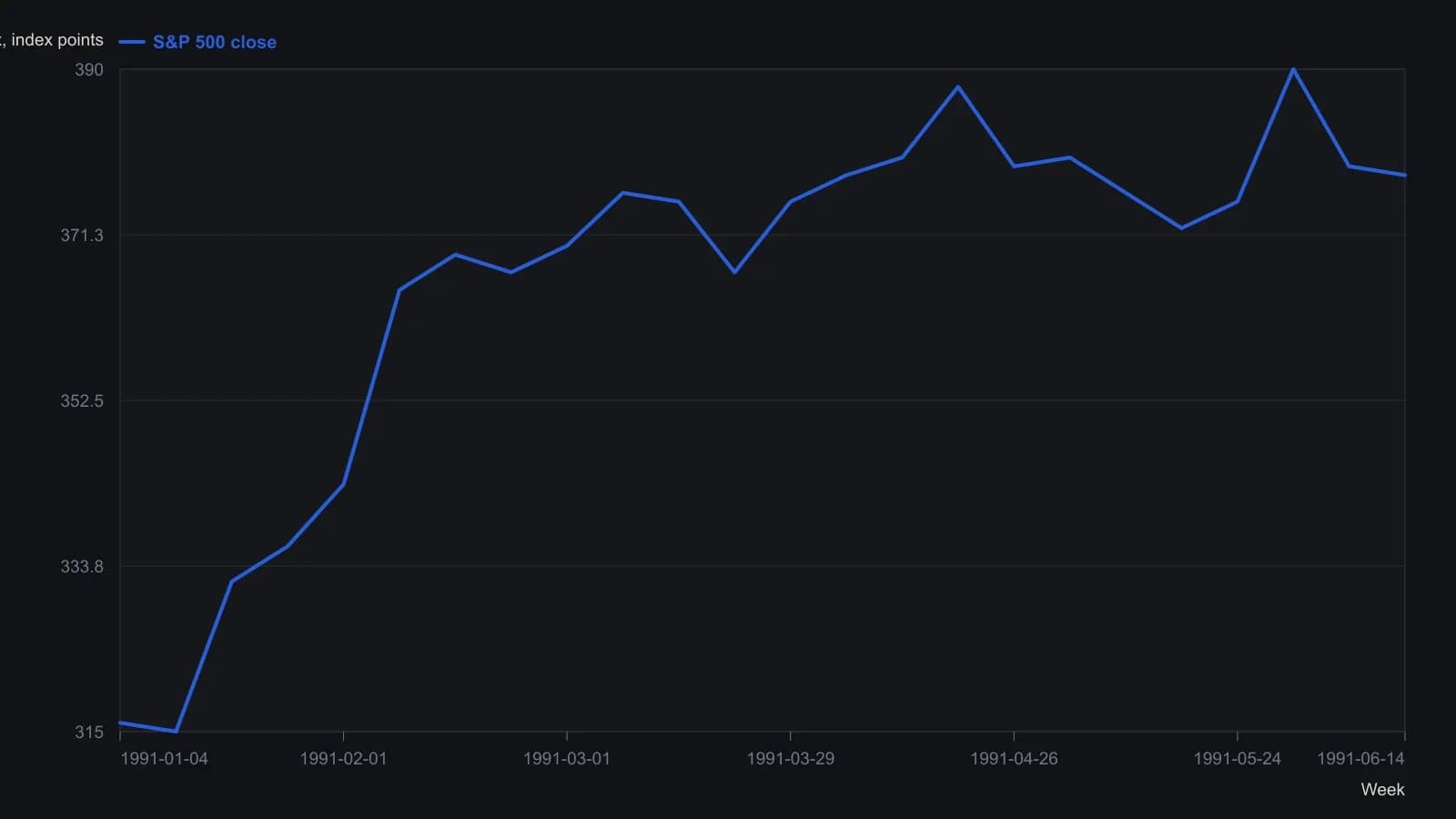
Raster is a 180-degree scan of Figure 2; prices were read from the labeled 298–368 scale after rotating the figure upright.
Phase-lag spent by each average
A full-cycle exponential average is described as imposing about 72 degrees of phase-lag and reducing cycle amplitude to about 31 percent. A half-cycle average imposes about 54 degrees and leaves about 57 percent.
Vector subtraction of the longer average from the shorter is said to leave a residual about 35 degrees behind price. The half-cycle signal-line adds about 54 degrees, so the cross occurs near 62 degrees after the crest or trough. On a 12-day cycle that delay is about two days. After a next-bar fill the same construction sits about 90 degrees late, which on a pure cycle implies a theoretical pre-cost break-even if exit is delayed by the same amount.
Inverse-length-order and the parameter-surface
A parameter-surface, a grid of the two exponential-average lengths against a historical outcome metric, was described as relatively smooth. That smoothness implies low local sensitivity to small length changes. The extreme of that surface sat in the region where the first length is shorter than the second, which is inverse-length-order, the opposite of the usual MACD convention.
A 4-and-12 length pair produced marks early relative to cyclic highs and lows. The archive states that pair applies only to the immediate past of the illustrated window and generated a contrary January mark.
On a 12-day cycle, a 4-period average is described as retaining about 80 percent of amplitude with about 40 degrees of lag, and a 12-period average as retaining about 31 percent with about 72 degrees. Inverting the shorter vector yields a MACD about 203 degrees behind price, or 157 degrees ahead of the next cycle. After a further 72-degree signal delay the crosses lead the next cycle by about 67 degrees.
Retire the pair when the swing changes
The archive workflow measures a swing, assigns lengths, and does not treat those lengths as permanent. Editorial reading: once the counted cycle changes, the phase budget changes with it, so the pair should be retired rather than copied forward.
All readings on this track · 80 readings
- 1988Rebuild MACD-Mo and MACD-H before treating them as signals
- 1989Four-span MACD lookbacks as perishable parameters
- 1989Weekly then daily MACD confirmation on individual stocks
- 1991Regime-gated MACD and stochastic rules inside a checklist
- 1991Constructing MACD signal lines and divergence tests
- 1991MACD parameter order and cycle phase lag
- 1992Lengthened bond MACD as an equity regime filter
- 1992Long-horizon MACD construction from paired exponential averages
- 1993Constructing a signed ten-point trend filter
- 1994Constructing lag-reduced double exponential averages for MACD
- 1994Seeding DEMA2 filters to build a MACD signal
- 1994Constructing MACD from lag-reduced exponential averages
- 1994TEMA1 from nested exponential averages, then a two-horizon MACD
- 1994Constructing entry and exit on a relative-strength MACD
- 1994Constructing a relative-strength MACD crossover spreadsheet
- 1995Consensus presignal filters for Relative Strength Index, MACD and the Stochastic oscillator
- 1997Confirm the MACD turn with price, then exit on the histogram
- 1997Reconstructing a stochastic oscillator, MACD, and a triple-smoothed oscillator
- 1997Moving-average windows before crossovers and MACD
- 1999Second-stage MACD on relative-strength inputs
- 1999Constructing MACD from exponential-average spreads for crossover and divergence
- 1999Coding candlesticks into numeric indicators
- 2001Second-low confirmation with a percentage oscillator and money-flow filter
- 2001Constructing MACD from exponential average spreads and a signal line
- 2002Separate bounded and trend-following oscillator rules
- 2002Sort the regime before assigning MACD and stochastic jobs
- 2002Building classic divergence filters from RSI and MACD
- 2002Weekly highs and lows as trend gates
- 2002Constructing channel-normalized Fisher reversal signals
- 2002Affine-price and the Fisher transform as a constructed companion to MACD
- 2003Regularized EMA construction with a MACD line and a thrust oscillator
- 2003Curvature-penalized exponential averages versus MACD
- 2003MACD, moving averages, and a trend filter as one timing system
- 2003Fractional MACD and linear-regression reversal construction
- 2004Weekly MACD-histogram timing of bear-market rallies
- 2004Candlestick triggers filtered by MACD divergence
- 2004Staging energy-complex tops with trendline, breakout, and MACD
- 2005Selling climax holds versus fails
- 2006Treat a sideways Wave as permission before a breakout
- 2007MACD with a Stochastic oscillator for spotting trend reversals
- 2007Rebuilding an S&P 500 fifth-wave count after a broken target
- 2007Constructing MACD, RSI, and stochastic confirmation for futures
- 2007MACD histogram divergence needs a confirming close
- 2007Write the plan as a stack: ratio, boundary, then oscillators
- 2008MACD divergence and Stochastic oscillator confirmation on lumber futures
- 2008Assign confirmation, timing, and a stop before a currency pair is tested
- 2008Confirm the ten-bagger launch path before the MACD exit
- 2008Reading the offloaded evidence file
- 2008A Leader companion for MACD direction warnings
- 2008Relative strength exits with MACD averages and RSI
- 2008Assign one job per indicator in a three-screens rule set
- 2008Sequencing RSI, MACD, and average crossovers
- 2010Constructing the Schaff Trend Cycle from MACD and a dominant-cycle window
- 2010Schaff Trend Cycle as a MACD and Stochastic oscillator combination
- 2010Combining Relative Strength Index, the stochastic oscillator, and MACD as slope filters
- 2010Short-term wave and ratio clues without direction calls
- 2010A precise pullback entry and an unplanned profit-protection exit
- 2010Filtering MACD false signals with trendline breaks
- 2011Vendor feeds as an input variable in a MACD evaluation
- 2012Out-of-the-money versus in-the-money option sensitivity to implied volatility
- 2012MACD window tuning as hold-time control
- 2012Combining a moving-average crossover with MACD and support-resistance
- 2012Testing a published MACD entry with a histogram and signal-line agreement filter
- 2012Treat sample systems as a lab before live rules
- 2013Constructing moving averages and MACD from one price series
- 2013The next-bar price that forces a MACD signal-line cross
- 2013Constructing next-bar MACD reversal prices
- 2013Constructing inverted MACD reversal prices
- 2014Shared-filter combinations of the stochastic oscillator, MACD, and RSI
- 2014Square-root lookbacks for combined MACD and RSI
- 2015Audit open interest and trend before trusting oscillator crossovers
- 2016MACD without a signal line, confirmed by moving-average trend filters
- 2016Use RSI, MACD, and a moving average as a market-health consensus
- 2016MACD line versus histogram is a display problem first
- 2017Weekly and daily MACD on a single daily chart
- 2017Weekly and daily MACD as a stacked momentum filter
- 2017Nested weekly and daily MACD from paired EMA spreads
- 2018Weekly and daily PPO scale versus MACD, with bounded RSI and stochastic readings
- 2018Constructing a weekly and daily percentage price oscillator
- 2020Constructing Wyckoff tape reading with MACD, moving-average, and RSI filters