2017issue C0326-29
Rebuilding the relative strength index as open-scale buy-sell pressure
The relative strength index is a 0–100 map of two exponentially smoothed pressure columns. Rebuilding those columns as open-scale buy-sell pressure, and updating them with a standard exponential mix, shows when range compression conceals a change in intensity.
- The relative strength index is a 0–100 oscillator formed after two non-negative close-to-close series are each smoothed with an exponential average whose effective length is twice the lookback minus one.
- As the lookback lengthens, that exponential-smoothing memory lengthens with it, so the relative-strength ratio retains older observations and the oscillator becomes less responsive.
- Range compression maps large moves in the relative-strength ratio into small moves near 0 and 100, while open-scale buy-sell pressure reports the same ratio as a signed multiple with no ceiling or floor.
- A standard EMA update places more weight on the new observation than the original RSI update; on the same reconstructed series the standard mix moved sooner, and signed pressure kept accelerating after the oscillator flattened above 90.
Two smoothed columns, then a bounded map
The relative strength index begins by splitting close-to-close changes into two non-negative series, one for up-day changes or zero and one for down-day changes or zero. Each series is then smoothed with exponential smoothing: a recursive average that blends a new observation with the prior average. In this construction the effective length of that average is twice the oscillator lookback minus one.
The relative-strength ratio is the intermediate quotient of the up-day average over the down-day average, before any 0–100 mapping. A 14-day lookback therefore applies a 27-day exponential average to both series before that ratio is formed and mapped onto the oscillator.
Lookback sets how long pressure is retained
Because those exponential averages lengthen with the lookback, the intermediate ratio retains older observations for longer and the oscillator becomes less responsive as the lookback increases. Across lookbacks from 6 to 42 stepped by 2, the built-in smoothing weight is the reciprocal of the lookback, and the equivalent exponential length runs from 11 to 83 using the identity 2/(L+1).
Range compression on the 0–100 scale
On the 0–100 scale the mapping is nonlinear. A tenfold rise in the relative-strength ratio from 1 to 10 lifts the oscillator only from 50 to about 91, and a tenfold fall from 1 to 0.1 lowers it from 50 to about 9.
The same mapping can turn a move in the up-to-down pressure ratio from 3:1 to 12:1, a 300 percent increase, into a move on the oscillator from 75.0 to 92.31, about a 23 percent increase. Equal-magnitude pressure ratios of 4:1 and 1:4 both sit 30 points from the midline of 50, printing 80 and 20, so the numeric labels are not symmetric with the underlying force. That nonlinear squeezing of large moves in the ratio into small moves near the 0 and 100 bounds is range compression.
RSI versus relative strength on the hypothetical EMA pairs
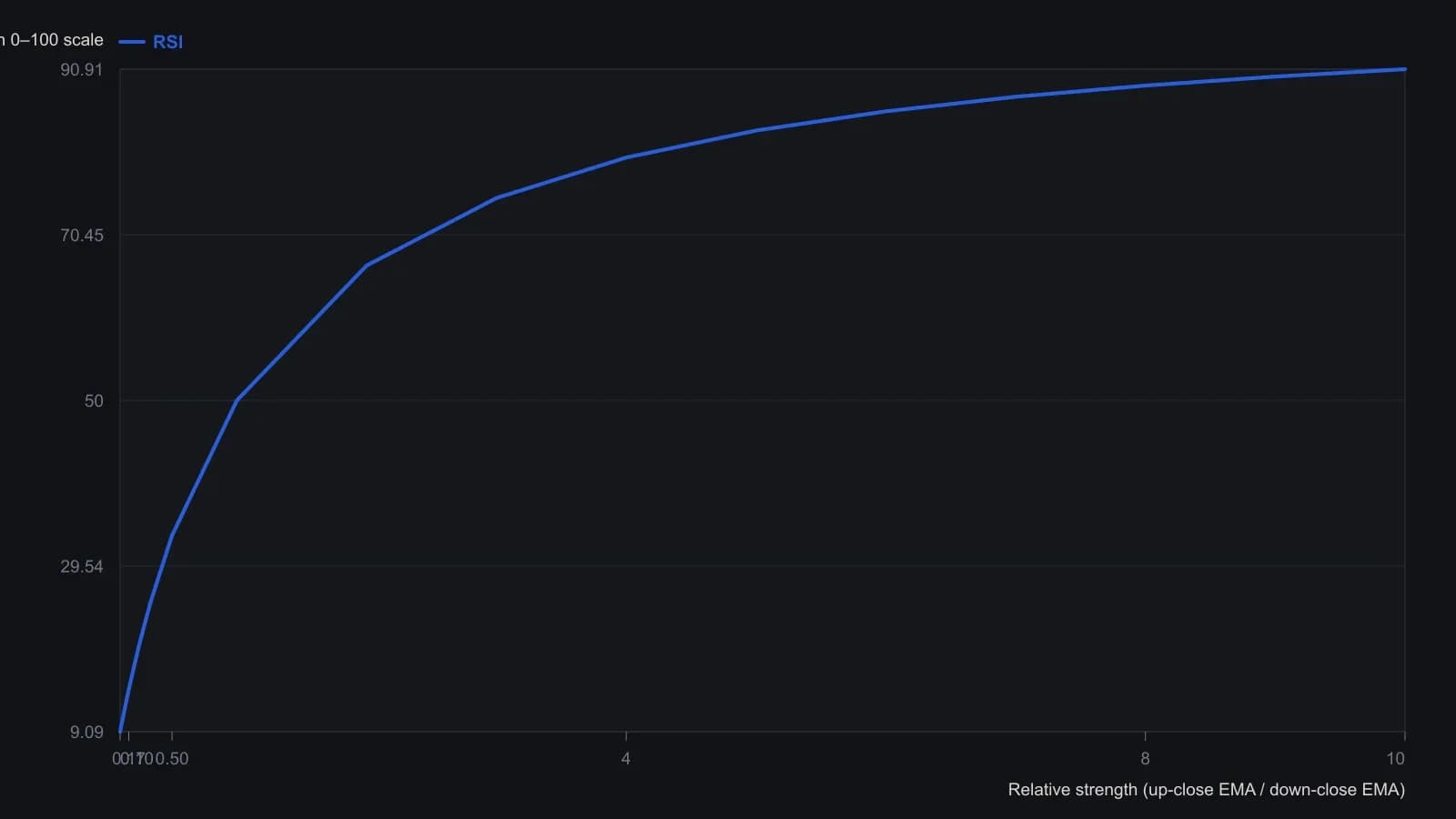
One side’s close-to-close EMA is held at 1 while the other steps from 1 through 10. These pairs are synthetic, not a market sample.
Open-scale buy-sell pressure
Open-scale buy-sell pressure is a signed transform of the same ratio. It reports the ratio itself when the ratio is at least 1, and the negative reciprocal when the ratio is below 1. The result is a signed reading of how many times one side exceeds the other, with no fixed ceiling or floor, and with symmetric pressure readings such as +10 versus -10.
The same signed series can be recovered from the oscillator. Below 50 it equals (0.01 times the oscillator minus 1) divided by (0.01 times the oscillator). At or above 50 it equals (0.01 times the oscillator) divided by (1 minus 0.01 times the oscillator).
Original update versus a standard exponential mix
For a 14-day lookback the original RSI update applies 1/14 of the new observation and 13/14 of the prior average. A standard EMA update applies 2/15 of the new observation, about 0.13 versus 0.07. On the same reconstructed series the standard mix moved sooner, and the signed pressure series continued to accelerate after the 0–100 reading had flattened above 90.
All readings on this track · 41 readings
- 1984Matching average age across price filters
- 1984Residual-impact construction of exponential smoothers
- 1988Constructing simple and exponential moving averages as specified filters
- 1989Evaluating smoothed free reserves and funds-discount spreads
- 1990Integer construction of moving averages and exponential smoothing
- 1990Constructing incremental moving average filters
- 1991Constructing a double-smoothed stochastic oscillator
- 1991Constructing an exponential average from a smoothing weight
- 1991Constructing a double-smoothed momentum oscillator family
- 1991Competing certainty rules from exponential-average conditions
- 1991Hybrid construction of a mechanical timing system from smoothed signals
- 1991Constructing an exponential smoother from a moving-average length
- 1991Equivalent relative-strength-index constructions from a ratio and from smoothed momentum
- 1991Constructing the true strength index from double-smoothed momentum
- 1991True strength index from signed, double-smoothed momentum
- 1992Constructing exponential averages from simple lookbacks
- 1992Constructing exponential averages by the smoothing constant, startup length and lag
- 1992Nested range smoothing and windowed high-low damping
- 1992A weekly equity stance from the discount-bill spread
- 1993Double-smoothed stochastics momentum index construction
- 1993Constructing the true strength index with double exponential smoothing
- 1994Polarized fractal efficiency with a shared exponential smoother
- 1994Five-interval exponential smoothing of ten-interval signed path-efficiency
- 1994Hand-ranked price-volume series with stacked smoothing and stochastic
- 1995Range expansion filter on multi-horizon averages
- 1995The exponential smoothing constant from averaging lag
- 1997Construct a nested-average rainbow band and oscillator
- 1998Filter stacks that combine a moving average with exponential smoothing
- 2002Smoothed relative-strength construction from wilder-averaging and a price prefilter
- 2003Reverse-engineered RSI price targets
- 2004Piecewise trend quality from moving-average reversals
- 2004Nested smoothing recipes versus unaudited oscillator experiments
- 2008Weight construction beyond the N-day label
- 2010A consensus filter for objective RSI and smoothing construction
- 2012Sentiment-zone oscillator from signed closes
- 2012Classic RSI one-over-N smoothing versus the standard exponential average
- 2013Why exponential smoothing uses two over n plus one
- 2015Constructing ratio indicators with moving-average and exponential-smoothing weights
- 2015Slow relative-strength index from an exponentially smoothed price
- 2017Rebuilding the relative strength index as open-scale buy-sell pressure
- 2017Comparing Wilder and exponential smoothing inside a relative-strength index