1994issue C011-3
Constructing Chaikin money flow and a double-exponential smoother
Build Chaikin money flow as a volume-weighted close-location series and DEMA1 as a two-pass exponential smoother, then read polarity, persistence, and divergence as separate, checkable hypotheses.
- A Chaikin money-flow value places each close inside its high-low range, multiplies that location by volume, and divides the summed product by summed volume over a lookback-window.
- DEMA1 is twice a single exponential average of the chosen price minus a second exponential average of that first average, with both passes sharing one length.
- Extended stays of the oscillator above or below zero are labelled positive-flow or negative-flow readings, and a mismatch with price at a direction change is a candidate divergence.
- A joint reading treats an upward DEMA1 slope together with a positive money-flow reading as the aligned-upside case.
Two separately specified series
Chaikin money flow and DEMA1 are built as two different series. The money-flow series is a volume-weighted close-location oscillator formed by summing each bar’s accumulation-distribution-increment and dividing by summed volume over a fixed lookback. DEMA1 is a double-exponential-filter on a chosen price.
Editorial reading: specify each series first, then write polarity, persistence, and divergence as one-line hypotheses that can be checked layer by layer.
The volume-weighted close-location series
A Chaikin money-flow value is built by placing each close inside its high-low range, multiplying that location by volume, summing the product over a lookback-window, and dividing by the sum of volume over the same lookback-window.
The accumulation-distribution-increment is that bar-level term: it places the close between high and low, then multiplies that location by volume. The oscillator is the sum of those increments divided by the sum of volume over the lookback-window.
Two lookback constructions
One construction of that oscillator uses a 21-bar summation window. The 21-bar Chaikin money-flow series is treated as an oscillator that can be compared with price for divergence at direction changes.
Another construction uses a 30-bar lookback-window, scales the ratio by 100, and withholds the accumulation-distribution-increment when the high-low range is zero or volume is zero.
The double-exponential smoother
The DEMA1 series is a double-exponential-filter: twice a single exponential average of the chosen price minus a second exponential average applied to that first average, with both passes sharing one length. Exponential smoothing here is a recursive average with a constant decay. The two nested passes subtract the second average from twice the first in order to cut lag.
A worked specification uses the close as the price input and a length of 30. DEMA1 is applied to reduce short-interval price swings while leaving the slope of the trend visible.
Polarity, persistence, and divergence
Editorial hypotheses, each written as one line that can be checked on its own layer.
Polarity: extended stays of the oscillator above zero are a positive-flow reading, and extended stays below zero are a negative-flow reading.
Persistence: the flow label is the extended stay, not a single-bar sign.
Divergence: a mismatch between a turn in the oscillator and a turn in price is a candidate condition rather than a completed forecast.
A joint reading
A joint reading treats an upward DEMA1 slope together with a positive money-flow reading as the aligned-upside case.
Editorial reading: check the money-flow polarity first, then the DEMA1 slope, then any divergence at a direction change. Each layer can fail on its own.
Compaq price with 21-day Chaikin money flow
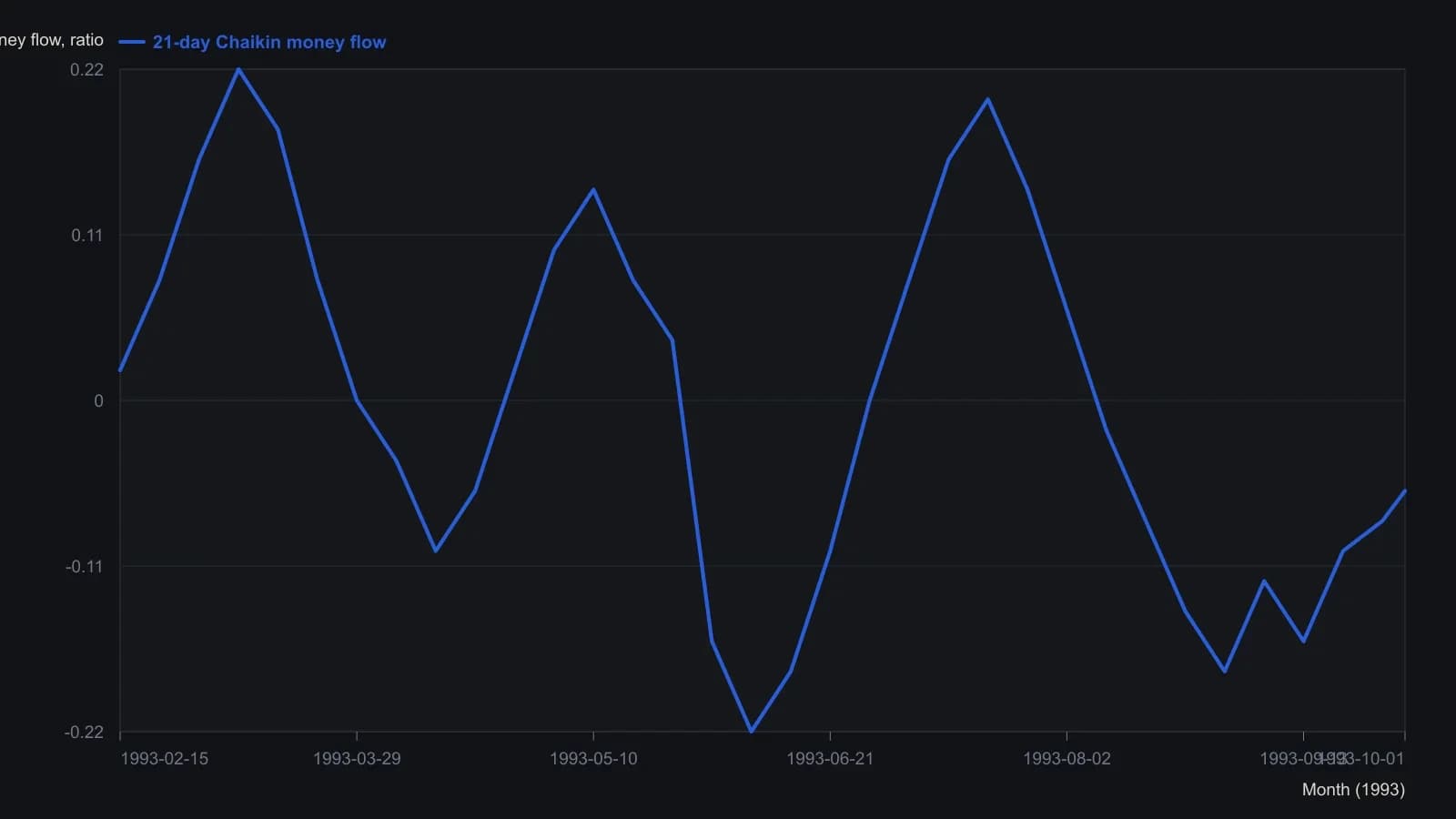
MetaStock 21-day CMF: sum((((C-L)-(H-C))/(H-L))*V,21)/sum(V,21). Raster is low-resolution; y values are approximate to about 1 point on price and 0.02 on CMF.
All readings on this track · 9 readings
- 1992Fitting oscillator parameters to stock personality
- 1994Constructing the Chaikin oscillator from close-in-range volume
- 1994Constructing Chaikin money flow and a double-exponential smoother
- 1994A three-lock reversal drill: line, oscillator, and volume
- 2000Constructing a Chaikin oscillator from the accumulation-distribution line
- 2005Volume-spike alerts versus direction from follow-through
- 2014A 2014 research stack as a classroom for volume-flow hypotheses
- 2015Money flow oscillator construction from volume pressure
- 2017Small-cap swing entries that wait for accumulation and Chaikin to clear