1993issue C021-6
Five-rung money flow from signed print volume
A daily money-flow series is built by signing each print from the prior tick and letting share size dominate the running total. The joint path of that total and price is then given an integer rank from 5 through 1 that separates ongoing accumulation from an unsupported-advance and from continuous selling. The same signed tape is also read as a volume-price check and, by scoring large prints apart from small ones, as an order-flow filter.
- The money-flow-index is a day’s running total that adds uptick-volume and subtracts downtick-volume, so a large print moves the series more than a small print.
- A five-rung-flow-score from 5 through 1 ranks how persistent signed-print-volume is relative to the price path, from ongoing accumulation to continuous selling.
- Rank 2 marks an unsupported-advance. Rank 4 can mark interrupted buying or an unconfirmed-decline, including roughly neutral flow while price falls.
- The same ranking can be applied separately to retail prints and to block prints, so large-share tape and small-share tape are scored on their own.
Sign each print, then let size lead
The series is built by adding share volume on upticks, subtracting share volume on downticks, and plotting the day’s running total. That running daily total is the money-flow-index. Uptick-volume is the shares printed on a trade that occurs at a higher price than the immediately prior trade. Downtick-volume is the shares printed on a trade that occurs at a lower price than the immediately prior trade.
Signed-print-volume is the construction step that attaches a plus or minus to each trade’s size from the tick direction before the sizes are summed. A single large-share print is treated as more informative than a small-share print when inferring buying or selling pressure, because the large print moves the running total more.
A downtick on 200 shares followed by an uptick on 12,000 shares is read as aggressive large-buyer demand. An uptick on 100 shares followed by a downtick on 11,000 shares is read as large-trader selling.
A five-rung score of flow versus price
Each issue is then assigned an integer rank from 5 through 1 that describes how persistent the signed flow is relative to price. That integer label is the five-rung-flow-score.
Rank 5 marks ongoing accumulation. Rank 4 covers interrupted buying or a price decline that is not matched by selling, including a roughly neutral flow while price falls. Rank 3 is used when signed flow and price move together and there is no buying of weakness or selling into strength. Rank 2 marks a price advance without outright buying and is framed as a short-lived move rather than the start of a lasting advance. Rank 1 marks continuous selling in which any price bounce is treated as another chance to sell.
Non-block money flow versus closing price
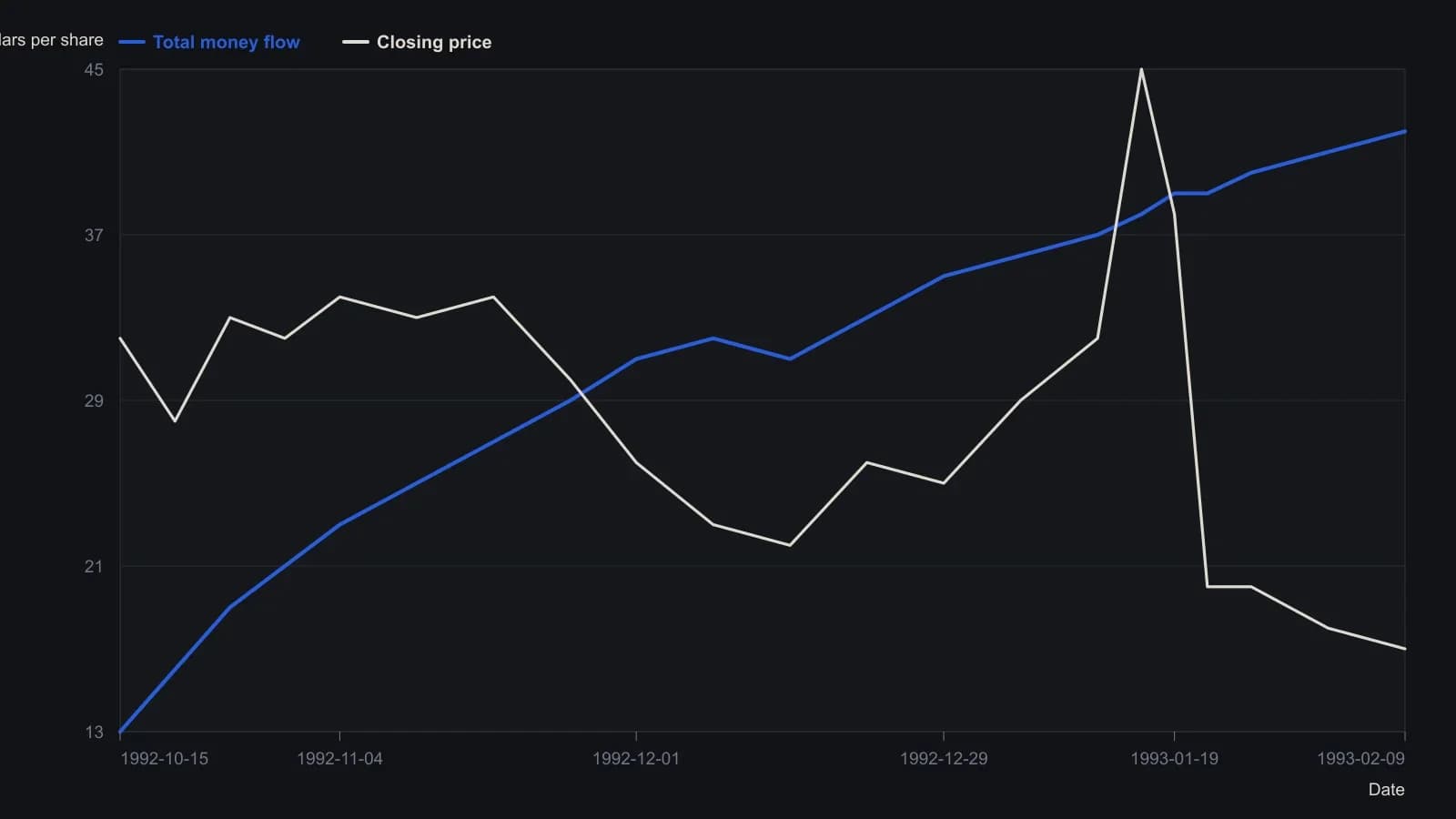
Y-values are approximate readings from the printed 15–45 axis; money flow is the source’s scaled overlay, not raw dollar volume. Day-of-month ticks run mid-October through early February; the year follows the February 1993 issue window.
Split the tape by print size
The same ranking can be applied separately to retail prints and to block prints. Order-flow-analysis, in this workflow, is reading who is pressing by comparing large-share prints with small-share prints, and by scoring block tape separately from retail tape.
All readings on this track · 13 readings
- 1988Constructing tick-weighted money flow and price divergences
- 1989Four-state money-flow-index as permission for a next-bar breakout-system
- 1989Constructing a suggest-then-confirm Money Flow Index
- 1993Five-rung money flow from signed print volume
- 1993Physics analogies for building cycle and money flow indicators
- 1994Keep a wave count as a draft until money flow and a trendline agree
- 1999Take the rectangular-base breakout from money-flow confirmation, not from a late strength average
- 2004Constructing a volume-flow rule from money flow
- 2006Classify the regime before the bar read
- 2015Constructing a bounded money-flow oscillator from range and volume
- 2016Combining RSI, moving averages, and money flow
- 2018Five-rule technical rating as a rotation filter
- 2020Combining money-flow, RSI, and breadth for dynamic pressure zones