1996issue C091-2
Standard-error bands, width gates, and weekday counts
A residual envelope is built from a least-squares midline and a standard-error envelope. A mean-deviation envelope, a volatility-width gate, and a weekday up-close rate sit beside that fit as separate layers a reader can rebuild one at a time.
- A residual-width channel places a standard-error envelope around a least-squares midline fitted to a window of closes.
- A post-fit smoother is applied after the residual is calculated and is described as reducing the statistical accuracy of that residual measure.
- A mean-deviation envelope and a volatility-width gate compare width by a different rule than the regression residual.
- A weekday up-close rate is a session tally by weekday, not a reading taken from the fitted envelope.
A stack of construction choices
A residual-width channel is formed by fitting a least-squares line to a window of closes and placing guides a stated multiple of that fit's standard error above and below the line. The straight fit is the least-squares midline. The guides are the standard-error envelope.
The default construction uses a 21-observation regression window, a residual scale of 19, and a two-standard-error offset. Residual scale is the regression window length reduced by two before the residual width is computed.
What the post-fit smoother changes
A three-observation simple smoother is applied after the fact to the fitted line, the residual, both guides, and the coefficient of determination. That post-fit smoother changes the displayed series.
Smoothing the fitted line and residual after they are calculated is described as reducing the statistical accuracy of the residual measure.
Position inside the envelope
A percent-in-band reading maps the latest close onto the interval between the smoothed lower and upper residual guides.
Companion series include the 21-observation regression slope and a smoothed coefficient of determination between a time index and the close.
A mean-deviation envelope and a width gate
A separate comparison channel is a 21-observation average of closes plus and minus two standard deviations of the same closes. That mean-deviation envelope is centered on an average of closes and widened by the series standard deviation rather than the regression residual.
A binary width screen flags when 55-observation average true range exceeds 50 percent of the width of those 21-observation, two-deviation mean-centered bands on the close. That screen is a volatility-width gate.
Weekday counts beside the overlay
A weekday study tags each session Monday through Friday, accumulates session counts and up-close counts by weekday, and converts the two counts into a percentage of up closes. That share is the weekday up-close rate.
The weekday tally was computed on a broad industrial equity average from early 1989 through 12 July 1996.
DJIA share of up closes by weekday
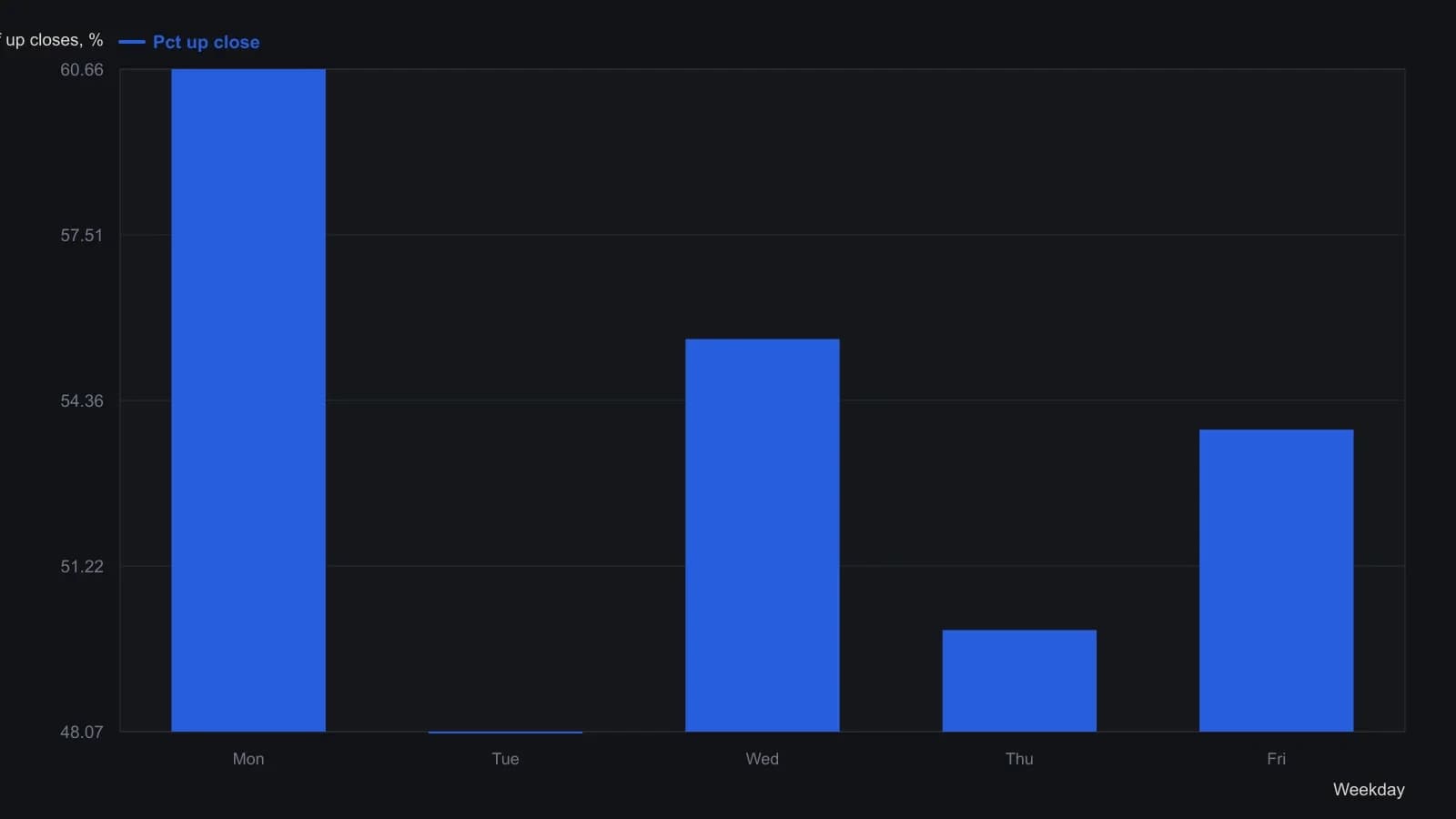
Each rate is 100 times accumulated up-closes for that weekday divided by how many times that weekday occurred. The final Friday closed down, so the Friday rate is 53.81 rather than the 53.95 shown on 11 July 1996.
All readings on this track · 21 readings
- 1986Two gates for setup and operator readiness
- 1990Time-only cycle dates in a Treasury bond case study
- 1990Constant-dollar regimes, the value line, and nested cycles
- 1992The four-year election cycle as an equity regime map
- 1992A semiconductor seasonal-index before the relative-strength overlay
- 1992Lock the holiday window as a regime, then veto resistance
- 1995Regime-aware stock screening with intermarket context
- 1996Standard-error bands, width gates, and weekday counts
- 1999Constructing seasonal factors from centered moving averages
- 2000Seasonal window, then weekly breadth
- 2004Copper as a regime map for cycles and recessions
- 2008Election-cycle windows as a mechanical seasonal system
- 2012A 2012 case study in Kondratieff-wave and presidential-cycle overlays
- 2012The October to May window as a mechanical portfolio procedure
- 2013Half-year seasonality as an equity regime overlay
- 2014Seasonal cycles as a regime overlay
- 2015Seasonal oil window as a defined-risk spread case
- 2017Calendar regimes, RSI events, and sector rotation rules
- 2018Seasonal windows as testable entry and abstention rules
- 2019Calendar rotation of seasonal and regime questions
- 2020Constructing calendar interval votes for cycle workbooks