1998issue C021-10
Constructing anchored momentum from a centered average
Ordinary momentum subtracts a single older price from the latest close. Anchored momentum pins that lookback to the end of a centered simple moving average, then uses the percentage form so different securities can be ranked on a common period.
- Ordinary momentum is the latest price minus an older price over a chosen period, and the percentage form is 100 times that difference divided by the older price.
- Anchored momentum starts at the end of a centered simple moving average and ends at the latest close, so the left end rides a smoother reference than a single older price.
- When securities are ranked by percentage anchored momentum rather than percentage ordinary momentum, ranks change more gently and a ranking system is less likely to chatter through buy or sell triggers after past price bumps.
- Most anchored momentum uses the longest allowed centered average and leaves only the momentum period free, which is easier to calculate and leaves less room to overfit in a trading system.
Ordinary momentum
Ordinary momentum is the latest price minus an older price over a chosen momentum period. The percentage form is 100 times that difference divided by the older price.
A complete momentum strategy, as used here, is an entry, exit and abstention procedure whose signal is a percentage-change momentum reading over a stated holding period. Percentage momentum with a common period is the form used to compare and rank different securities fairly.
A centered simple moving average
A simple moving average is centered by shifting it left by half its period so the plot is smoother than price, is not delayed relative to price, and ends short of the last bar.
That centered simple moving average is an ordered-price smoother used here as a centered simple-average reference. It can also be used later as an exponential smoother of the latest price.
Pin the lookback to the centered average
Anchored momentum starts at the end of a centered simple moving average and ends at the latest close, so the left end rides a smoother reference than a single older price. The reading is measured from the latest price back to a point on the centered average rather than to a single older close.
A mid-1996 comparison
On a mid-1996 NASDAQ composite example, a 10-day anchored reading was smoother than a 10-day ordinary reading and was not delayed relative to it.
In that same example, July price dips later inflated ordinary-momentum peaks in August, while the anchored reading stayed closer to contemporaneous index action.
NASDAQ Composite 10-day ordinary vs anchored momentum, June–December 1996
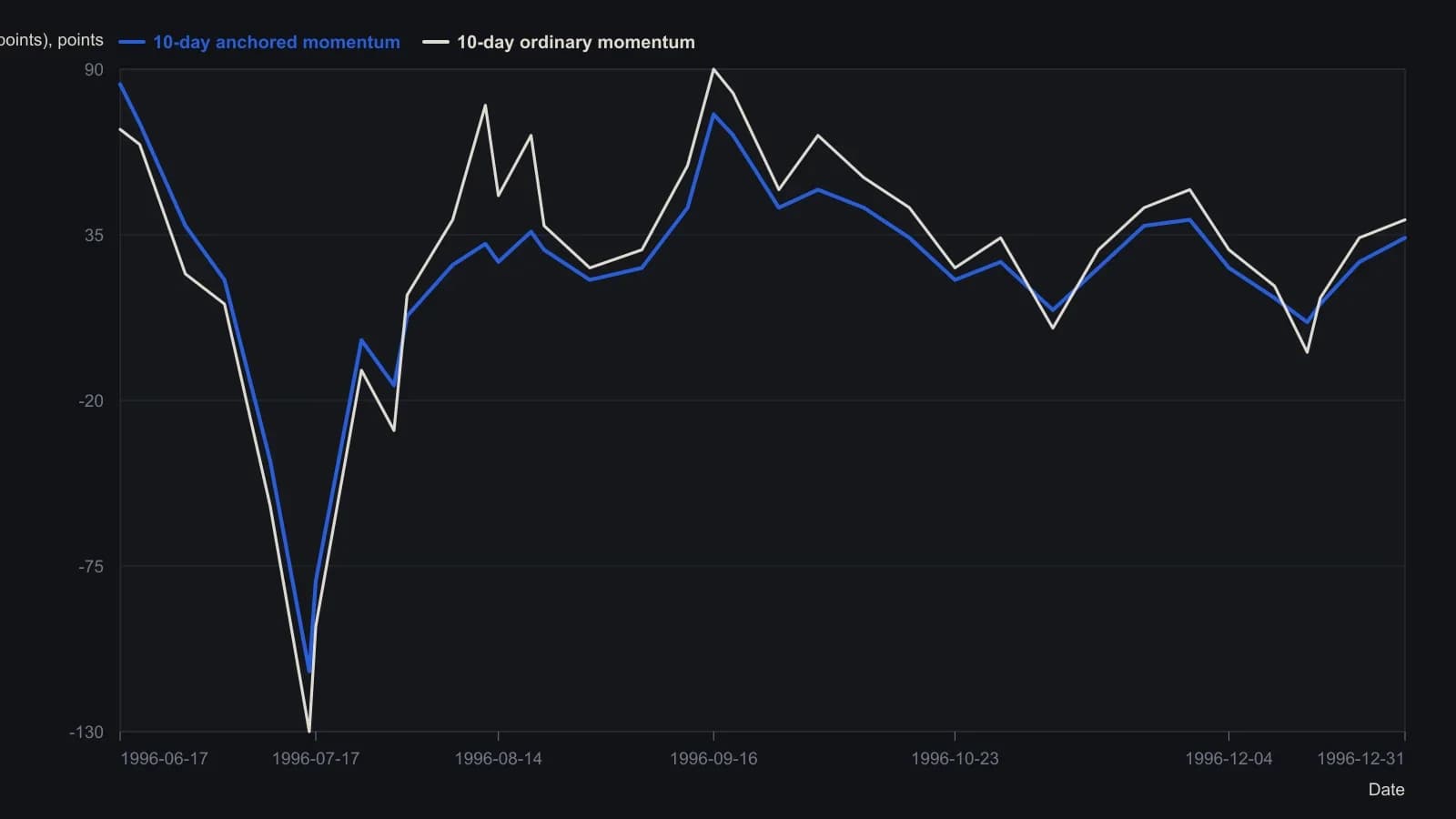
Both traces use a 10-session lookback. Ordinary momentum is the latest close minus the close 10 sessions earlier; most-anchored momentum subtracts the matching 21-day simple moving average. The source pane shows the raw point difference, not the percent form introduced later in the article. Digitized from a coarse raster and rounded to 5 index points.
The same reading as a rank rule
When securities are ranked by percentage anchored momentum rather than percentage ordinary momentum, ranks change more gently and a mutual-fund ranking system is less likely to chatter through buy or sell triggers after past price bumps.
Rank rotation, in this use, ranks securities by the same-period percentage momentum reading and trades only when rank crosses a trigger.
One variable or two
General anchored momentum has two variables, the momentum period and the centered-average period. Most anchored momentum uses the longest allowed centered average and leaves only the momentum period free.
The one-variable form is easier to calculate and, in a trading system, leaves less room to overfit. The two-variable form keeps a controllable amount of past-bump influence when that influence is judged useful.
Smoothing the latest price
Smoothing the latest price with a moving average removes remaining jaggedness at the cost of a little delay. Either form can take an exponential average of the latest price as an extra variable.
TradersWeek editorial
TradersWeek editorial: pinning the lookback to the centered average keeps one percentage reading that can be tested as a momentum strategy over a stated holding period, then reused as a rank-rotation rule that fires only when rank crosses a trigger. Choosing most anchored momentum leaves the momentum period as the main free choice.
All readings on this track · 39 readings
- 1987A mechanical rank-rotation sleeve for monthly fund leaders
- 1989Rank rotation in a five-name no-load sleeve
- 1990Cycle-tested five-year fund rank rotation
- 1991Blue-chip rank rotation by relative-strength-index slope
- 1992Currency rank rotation and intermarket timing
- 1992Rank rotation and relative strength for portfolio construction
- 1994MACD crossovers then short-horizon rank rotation
- 1994A comparable group-trend ledger from published ranks
- 1997Normalized yield rank rotation as a full portfolio procedure
- 1997Constructing an investor preference index from two capitalization-weighted series
- 1998Constructing anchored momentum from a centered average
- 2000Rank rotation, a stop-loss order, and Relative Strength Index in fund switching
- 2003A one-fund daily rank is a two-sleeve construction problem
- 2004Evaluate rank rotation only where persistence already exists
- 2004Sector fund rank rotation with regression and trailing stops
- 2006Evaluating equal-weight annual yield-rank rotation
- 2007Weekly preferred-symbol reselection for mechanical trend systems
- 2011Portfolio capacity and entry pacing for mechanical systems
- 2011Rank rotation as a testable ETF construction procedure
- 2011The inverse-Fisher stochastic is a forecast layer until the book rules can be disabled
- 2012An underwater stretch is a sizing test for rank rotation
- 2015Rule-based ETF rotation as one testable procedure
- 2015MACD crossover evaluation by trend rank rotation
- 2015Persistence and strength as one close-to-close switch
- 2015Evaluating rank rotation after a persistence screen
- 2016Evaluating an annual valuation rank rotation
- 2017A two-step yield and price rank rotation for a five-name sleeve
- 2018Smoothed volatility and the missing rank-rotation exit
- 2018A five-condition scorecard that ranks stocks and can refuse the trade
- 2018Small-cap growth sleeve eligibility with trend and rank rotation
- 2018Evaluating rank-rotation momentum across fund wrappers
- 2019Evaluating an annual equity-gold momentum rank rotation
- 2019Evaluating equity-gold momentum on funds versus indexes
- 2020How a signed comparative-strength oscillator is built for rank rotation
- 2020Which calendar clock changes a gold-versus-equity rotation test
- 2020Four-dimension relative strength as rank rotation
- 2020Portfolio construction as a ranked relative-strength problem
- 2020Two clocks for a Nasdaq put/call sleeve
- 2020Rank, filter, and stop the hedge sleeve as one procedure