2003issue C021-3
Rebuilding band distance as a z-score crossover
A 20-period close-based z-score uses the same simple mean and standard deviation as a two-standard-deviation envelope of closes. Horizontal marks at plus two, zero, and minus two match the upper band, the mean line, and the lower band, and a 3-period average of the residual crossing a 5-period average of that average is the illustrated timing rule.
- A close-based z-score is the close minus an n-period simple moving average of closes, divided by the n-period standard deviation of those same closes.
- On a 20-period envelope drawn two standard deviations from the mean, a touch of the upper band coincides with the z-score at plus two, and a touch of the lower band coincides with the z-score at minus two.
- Horizontal marks at plus two, zero, and minus two are treated as the oscillator counterparts of the upper band, the moving-average midline, and the lower band.
- The residual is an irregular curve smoothed with a 3-period simple average and then a 5-period simple average of that average, so an upward or downward cross can be stated apart from a band-touch rule.
One close, two readings
The archive starts from the same three quantities: a close, a simple moving average that is the equal-weighted mean of the last n closes, and the standard deviation of those same closes around that mean. The lookback is the sampling window over which that mean and standard deviation are estimated.
Bollinger Bands place those quantities on price as an envelope drawn a chosen number of standard deviations above and below the n-period mean of closes. Z-score-normalization rewrites the close as its signed distance from that n-period simple mean, then divides that residual by the n-period standard deviation of the same closes, so the reading is a unitless location of the close.
The worked construction uses a 20-period window for both the mean and the standard deviation and states that other periods may be substituted.
The residual and its reference levels
A close-based z-score is built as the close minus an n-period simple moving average of closes, divided by the n-period standard deviation of those closes. A z-score of zero means the close equals the chosen mean. Readings of plus two and minus two mean the close is two standard deviations above or below that mean.
The archive states that more than 95.5 percent of observations fall between the plus-two and minus-two standard-deviation references.
On a 20-period envelope drawn two standard deviations from the mean, a touch of the upper band coincides with the z-score at plus two, and a touch of the lower band coincides with the z-score at minus two. Horizontal z-score marks at plus two, zero, and minus two are treated as the oscillator equivalents of the upper band, the moving-average midline, and the lower band. Those reference levels are the residual counterparts of the upper band, the mean line, and the lower band.
DJIA daily z-score versus two-standard-deviation bands
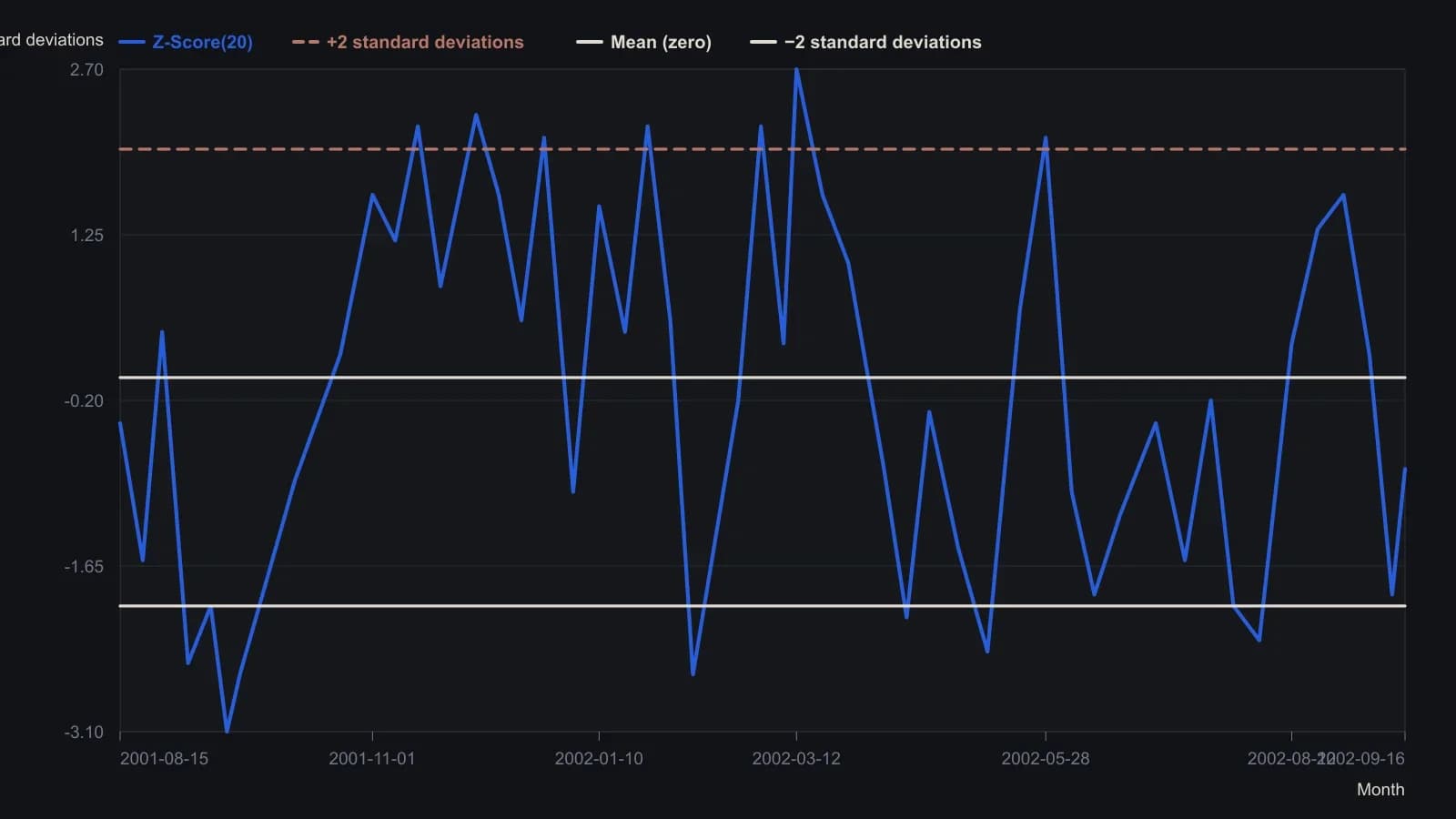
Source construction is z = (Close − SMA(Close, 20)) / StdDev(Close, 20), matching Bollinger Bands(C,20,S,2). Digitized at turning points from a raster, so levels are approximate.
Smoothing into a crossover
The raw close-based z-score is described as an irregular curve. It is smoothed with a 3-period simple average, then with a 5-period simple average of that first average.
The illustrated moving-average crossover is a timing condition formed when a shorter simple average of the z-score series crosses a longer simple average built on that shorter average. In the worked construction that is the 3-period simple average of the 20-period z-score crossing the 5-period simple average of that 3-period average. The upward cross and the downward cross are treated as opposite directional conditions.
A supplement, not a replacement
The z-score series is presented as a supplement for locating a close relative to band-defined support and resistance, not as a replacement for the bands.
A stricter confirmation rule is described as a shared crossing among the z-score, its average, and the average of that average, optionally pairing a different band lookback with different average lookbacks.
All readings on this track · 11 readings
- 1991Constructing standardized sentiment trend filters
- 1995Market z-score residuals for style pair construction
- 1995Constructing scaled z-score normalization for model inputs
- 1996Normalize price and volume onto a common scale
- 2001Constructing pair spreads with z-score triggers
- 2003Rebuilding band distance as a z-score crossover
- 2003Constructing price z-scores with dual averages and bands
- 2003Zigzag target zones from a normalized deviation oscillator
- 2005Constructing a z-score scored range-breakout filter
- 2006Constructing a trend system from Bollinger Bands and z-scores
- 2011How an adjustable-bands z-test resizes the no-trade zone