2010issue C0350-59
Evaluate Turtle-style bands as one mechanical procedure
Editorial stance: lock Turtle-style breakout bands, a stop family, and the right to sit out into one Mechanical trading system before grading alerts, scans, and backtests as a single object.
- A mechanical suite can be evaluated as one procedure that issues buy and sell alerts, scans a market for setups, and backtests the same rule set.
- Turtle-style band rules can fire chart alerts from the same band logic, so the breakout is readable as a single procedure.
- A tester can run a bundled set of mechanical systems on one instrument, or one system across several instruments, and compare the whole rule set as a procedure rather than a single trade.
- Detailed evaluation can expose the system formulas, the trade list, and the equity path so late exits can be inspected before a stop family is swapped.
Evaluate the suite as one procedure
A mechanical suite can be evaluated as one procedure that issues buy and sell alerts, scans a market for setups, and backtests the same rule set.
One included Mechanical trading system applies Turtle-style band rules so chart alerts fire from that same band logic, making the breakout readable as a single procedure.
Turtle trading bands on the chart
A Turtle trading long rule can be stated as entering when price exceeds the highest high of the last n periods and exiting when price falls below the lowest low of the last n/2 periods.
A 20-period Turtle-band overlay for longs is drawn as a pair of bands: go long when price clears the upper band and exit when price crosses below the lower band. Shorts use a matching separate overlay.
Compare the whole rule set
A tester can run a bundled set of 26 mechanical systems on one instrument, or one system across several instruments, so the whole rule set is compared as a procedure rather than a single trade.
A channel template that compiles as one signal
A Keltner-style channel can be specified with a 10-period average of typical price as the midline and bands offset by a 10-period average of the trading range, so a band break is treated as an abnormal setup rather than a frequent signal. Typical price is the average of high, low, and close used as a smoothed price input. That form is a midline of averaged typical price with bands offset by an averaged trading range.
One mechanical template combines those channel bands with a price oscillator and an average directional movement index so entries, exits, and chart markers compile as one signal procedure.
Inspect the path before swapping stops
System optimization of exits can be evaluated by swapping among stop families that include breakeven, trailing, an average-true-range chandelier, and adaptive stops that retune to cycle, volatility, or both. A chandelier stop is a trailing exit that steps with average true range. An adaptive stop is an exit that retunes to cycle, volatility, or both.
Detailed evaluation can expose the system formulas, the trade list, and the equity path so late exits and other systematic problems can be inspected before a stop family is swapped.
VHF procedure versus buy-and-hold on QQQQ
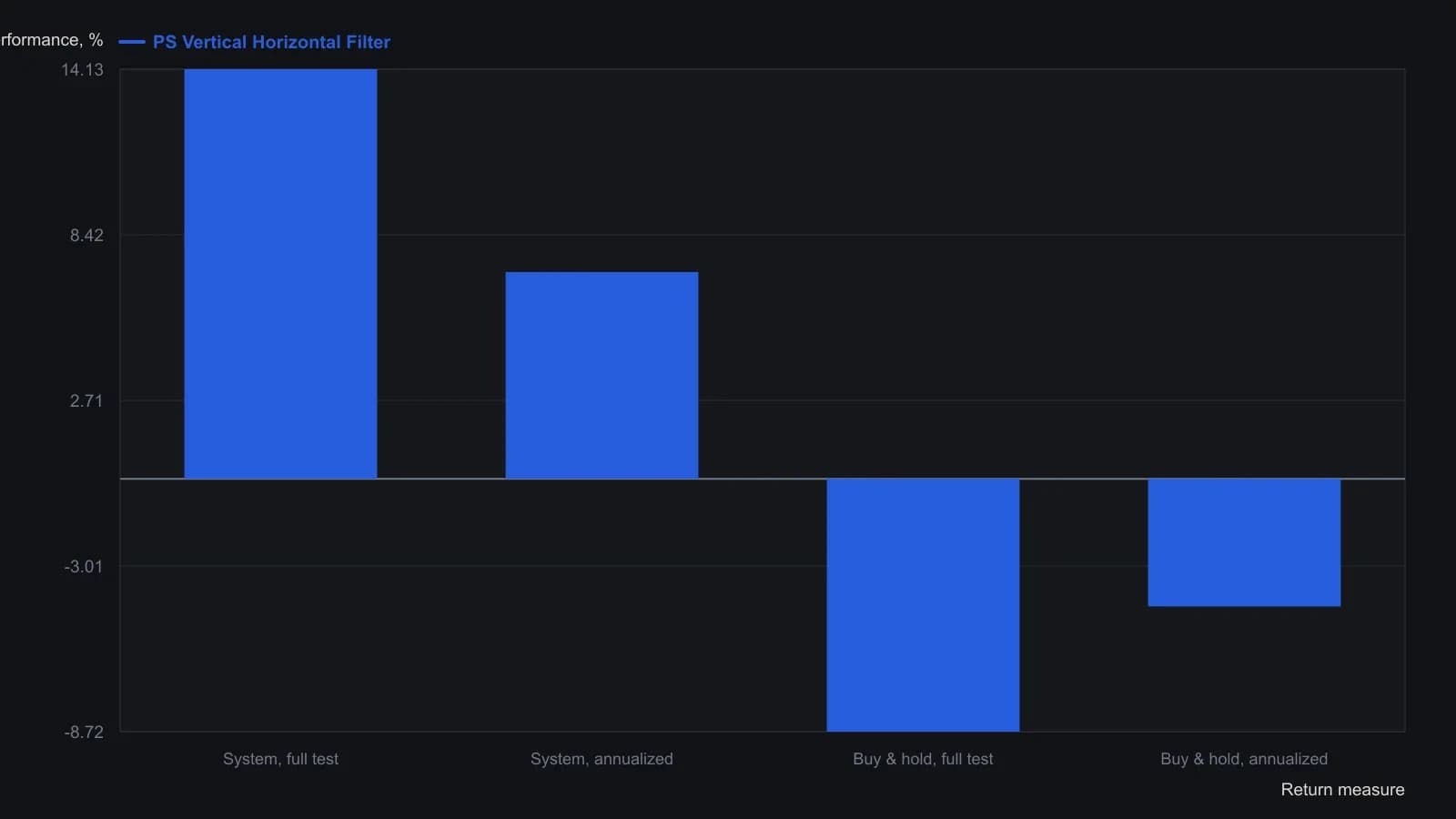
The review fixed 500 daily bars, entries on the open, exits on the close, a one-day delay, and a zero money-market rate; this run also shows commissions and interest at zero.
All readings on this track · 6 readings
- 1992Turtle trading as one testable Donchian breakout procedure
- 2001Hourly Donchian and Turtle rules locked after one walk-forward window
- 2001Critiquing Turtle trend following as a drawdown budget
- 2010Evaluate Turtle-style bands as one mechanical procedure
- 2012Quiet-tape cycle clocks for index futures
- 2020Constructing Turtle-style dual Donchian trend-bands