1994issue C101-6
Rate of change parameters for testable entries
Rate of change can be written as a percentage or a scaled ratio, then used in a zero-line cross or an extreme-threshold entry with a searchable lookback period and, where used, threshold. A chosen set can be reapplied to other securities, the related industry group, and the broader market as a check against fitting one series.
- Rate of change can be plotted as a percentage with a zero equilibrium line, or as a current-to-earlier-price ratio scaled by 100 with a 100 line, using the series and the lookback period as inputs.
- The series may be any valid price, derived indicator, or custom calculation, including a daily average of high, low, and close, not only a quoted close.
- A zero-line cross and an extreme-threshold band can leave lookback, and for the band the threshold, as searchable inputs. A search can step lookback from 8 through 40 in increments of 2, or the threshold from 5 through 12 in increments of 1, then rank the rule sets.
- Parameters chosen on one history can be reapplied to other securities, the related industry group, and the broader market. As written, both rules remain in a position at all times unless separate stop or exit conditions are added.
Rate of change as rule inputs
Rate of change is a comparison of the current value of a price or derived series with its value a fixed number of bars earlier, shown either as a percentage or as a scaled ratio. The lookback period is the number of bars between the current reading and the earlier value.
Editorial: treat the construction as a small set of rule inputs rather than as a finished signal. The inputs are the lookback period, the plot scale, optional smoothing, and whether the trigger is a zero-line cross or an extreme band. Those inputs can then be tested as one entry procedure.
Scale, series, and a plotted condition
The reading can be plotted as a percentage with a zero equilibrium line, or as a current-to-earlier-price ratio scaled by 100 with a 100 equilibrium line. The series and the lookback length are the inputs to either form.
The series input may be any valid price, derived indicator, or custom calculation, not only a single quoted close. Rate of change can also be computed on a daily average of high, low, and close, and lookback length can be profiled across many periods for each input series.
In one illustrated bond-futures plot, readings above the reference were treated as an uptrend condition and readings below it as a downtrend condition.
A smoothed short-horizon construction
A short-horizon construction used a two-period rate of change smoothed by a four-period exponential average. The rule went long when that average rose versus the prior bar and short when it fell, so it acted on the slope of the smoothed rate of change rather than on the raw reading.
Zero-line cross and extreme-threshold entries
A zero-line cross can be written as long when rate of change crosses from below the equilibrium line to above it, and short on the opposite cross, with the lookback period left as a searchable input.
An extreme-threshold entry can be written as long when rate of change falls below a negative threshold and short when it rises above a matching positive threshold. Both the lookback period and the threshold are then available for a parameter search.
12-day ratio rate of change, Treasury bonds
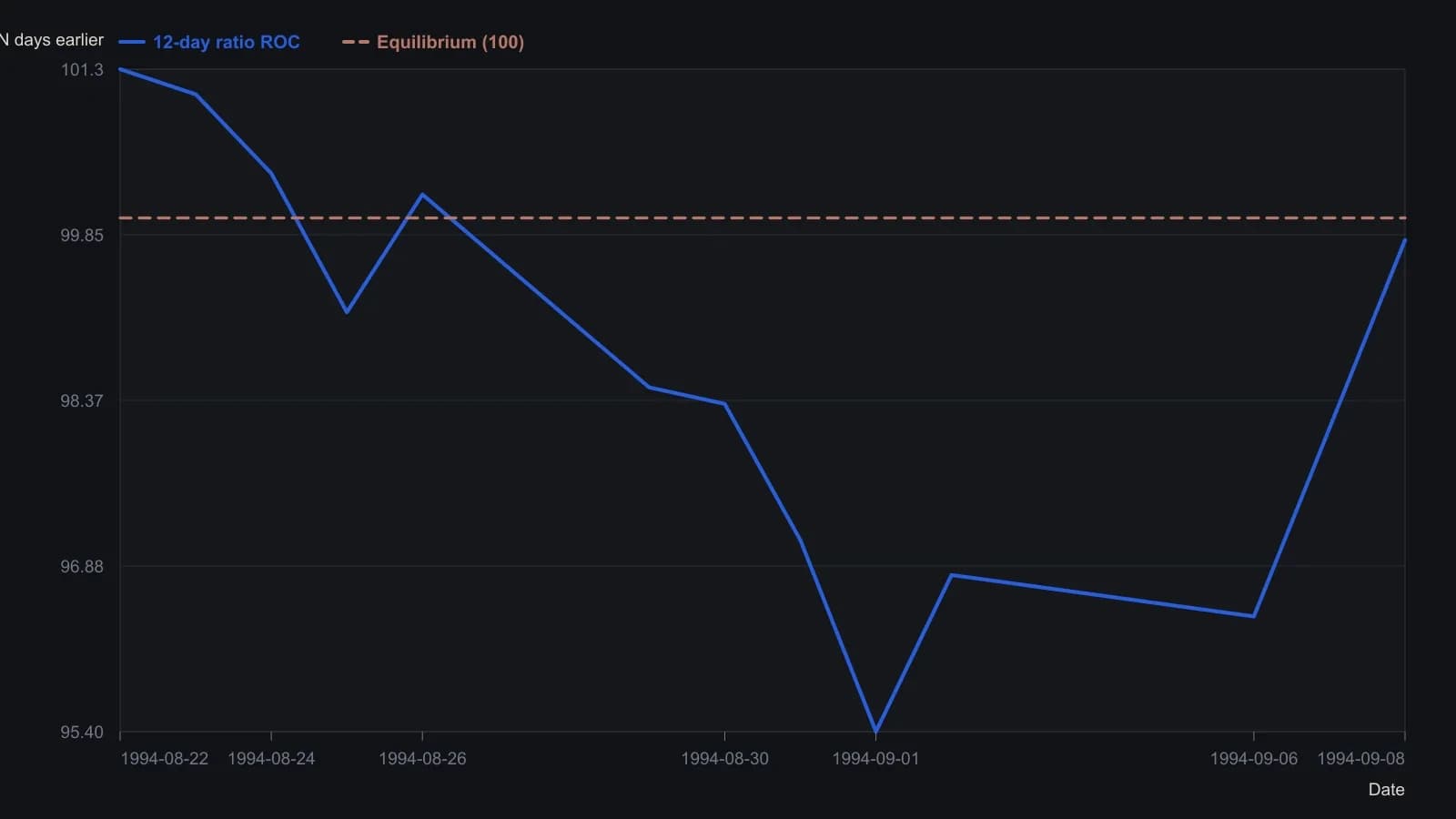
Source formula is (Price/Price[N])*100 with N defined as the lookback in days; the printed grid uses a 12-day window and plots 100 as the equilibrium, not a percentage ROC around zero.
Parameter search and an out-of-sample check
A parameter search can step the lookback period from 8 through 40 in increments of 2, or step an extreme threshold from 5 through 12 in increments of 1, and then rank the resulting rule sets.
Parameters chosen on one history can be reapplied to other securities, the related industry group, and the broader market. That out-of-sample check asks whether the rule still behaves reasonably, or whether it was fitted too tightly to a single series.
Editorial: after a set is selected, try to break it on a different series rather than treating the rank order as a finished result.
All readings on this track · 46 readings
- 1985Constructing excess and momentum difference-curve oscillators
- 1988Five reading rules for smoothed indicator charts
- 1989Momentum overlays that speed moving-average oscillators
- 1990A laboratory template that constructs Rate of Change as a pane module
- 1991Volume-scaled rate of change as a momentum construction
- 1991Three-indicator market overview from tape, sentiment and rates
- 1991Three-component trend model with rate-of-change filters
- 1992A KST oscillator from a weighted rate-of-change stack
- 1992Four-window weighted rate-of-change composite
- 1992Constructing multi-span smoothed rate-of-change filters
- 1992Constructing a four-horizon summed rate of change
- 1992Constructing KST from four weighted smoothed rates of change
- 1992Constructing a composite from weighted smoothed rates of change
- 1992Three-horizon KST maturity alignment
- 1992Construct a bond-led dividend-to-bond-yield regime first
- 1992Constructing relative-strength KST from weighted rate-of-change
- 1993Constructing a volume oscillator from average ratios and smoothed rate of change
- 1994Gold as a cycle clock for commodities and yields
- 1994Constructing a composite from weighted, smoothed rate-of-change windows
- 1994Constructing gold-mining rate-of-change tripwires for Treasury bonds
- 1994A capacity-stress checklist across commodities, bonds, and breadth
- 1994Rate of change parameters for testable entries
- 1994Constructing rate-of-change midpoints, lookbacks and divergence
- 1994Lead oscillator breaks need price trendline confirmation
- 1994Nested averages for an annual momentum curve
- 1994Evaluating a Coppock-style rate of change as a bottom-regime filter
- 1995A weighted eleven-month Dow rate of change as one testable timing procedure
- 1996Named lookbacks, thresholds, and streaks for entry rules
- 1997A midpoint rate-of-change test for bond trend follow-through
- 1997Constructing a short-rate-adjusted equity momentum filter
- 1998Daily momentum rank-churn as a portfolio-construction problem
- 1999Constructing a lagged rate of change cycle system
- 2000A triple delay line then a one-bar elliptic oscillator
- 2001Confirming rate of change divergences with price
- 2001Momentum trendline breaks need price confirmation
- 2001Market breadth, On-balance volume, and Rate of Change as a combined timing framework
- 2001Know Sure Thing with stacked horizons and trendline confirmation
- 2003Constructing a mechanical system from a rate of change condition
- 2003Constructing momentum from two closes and spotting divergence
- 2003Formula choice tilts which momentum mismatches count as divergences
- 2004RSI and momentum agreement as an asymmetric filter
- 2005Constructing price-normalized moving-slope hybrids
- 2005Unsigned speed gates on a fixed average-cross pair
- 2007Rebuilding rate of change as a path-weighted oscillator
- 2008Construct Special K so short-horizon signals stay inside the primary trend
- 2013Restore volume balance before adding another price-time indicator