2012issue C0512-17
Sentiment-zone oscillator from signed closes
Code each bar as plus one after a higher close and minus one otherwise, then take a lookback-period triple exponential moving average of those signed closes and scale it by 100 divided by the same period. A 14-bar default uses extremes above 7 and below -7 rather than a zero line, and a longer high-low range of the oscillator can replace those fixed bands.
- Each bar is coded plus one after a higher close and minus one otherwise, so the input series encodes only the direction of consecutive closes.
- Sentiment position is the lookback-period triple exponential moving average of those signed closes, then scaled by 100 divided by the same period.
- The default 14-bar construction treats readings above 7 and below -7 as contrary extremes. Zero is not used as a signal line.
- A longer-window high-low range of the oscillator can replace the fixed 7 and -7 bands, and illustrated system code then combines those extremes with a 30-bar average of the oscillator and a 60-bar exponential average of price.
Code only the direction of consecutive closes
Each bar is coded plus one after a higher close and minus one otherwise, so the input series encodes only the direction of consecutive closes.
Sentiment position is the lookback-period triple exponential moving average of those signed closes, then scaled by 100 divided by the same period. That exponential smoothing applies a triple exponential moving average to the plus-one or minus-one close series so the sentiment position reacts to recent signed closes without treating every day equally.
Use extreme thresholds, not a zero line
The default construction uses a 14-bar period and treats readings above 7 as one extreme and readings below -7 as the opposite extreme. Zero is not used as a signal line in the base construction. Only the extreme thresholds define the contrary conditions.
DJIA 14-bar sentiment zone oscillator with ±7 rails
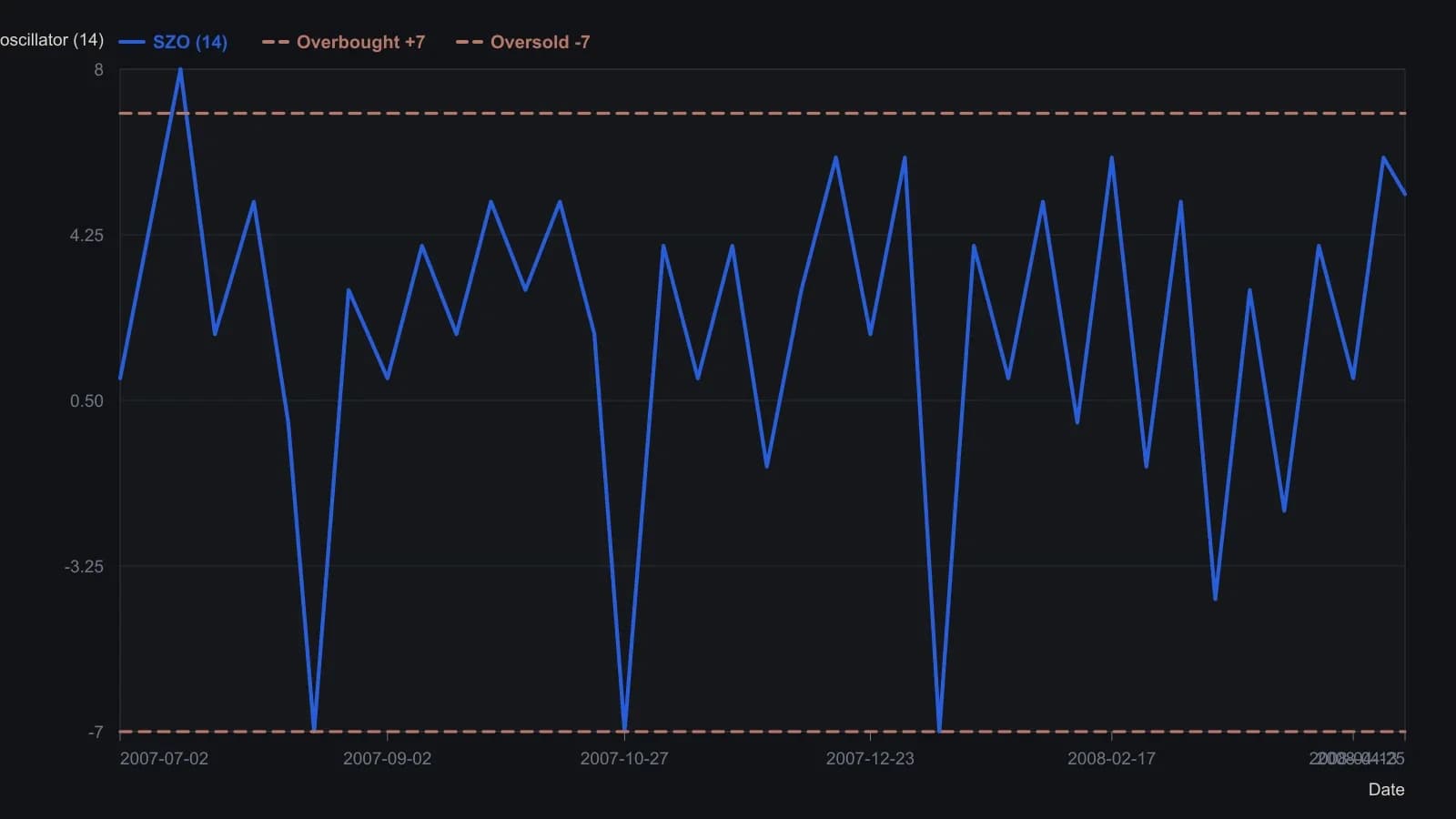
Default lookback is 14 bars. With that length the oscillator cannot reach ±100, so the source uses +7 and -7 as the extreme rails and ignores the zero line. Intermediate readings are approximate to the raster; only the final 5.17 is a printed figure.
Replace fixed bands with a longer high-low range
A longer-window high-low range of the oscillator can replace the fixed 7 and -7 bands with adaptive overbought and oversold levels.
Ask longer filters to agree with the extremes
The illustrated trading-system code combines the oscillator extremes with a 30-bar average of the oscillator and a 60-bar exponential average of price as agreement filters.
That moving average is a simple average of the sentiment-zone series over a longer window, used as a directional filter rather than a price smoother. The trend filter is a higher-timeframe directional gate, typically an exponential average of price or a moving average of the oscillator, that allows only those extreme crossings that agree with the prevailing drift.
All readings on this track · 41 readings
- 1984Matching average age across price filters
- 1984Residual-impact construction of exponential smoothers
- 1988Constructing simple and exponential moving averages as specified filters
- 1989Evaluating smoothed free reserves and funds-discount spreads
- 1990Integer construction of moving averages and exponential smoothing
- 1990Constructing incremental moving average filters
- 1991Constructing a double-smoothed stochastic oscillator
- 1991Constructing an exponential average from a smoothing weight
- 1991Constructing a double-smoothed momentum oscillator family
- 1991Competing certainty rules from exponential-average conditions
- 1991Hybrid construction of a mechanical timing system from smoothed signals
- 1991Constructing an exponential smoother from a moving-average length
- 1991Equivalent relative-strength-index constructions from a ratio and from smoothed momentum
- 1991Constructing the true strength index from double-smoothed momentum
- 1991True strength index from signed, double-smoothed momentum
- 1992Constructing exponential averages from simple lookbacks
- 1992Constructing exponential averages by the smoothing constant, startup length and lag
- 1992Nested range smoothing and windowed high-low damping
- 1992A weekly equity stance from the discount-bill spread
- 1993Double-smoothed stochastics momentum index construction
- 1993Constructing the true strength index with double exponential smoothing
- 1994Polarized fractal efficiency with a shared exponential smoother
- 1994Five-interval exponential smoothing of ten-interval signed path-efficiency
- 1994Hand-ranked price-volume series with stacked smoothing and stochastic
- 1995Range expansion filter on multi-horizon averages
- 1995The exponential smoothing constant from averaging lag
- 1997Construct a nested-average rainbow band and oscillator
- 1998Filter stacks that combine a moving average with exponential smoothing
- 2002Smoothed relative-strength construction from wilder-averaging and a price prefilter
- 2003Reverse-engineered RSI price targets
- 2004Piecewise trend quality from moving-average reversals
- 2004Nested smoothing recipes versus unaudited oscillator experiments
- 2008Weight construction beyond the N-day label
- 2010A consensus filter for objective RSI and smoothing construction
- 2012Sentiment-zone oscillator from signed closes
- 2012Classic RSI one-over-N smoothing versus the standard exponential average
- 2013Why exponential smoothing uses two over n plus one
- 2015Constructing ratio indicators with moving-average and exponential-smoothing weights
- 2015Slow relative-strength index from an exponentially smoothed price
- 2017Rebuilding the relative strength index as open-scale buy-sell pressure
- 2017Comparing Wilder and exponential smoothing inside a relative-strength index