1994issue C091-14
Fourier-tuned momentum filter design
The archive treats momentum as a three-step filter design: estimate dominant and trigger frequencies from a Fourier spectrum of detrended history, choose a prestored design that keeps phase error small inside that band, then apply a trigger and retest the marks after each rule change.
- Estimate the dominant frequency and the trigger frequency from a Fourier spectrum of detrended history before choosing filter lengths.
- Use a balanced design, whose signed phase at those two frequencies sums to less than 10 degrees in magnitude, as the usual starting choice.
- Fire basic marks only on crossings below the deadband for buys and only on crossings above it for sells.
- After the filter is fixed, widen or tighten the deadband and add validation rules instead of retuning blindly.
A three-step procedure
The archive procedure has three repeatable steps. First, estimate the dominant frequency and the trigger frequency from a Fourier spectrum of detrended history. The dominant frequency is the cycle that carries the most power and sets the lower edge of the band the momentum filter is tuned to. The trigger frequency is the higher-frequency cycle used with the dominant frequency to size the signal line and to judge phase lead versus lag in the selected filter.
Second, choose filter lengths that reduce phase error inside that band. Phase error is the lead or lag of the momentum filter at a chosen frequency, the quantity the design table is meant to keep small inside the trading band. Third, apply the filter plus a trigger to produce buy and sell marks and retest after rule changes.
How a balanced design is chosen
Six prestored WAMI designs are intended for series whose dominant frequency exceeds 5 degrees per sample and whose trigger frequency is below 30 degrees per sample. A WAMI design is a prestored combination of a time difference, a weighted moving average length, and two exponential-average lengths chosen so phase error is small between the dominant and trigger frequencies. Later designs shift power to higher frequencies and cut lag.
A design is treated as balanced, and used as the usual starting choice, when the signed sum of phase at the dominant frequency and phase at the trigger frequency is smaller than 10 degrees in magnitude.
WAMI prestored designs: power versus frequency
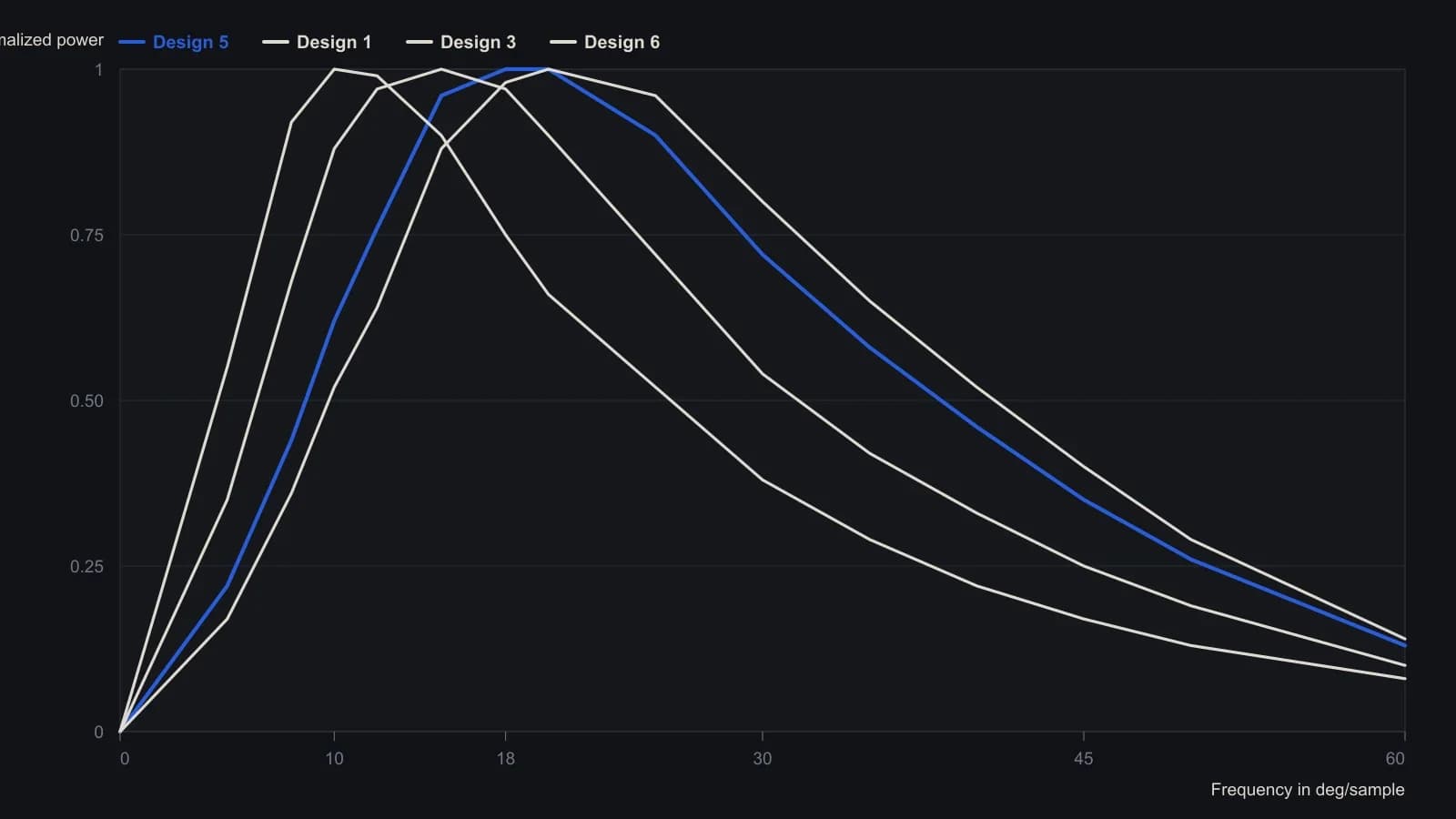
The article offers these catalog designs when the dominant frequency F1 is above 5 deg/sample and the trigger F2 is below 30 deg/sample. Designs 2 and 4 appear in the source plot but are omitted so only four series are returned.
Precious-metals sector series
On 64 weekly bars of a precious-metals sector series, the spectrum peaks convert to about 10 and 31 degrees per week. Design 5 is the balanced choice. The signal and trend averages are set to 5 weeks by dividing 150 by the trigger frequency.
The signal line is a short weighted moving average of the momentum series used to generate crossings for candidate entries and exits. Trend validation accepts a buy only when a moving average of price is rising and a sell only when that average is falling.
Basic marks fire only on crossings below the deadband for buys and only on crossings above it for sells. The deadband is a horizontal no-trade zone around the mean of the momentum series that suppresses crossings too close to zero. A first-sell delay after leaving the deadband removed two early exits on that same series. That delay is the second-signal rule: it withholds the first sell after the momentum series leaves the deadband until a second sell appears or the series re-enters the deadband.
One industrial stock
On 80 weekly bars of one industrial stock, spectrum peaks convert to about 14 and 26 degrees per week. Design 6 is selected, and the signal and trend averages are set to 6 weeks.
After rules 1 and 2 are applied to that stock, some later sells arrive only after an exit has already been taken. A first-sell delay cannot repair them because the oscillator re-enters the deadband between marks.
Rules after the filter is fixed
The closing workflow is to implement the chosen filter on history, widen or tighten the deadband until the basic crossing rules mark the major turns, then inspect remaining premature marks and add validation rules rather than retune blindly.
Editorial: once the band and the design are fixed, the remaining work is to make entry, exit and abstention rules testable as one procedure on held-out bars.
All readings on this track · 26 readings
- 1982Critiquing Fourier, Elliott, and seasonal commodity models
- 1982Evaluating half-hour crossovers with cycle priors and stops
- 1984Building moving-window spectral cycle forecasts
- 1988Fourier cycles versus calendar seasonal regimes
- 1989Constructing analog cycle signatures from price lows
- 1990Curve fits fail the forecast test
- 1991Auditing moving-average length with Fourier spectra
- 1991Closed-form phase for dominant-cycle spectra
- 1993Evaluating windowed spectral forecasts of index turning points
- 1994Window length for moving-window spectral forecasts
- 1994Constructing WAMI power and phase spectra
- 1994Fourier-tuned momentum filter design
- 1994Aliasing, leakage, and dominant-cycle reads from sampled prices
- 1995Constructing indicator lookbacks from Fourier spectra
- 1996Constructing phase from a dominant-cycle sine and cosine pair
- 1999Sinusoidal pseudo-securities for indicator evaluation
- 2000Constructing dominant cycle length from Hilbert phase
- 2000Constructing adaptive channel breakouts from a measured cycle period
- 2005Embedding forex prices into a singular-spectrum forecast basis
- 2005Constructing recurrent forecasts from grouped spectral components
- 2007Constructing a dominant cycle from transformed Fourier spectra
- 2010Why cycle indicators fail when parameters shift
- 2019Constructing futures momentum as open-interest-scaled rate of change
- 2019Judging a dominant cycle and a trend filter by sample, lag and the move they keep
- 2020Constructing futures turnover time and urgency
- 2020Stock power ratio as a growth trend filter