2010issue C0532-39
Constructing a trend filter as a low-frequency model
A Trend filter is assembled from a price-plus-noise decomposition and a causal smoother. Choose a Moving average or other Lowpass filter whose lookback matches the trading horizon, then treat the result as a direction model and judge it against an explicit baseline.
- A price series can be constructed as a constant plus a trend term, cyclical terms, and noise, then regrouped by frequency relative to a chosen trading horizon.
- A useful trend-identification method must be objective, repeatable, and consistent with the trading time frame, because one time frame's trend can be another frame's cycle segment.
- A Moving average is the common time-series construction of a Lowpass filter, and the lookback should be set so that unwanted cycle terms are removed or strongly attenuated.
- Editorial: treat the Trend filter as a low-frequency direction model and judge it against an explicit baseline rather than as a trade signal.
Specify the price-plus-noise decomposition
A price series can be constructed as a constant plus a trend term, cyclical terms, and noise. Those components can then be regrouped by frequency relative to a chosen trading horizon.
A useful trend-identification method must be objective, repeatable, and consistent with the trading time frame. One time frame's trend can be another frame's cycle segment.
Editorial: state the decomposition and the horizon first. The Trend filter is a model of the low-frequency path that belongs to that horizon.
Define the low-frequency path
A best-fit trendline is defined so that average deviations are minimized and secondary cycle features plus noise are removed from the modeled low-frequency path.
Smoothing that keeps low-frequency components is used to classify market state as up, down, or sideways, to set a base for bands and channels, and to measure trend rate of change.
In a linear-regression construction of the low-frequency trend, slope sign indicates direction and slope magnitude measures strength. The line itself is treated as a direction model rather than a trade-signal generator.
Choose a causal Lowpass filter
A more responsive trend model is constructed by passing the series through a Lowpass filter so that selected long-period cycle terms remain in the output.
An ideal Lowpass filter would pass frequencies below a cutoff unchanged and remove frequencies above it. A causal real-time filter can use only current and past inputs and therefore cannot replicate that ideal response.
A Moving average is the common time-series construction of a low-pass smoother. A lookback that is a multiple of a cycle period removes that cycle. A substantially longer lookback strongly attenuates it even when the multiple is not exact.
Editorial: choose a causal smoother whose lookback matches the trading horizon. The Moving average is the usual construction, and it cannot replicate the ideal Lowpass filter response.
How a simple moving average attenuates frequency
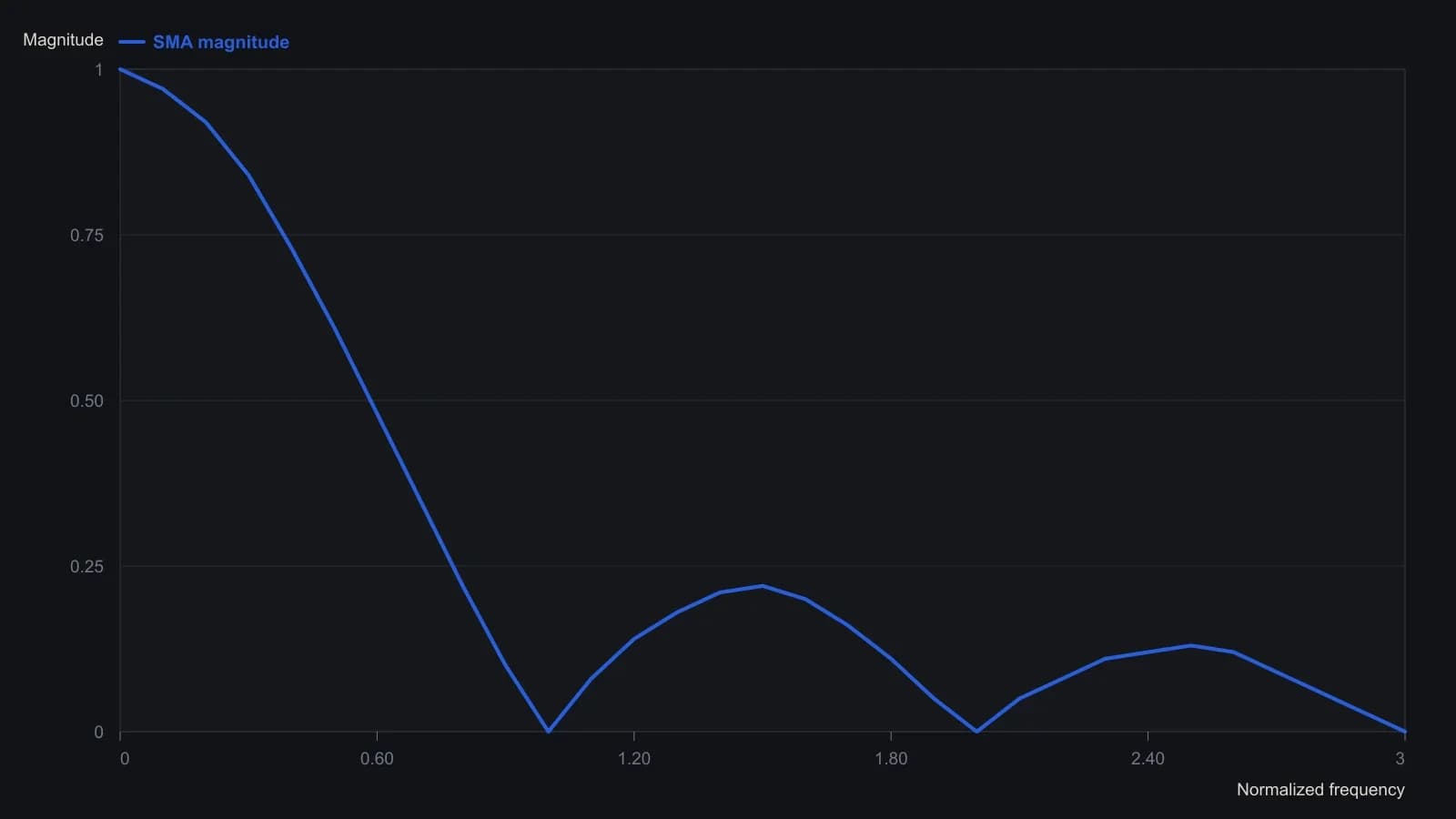
The source drawing is schematic. Vertical readings follow the 0.25 magnitude grid and are approximate. Nulls sit at normalized frequencies 1, 2 and 3. The matching phase panel is linear and is omitted because it uses a degree scale.
All readings on this track · 9 readings
- 1991Constructing a coincident moving average as a lowpass filter
- 1994Centering a dual lowpass bandpass on a counted cycle
- 1997Zero-lag cycle filters can fail on a price series
- 2002Constructing zero-lag finite-impulse-response and exponential smoothers
- 2010Constructing cycle versus trend mode filters
- 2010Constructing a trend filter as a low-frequency model
- 2015Whitened lowpass filters for trend and countertrend
- 2016Building Nyquist-safe lowpass trend filters
- 2018Constructing a Finite Impulse Response Filter compared with Exponential smoothing