2015issue C0154-56
Constructing a one-parameter bandpass oscillator from two-bar momentum
This archive article rebuilds a bounded universal oscillator from whitened momentum and a one-parameter second-order IIR smoother, then attaches opposite zero-cross rules so the same series can be read as a short-horizon countertrend baseline or a longer-horizon trend baseline.
- The construction starts from market observations treated as colored noise that retains memory, using whitened momentum as the high-pass input.
- A single bandedge setting, published at 20 in one formula, drives a second-order IIR smoother whose coefficients use the constant 1.414 and a half-turn angle of 180.
- Automatic gain control keeps the oscillator in the closed interval from -1 to +1 by decaying an unused peak by 0.991 before using it as the normalizer.
- The same bounded series supports a countertrend zero-cross rule, a trend zero-cross rule, scanner flags on either crossing, and both a numeric function and a plotted indicator.
Colored noise and whitened momentum
The construction is motivated by treating market observations as colored noise that retains memory rather than as uncorrelated residuals.
Whitened momentum is a two-bar close difference scaled by one half, used as the high-pass input to the smoother. The oscillator is formed by taking that two-bar close difference divided by two and then passing the series through a second-order recursive smoother.
One bandedge in a second-order IIR smoother
Bandedge is the single frequency-length input that sets how quickly the two-pole smoother responds. One published formula fixes that input at 20.
A second-order IIR smoother is a recursive two-lag filter whose current reading depends on the latest whitened input and the two prior outputs. Smoother coefficients are computed from bandedge with the constant 1.414 and a half-turn angle of 180, then assembled into a two-lag update.
Automatic gain control
Automatic gain control is a decaying peak envelope that rescales the filtered series into a fixed numeric range. It is described as keeping the oscillator inside the closed interval from -1 to +1.
When the current filtered magnitude does not exceed the stored peak, that peak is decayed by a factor of 0.991 before it is used as the normalizer. The result is a universal oscillator: a bounded bandpass-style series obtained by smoothing whitened price changes and then normalizing the result.
Opposite zero-cross rules on one series
A zero-cross rule is a forecast taken when the oscillator moves through zero from below or from above.
A short-horizon countertrend baseline goes long on a cross below zero and short on a cross above zero. A longer-horizon trend baseline goes long on a cross above zero and exits or reverses on a cross below zero.
Scanner logic flags a symbol when the oscillator crosses through zero in either direction. The same series is packaged both as a numeric function that returns oscillator values and as a plotted indicator.
RTN daily with 20-period universal oscillator
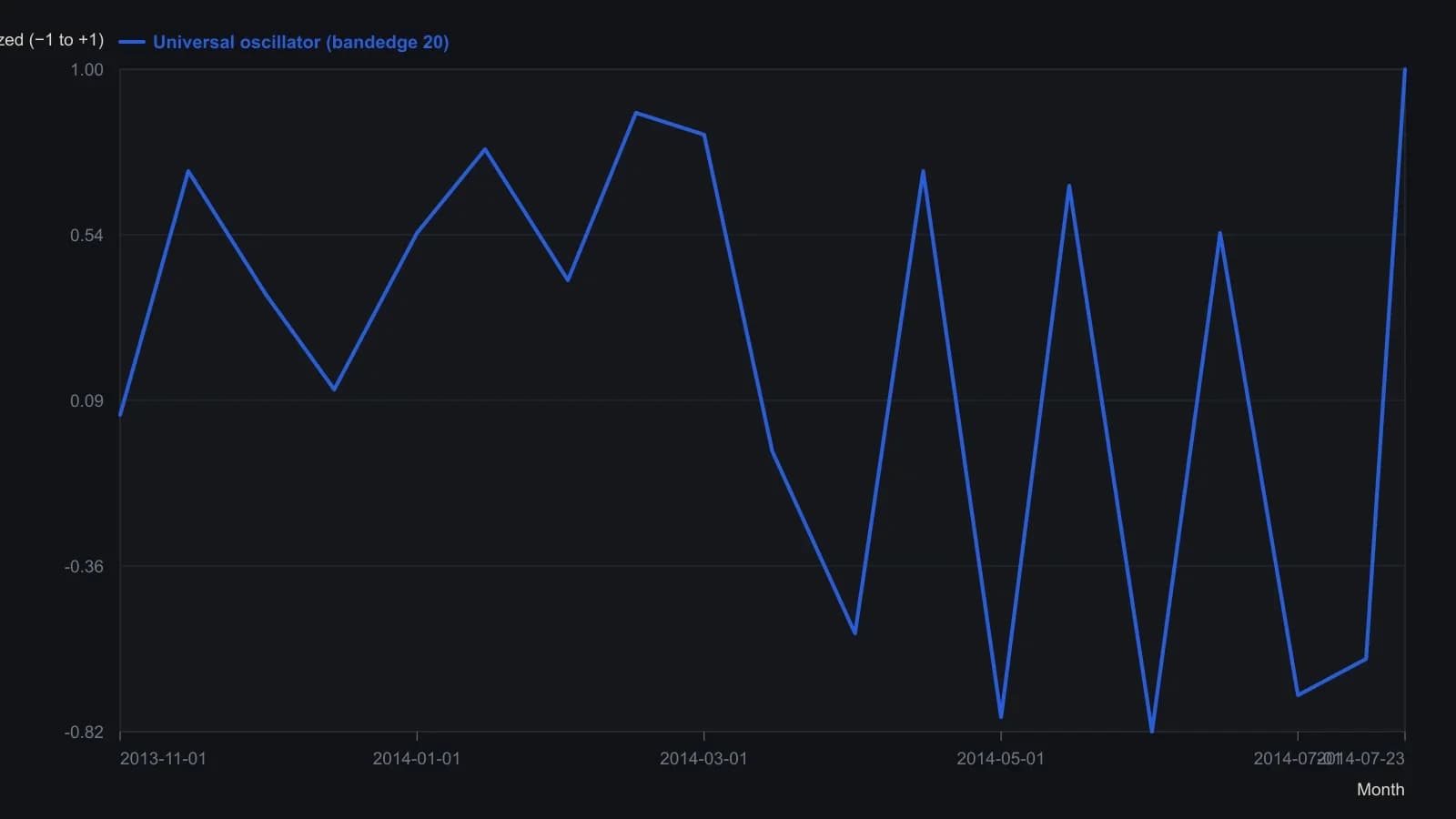
Digitized from the AmiBroker Figure 4 raster (RTN Daily, Universal(20)=1.0000). x is month-end anchors; y is approximate because the source prints no numeric series. The oscillator is already AGC-normalized to about −1…+1.
All readings on this track · 9 readings
- 1994Constructing a cycle-aligned bandpass from paired lowpass filters
- 2008A bandpass filter bank for dominant cycle construction
- 2010Construct a bandpass, cycle, and trend mode detector
- 2015Constructing a one-parameter bandpass oscillator from two-bar momentum
- 2015Bandpass cycle models cannot promise certainty
- 2016Dual exponential Super Passband filter construction
- 2017A three-flag swing window with a bandpass midpoint
- 2019Building a three-harmonic Fourier series cycle wave
- 2019Lock a band, take a short lead, then gate empty readings