2011issue C1269-72
The inverse-Fisher stochastic is a forecast layer until the book rules can be disabled
An inverse Fisher transform of a stochastic oscillator is specified as a fourth series beside put/call-ratio confirmation. Editorial: that bounded forecast layer is a lesson only after rank rotation, admission and sizing gates, and the crossing rules sit in one mechanical trading system that can be disabled.
- The inverse-Fisher stochastic oscillator is specified as a fourth series to use with put/call-ratio confirmation, and those confirmation series are not required to run the oscillator rules alone.
- Rank rotation orders long candidates by the transformed reading and admits only the higher-ranked names instead of treating every crossing as equal.
- Admission and sizing gates cap how many names may be held, how much mark-to-market capital each holding may take, and how many new positions may open in one session.
- Averaging-method substitution keeps the same lookback intent when a weighted smoother cannot be computed efficiently, and the illustrated rank-plan tests used the exponential choice.
A fourth series beside slower confirmation
An inverse-Fisher stochastic oscillator is a stochastic reading passed through an inverse Fisher transform so the series is compressed toward the extremes of a bounded range and can be sampled on a stated lookback.
The transformed series is specified as a fourth series to be used with fast and slow put/call-ratio measures and a slow inverse-Fisher put/call transform when forming entries and exits.
Put/call-ratio confirmation is a slower sentiment layer that may sit beside the oscillator. It is not required for the oscillator rules to be run on their own.
Price bands, moving averages, and lower panes
Example layouts place a 20-period band study and 50-, 100-, and 200-bar simple moving averages on price, with put/call-ratio series and the transformed stochastic in lower panes.
Lookback controls and averaging-method substitution
Multiple reconstructions expose the stochastic period and slowing as user-set parameters, and at least one strategy reconstruction also exposes a simple-moving-average period for backtesting.
One reconstruction replaced weighted averaging with exponential averaging because a built-in weighted smoother was unavailable and the long-form weighted code was too slow to plot or test. That averaging-method substitution keeps the same lookback intent when a platform cannot compute the original form efficiently.
A function-level switch can select simple, weighted, or exponential averaging inside the transformed stochastic, and the illustrated rank-plan tests used the exponential choice.
Rank rotation with admission and sizing gates
A mechanical trading system is a single testable bundle of entry, exit, abstention, ranking, and capital rules rather than a chart overlay used by discretion.
A mechanical book rule set a maximum of 10 open positions, sized each holding at 10 percent of daily mark-to-market capital, allowed at most three new positions per day, and ranked long signals by the transformed stochastic in descending order. Those limits are admission and sizing gates: hard limits on how many names may be held, how much capital each new holding may take, and how many new positions may open in one session.
Rank rotation orders candidate names by the oscillator reading and admits only the higher-ranked signals instead of treating every crossing as equal. A rank-rotation allocation plan applied an upper-percentile setting of 30 and a ranking-type setting of 0 when selecting names.
Crossings when the oscillator is the primary signal
When the oscillator is treated as a primary signal rather than confirmation, a buy is defined as a cross above 30 and a sell as a cross below 60.
At least two reconstructions tested the oscillator-based mechanical rules without applying put/call-ratio filters because no explicit filter procedure was supplied.
Daily inverse-Fisher stochastic on Wyndham Worldwide
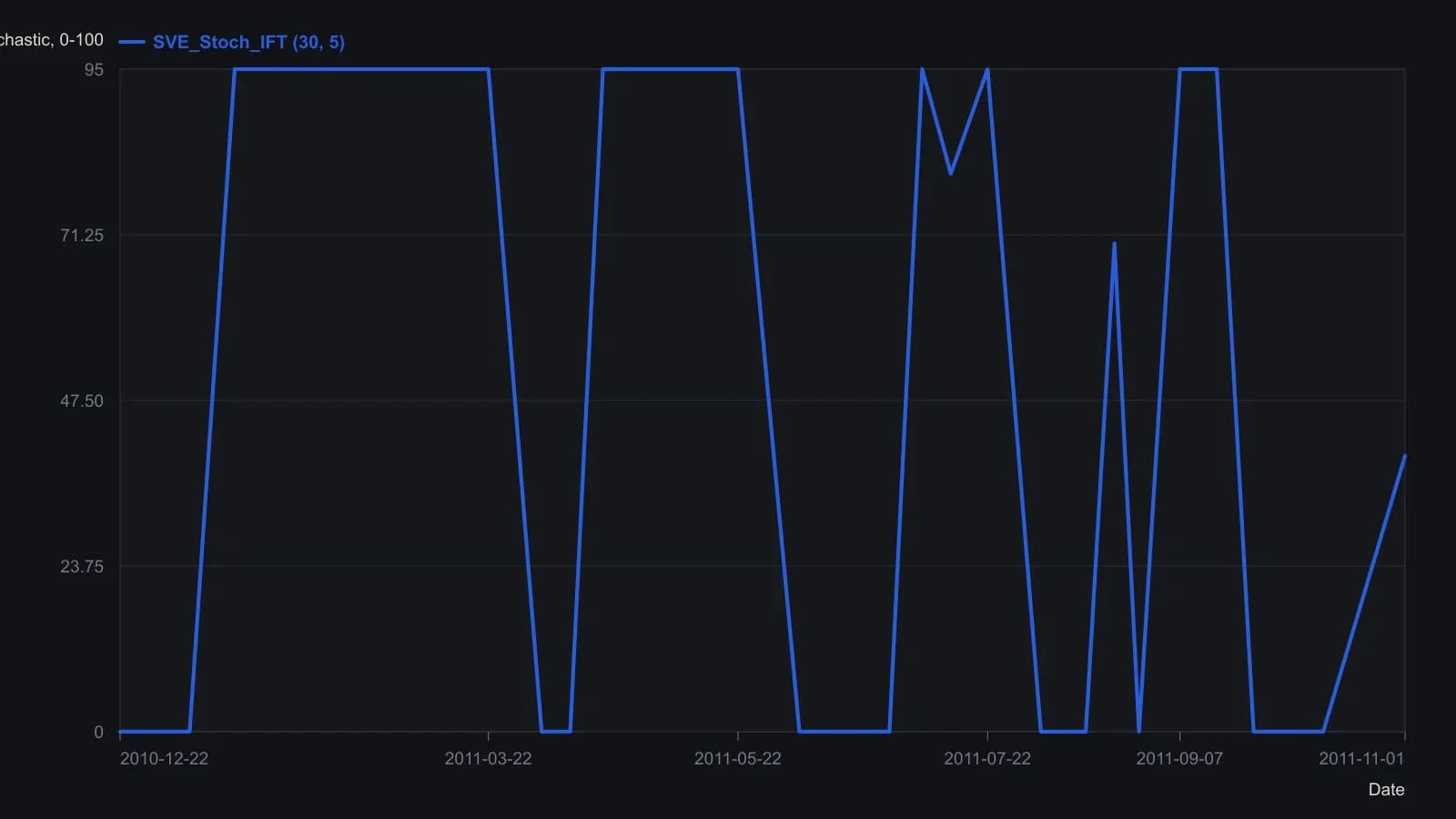
Pane inputs are stochastic period 30 and slowing 5; the strategy overlay also lists SMA period 165. Plateau readings are approximate to about five oscillator points and transition dates to about one week, because month ticks are the only time labels.
All readings on this track · 39 readings
- 1987A mechanical rank-rotation sleeve for monthly fund leaders
- 1989Rank rotation in a five-name no-load sleeve
- 1990Cycle-tested five-year fund rank rotation
- 1991Blue-chip rank rotation by relative-strength-index slope
- 1992Currency rank rotation and intermarket timing
- 1992Rank rotation and relative strength for portfolio construction
- 1994MACD crossovers then short-horizon rank rotation
- 1994A comparable group-trend ledger from published ranks
- 1997Normalized yield rank rotation as a full portfolio procedure
- 1997Constructing an investor preference index from two capitalization-weighted series
- 1998Constructing anchored momentum from a centered average
- 2000Rank rotation, a stop-loss order, and Relative Strength Index in fund switching
- 2003A one-fund daily rank is a two-sleeve construction problem
- 2004Evaluate rank rotation only where persistence already exists
- 2004Sector fund rank rotation with regression and trailing stops
- 2006Evaluating equal-weight annual yield-rank rotation
- 2007Weekly preferred-symbol reselection for mechanical trend systems
- 2011Portfolio capacity and entry pacing for mechanical systems
- 2011Rank rotation as a testable ETF construction procedure
- 2011The inverse-Fisher stochastic is a forecast layer until the book rules can be disabled
- 2012An underwater stretch is a sizing test for rank rotation
- 2015Rule-based ETF rotation as one testable procedure
- 2015MACD crossover evaluation by trend rank rotation
- 2015Persistence and strength as one close-to-close switch
- 2015Evaluating rank rotation after a persistence screen
- 2016Evaluating an annual valuation rank rotation
- 2017A two-step yield and price rank rotation for a five-name sleeve
- 2018Smoothed volatility and the missing rank-rotation exit
- 2018A five-condition scorecard that ranks stocks and can refuse the trade
- 2018Small-cap growth sleeve eligibility with trend and rank rotation
- 2018Evaluating rank-rotation momentum across fund wrappers
- 2019Evaluating an annual equity-gold momentum rank rotation
- 2019Evaluating equity-gold momentum on funds versus indexes
- 2020How a signed comparative-strength oscillator is built for rank rotation
- 2020Which calendar clock changes a gold-versus-equity rotation test
- 2020Four-dimension relative strength as rank rotation
- 2020Portfolio construction as a ranked relative-strength problem
- 2020Two clocks for a Nasdaq put/call sleeve
- 2020Rank, filter, and stop the hedge sleeve as one procedure