1992issue C081-8
Constructing exponential averages by the smoothing constant, startup length and lag
An exponential average is a recursive, front-weighted mean seeded on the first price. The same smoothing constant sets both the startup length needed to approach the long-run form and the time delay of a linear input, so a simple average with a similar lag is a paired baseline rather than a substitute curve.
- A simple n-period moving average is the equal-weight mean of the prior n prices and updates by dropping the oldest price and adding the newest.
- An exponential average starts with the first price, then weights the current price by a smoothing constant a and the previous average by 1-a, which unrolls into a front-weighted average with successive powers of 1-a.
- When a equals 2/(s+1) with s large, the series approaches its long-run form after about n=2/a intervals, and a linear input is delayed by about (1-a)/a periods.
- Substituting a=2/(n+1) gives a lag similar to an n-period simple average, so the two constructions are often paired even though their curves are not identical.
Recursive construction and front weighting
A simple n-period moving average is the arithmetic mean of the prior n prices. It can be rolled forward by dropping the oldest price and adding the newest.
An exponential average is computed recursively from the prior average, the current price and a smoothing constant, after the first average is set equal to the first price. The same recursion is equivalent to weighting the current price by a and the previous exponential average by 1-a.
Unrolling the recursion produces a front-weighted average in which each older price is multiplied by a successive power of 1-a.
Startup length set by the smoothing constant
When a is set to 2/(s+1) with s large, and the oldest geometric coefficient is treated as small (near 0.1 or e to the -2), the average approaches its long-run form after about n=2/a intervals. That count is the startup length of an exponential average seeded on the first price: the number of sampling intervals needed before it approaches the form it would have with a long prior history.
Exponential averages on a price that rises one point a day
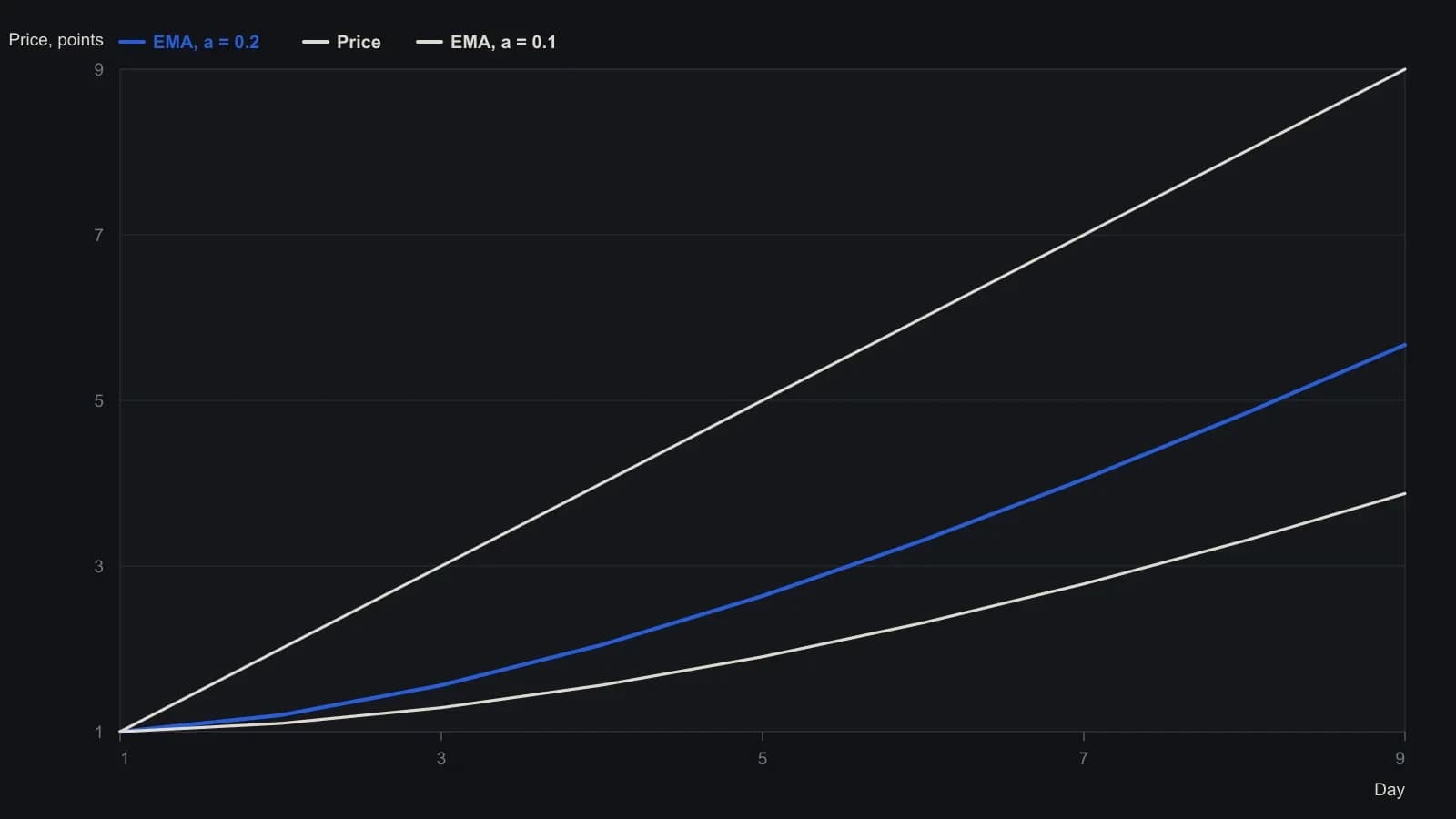
Each average is seeded on the first price. The printed sheet gives computed cells through day 9 and only the recurrence on day 10, so the series stops where the table stops rather than continuing to the 40-day run mentioned in the text.
Time delay on a linear input
On a 40-step synthetic series that rises one price unit per day, exponential averages with a=0.200 and a=0.100 settle into straight lines parallel to the input.
For a linear input the parallel shift equals (1-a)/a periods. A smoothing constant of 0.2 gives a delay of 4, and a smoothing constant of 0.1 gives a calculated delay of 9 versus an observed 8.9. That constant lag is the time delay between the linear input and the parallel exponential-average path that forms after startup.
A matched simple average as a baseline
Substituting a=2/(n+1) into that delay formula yields a lag similar to an n-period simple average, which is why the constructions are often paired even though their curves are not identical.
A charted comparison used a 10-day simple average against an exponential average with a=0.18 and showed the exponential series turning earlier on the plotted early-March decline.
All readings on this track · 41 readings
- 1984Matching average age across price filters
- 1984Residual-impact construction of exponential smoothers
- 1988Constructing simple and exponential moving averages as specified filters
- 1989Evaluating smoothed free reserves and funds-discount spreads
- 1990Integer construction of moving averages and exponential smoothing
- 1990Constructing incremental moving average filters
- 1991Constructing a double-smoothed stochastic oscillator
- 1991Constructing an exponential average from a smoothing weight
- 1991Constructing a double-smoothed momentum oscillator family
- 1991Competing certainty rules from exponential-average conditions
- 1991Hybrid construction of a mechanical timing system from smoothed signals
- 1991Constructing an exponential smoother from a moving-average length
- 1991Equivalent relative-strength-index constructions from a ratio and from smoothed momentum
- 1991Constructing the true strength index from double-smoothed momentum
- 1991True strength index from signed, double-smoothed momentum
- 1992Constructing exponential averages from simple lookbacks
- 1992Constructing exponential averages by the smoothing constant, startup length and lag
- 1992Nested range smoothing and windowed high-low damping
- 1992A weekly equity stance from the discount-bill spread
- 1993Double-smoothed stochastics momentum index construction
- 1993Constructing the true strength index with double exponential smoothing
- 1994Polarized fractal efficiency with a shared exponential smoother
- 1994Five-interval exponential smoothing of ten-interval signed path-efficiency
- 1994Hand-ranked price-volume series with stacked smoothing and stochastic
- 1995Range expansion filter on multi-horizon averages
- 1995The exponential smoothing constant from averaging lag
- 1997Construct a nested-average rainbow band and oscillator
- 1998Filter stacks that combine a moving average with exponential smoothing
- 2002Smoothed relative-strength construction from wilder-averaging and a price prefilter
- 2003Reverse-engineered RSI price targets
- 2004Piecewise trend quality from moving-average reversals
- 2004Nested smoothing recipes versus unaudited oscillator experiments
- 2008Weight construction beyond the N-day label
- 2010A consensus filter for objective RSI and smoothing construction
- 2012Sentiment-zone oscillator from signed closes
- 2012Classic RSI one-over-N smoothing versus the standard exponential average
- 2013Why exponential smoothing uses two over n plus one
- 2015Constructing ratio indicators with moving-average and exponential-smoothing weights
- 2015Slow relative-strength index from an exponentially smoothed price
- 2017Rebuilding the relative strength index as open-scale buy-sell pressure
- 2017Comparing Wilder and exponential smoothing inside a relative-strength index